
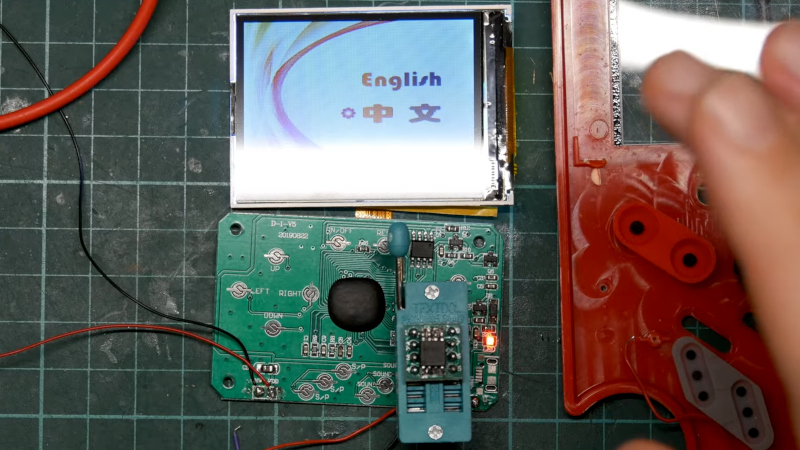
The NES was Nintendo’s smash hit console of the 1980s, the international version of their Japanese Famicom system. It wasn’t a particularly complex device, so it was the subject of many clones back in the day. More recently, it has enjoyed a new life thanks to “NES on a chip” systems. It’s one of these that [Poking Technology] has, real rock bottom for the console built into a cheap phone case.
Reverse engineering the thing starts with disassembly, upon which the brain of the unit is revealed as a mystery resin blob chip. There’s a ROM which, with a little effort, [Poking Technology] dumps. ROM analyses in situ requires quite a bit more effort. He identifies the black blob as a VT369 NES-on-a-chip and thus deduces that part of the device’s code is hidden in the chip’s 4K ROM. Some investigation and code injection allows him to control the backlight, from which he can dump the internal ROM by flashing it on and off.
The video is a very long one, but along the way you can learn a lot about the operation of these devices. What strikes us is that these ICs may be a NES, but just like the original, they have potential as a versatile computer beyond Mario. We won’t be ordering a NES phone case, but we can see they have potential.
Thanks [Anebix] for the tip!












I/O via LED was a really clever solution..
How about an acoustic coupler through the speaker next :)
I once amused myself (and worried a few others) by using the keyboard LEDs to export data from a “secure” system. One LED as clock and the other 2 as data.
Like this project it sure is slow, but it works!
These NOACs are fascinating!
Many have enhanced features that make them look like little Super NESes.
Here’s a small overview: https://www.nesdev.org/wiki/VTxx
It’s wild how a CPU or chipset will go through that progressive downgrading from:
Main CPU on a “serious” computer for serious work.
CPU for game console.
Embedded MCU
Integrated into an ASIC for inexpensive toys.
Same chip-under-epoxy-blob added to trinkets (keychains, beer openers, phone cases).
I still occasionally find 6502 instructions floating up unbidden from my subconscious to this day, and I can’t help but reflect how much time and focused attention in my youth was spent inteeacting with a 6502 of some form (using and progeamming a Franklin Ace 1000 but some playing NES games too). It’s just surreal to see a chip design go from precious tool to time wasting trinket like that.