
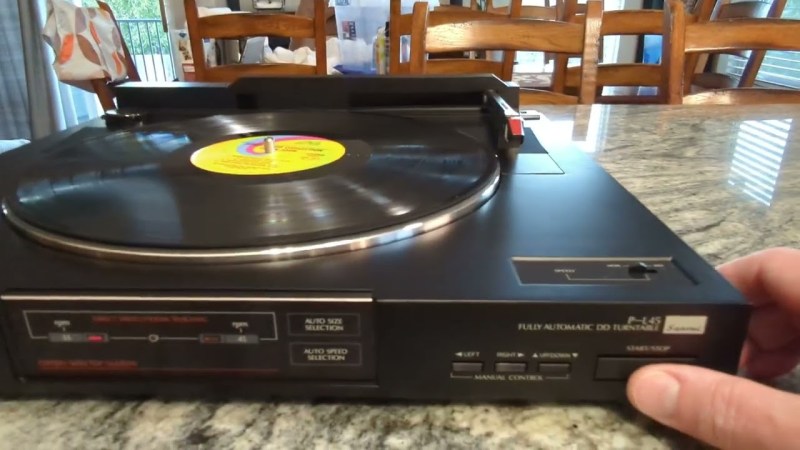
When [Marsupial] picked up a vintage Sansusi P-L45 turntable, he figured it would be an easy fix: a few capacitors, a belt or two, and maybe a new cartridge, the usual. But it turned out the electronics were fried, which set the stage for an upgrade that turned it into what may be the world’s only ESP32-driven, Home Assistant integrated, linear tracking turntable.
That last bit, the linear tracking, is why the turntable originally had a microprocessor in the first place: rather than an arm that pivots along the groove naturally, fancy turntables towards the end of the golden era of vinyl slid the needle along a linear track at a variable speed to follow the spiral groove on the record. You can see that in action in the demo video below, though it’s of a working version owned by [BFinks].
The fancy linear mechanism required electronic control to match the speed to the RPM, and in the example of Sansusi’s P-L45, that was provided by an NEC microcontroller on a daughter-board labelled “F4992 CPU”. CPU is a grandiose title, perhaps, but that’s irrelevant since the chip on the board was deader than disco.
That meant [Marsupial] had some reverse engineering to do — figuring out exactly what that chip did to drive this board, in order to replicate its behavior on an ESP32-S3. Luckily the golden era of vinyl correlated with the golden era of service manuals, and the manuals are still available, so [Marsupial] had a big leg up on that. After making the turntable work like stock, what else to do with the extra capability of the ESP32 than plug it into HA and make it really automatic?
Of course it wasn’t quite that easy: a new daughter-board was created that needed to do level shifting to the ESP32’s modern 3.3 V logic as well as hardware debounce on some inputs. The whole saga is very well documented on [Marsupial]’s blog WeAreAllGeeks. The link here takes you to the overview, but he’s got a lot more info on other pages — and of course links to the firmware and PCB design if you happen to have a Sansusi turntable in need of a brain transplant.
Vinyl lovers will appreciate this project much more than the last ESP32 “turntable” we featured, which was anything but. If you want to get into records but don’t have a turntable, you can always make your own.












Now its needs a mechanism to change the records that is not a massive jukebox…. We don’t all live in the US with its massive surface area.
I think that’s called a thumb drive with MP3’s on it. Though if you give me that “warm fat sound” crap about vinyl I will beat you soundly with oxygen-free vacuum tubes =))
Like… a record changer arm? They were very common on 45 players, but I had a couple 33/45/78 tables with them. Although it did say not to use 78s on the changer.
Get a vintage “Dual” brand record player for ~$250 which can play a stack of 5 records. Look for models in the 1000 and 1200 series (1009, 1219, 1229 for example) and a matching “stacker spindle”.
If you are a true audiophile then you may object to stacker spindles on the grounds that they can cause wear on your vinyl. I don’t own any rare records, so I’m not worried.
Sansui not Sansusi. Legend has it they had lots of Susis.
That’s the US spelking : – ] Susie The Linear Que.
Linear tracking isn’t very complicated, it can be done without a microcontroller. RFT/Ziphona (DDR) made such a turntable in the 1980s using series 4000 CMOS logic and other vanilla parts. Schematics for the “HiFi Phonoautomat HK-PA 1203” can be found here: https://ifatwww.et.uni-magdeburg.de/~madaus/kdownanl.html
You are right, and Sansui’s P-L series turntables had the linear tracking done by pure electronics.
The position of the arm is the equilibrium between the tray position motor rotation and the arm’s angular sensor. They called it servo.
You can see it in the P-L45 & P-L55 schematics there: https://archive.org/details/manual_PL45_SANSUI/page/n9/mode/2up
it is within the F-4897 Arm-Servo board which also includes other arm tray movement circuitry. it is very simple and efficient, only a couple components.
Where the processor came to play was for bringing the arm to the record, drop the needle at the proper place after determining the size (and speed) of said record, mute volume while the needle drops to prevent an audible thwomp, and return the tonearm home after the record is fully played.
Without the processor, the turntable may be linear tracking, but not computerized nor fully automated. Advanced models can sense tracks on the records and skip songs like a CD. or randomize order. (Adding this functionality is my next project)
The linear tracking per say is not in the control of the processor.
It’s “per se.”
The problem with LT is that it doesn’t “degrade” well. Even if the automatic motors are acting wonky, you can usually still use an conventional turntable by manually dropping and lifting the tonearm, since it’s just balanced on a central pivot. The motors often disengage when the arm is over the record to limit resistance and interference. I may need to “deautomate” my Onkyo CP-1030F which seems to want to cycle constantly now instead of just playing the record.
If the tonearm drive is stuck/dead on a linear tracker, it’s a doorstop until it gets fixed. It’s frequently a belt-drive mechanism, so a $2 replacement belt often solves it though.
An interesting angle might be to see if the motor controller can be made more sophisticated with a modern MCU. I could see adding pitch controls, trying for more accurate speed compensation than the existing servo design, or the ability to drive the motor in reverse to play back Satanic secret messages.