
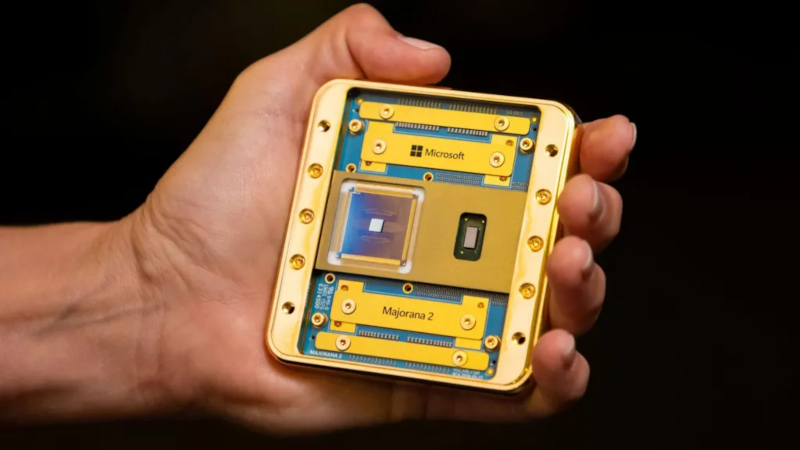
While it might seem that your computer malfunctions every few minutes, the reality is that modern computers are usually quite robust. Not so much for quantum computers, where qubit life is often measured in milliseconds. Now, the company claims to have qubits that last for about 20 seconds.
For example, Microsoft’s Majorana 1 quantum chip, which, incidentally, was mired in controversy, provided 8 qubits that were stable very briefly. This second-generation chip provides 12 qubits that average 20-second lifespans.
Microsoft claims to use topological superconductors based on Majorana modes. However, despite claims, some researchers think the technology is using Andreev modes and does not contain any Majorana modes, although this is apparently debatable. Despite retracting an earlier paper, the company appears to stand by its claim that it is producing Majorana fermions.
The biggest problem, of course, is that to be practical, you will need millions of qubits instead of 8 or 12. That’s in addition to better fault tolerance, error correction, and other operational details. So raw qubit count can be misleading, but Fujitsu has a 256-qubit system and is on track to install one with 1,000 qubits this year, although redundancy probably cuts the number of logical qubits quite a bit. Microsoft claims it will have a commercially viable machine by 2029.
Until you can get your hands on a real quantum computer, there’s always simulation.











I’m not very surprised that this is possible, but it’s also not really pushing the envelope. 12 qbits is uselessly few, and the problem has always been that the sensitivity and probability of collapse grows exponentially with the number of entangled qbits involved. This is why there’s been speculation that quantum computers as a practical concept might be impossible, and microsoft’s most recent result doesn’t really move the needle here.
It’s not even the real recordholder. Optical qbits have had essentially unlimited lifetimes for decades (and been passed through hostile environments like open air above moisture-radiating lakes), they’re just also really hard (nearly impossible) to react with each other.
If Microsoft scales this underlying technology, you would not need millions of qubits. A machine with 10,000 to 50,000 raw physical topological qubits could surpass the computational power of a transmon-based system possessing millions. It is the physical to logical qubit ratio that changes with the Microsoft technology, if it does what they claim.
The problem is that it is the addition of more qbits that raises the probability of collapse. This doesn’t tell us anything about the stability of real quantum systems that would actually be useful.
≥ stable very briefly.
Of course, it’s Microsoft! :-P
So what 3 trillion dollar company did you create, Einstein?
You boomers crack me up!
What a short-sighted comment. You are obviously not old enough to have lived through ALL of Microsoft.
Maybe not a 3 trillion valued company, but what did those before you brought you? Basically just the world you live in today…space flight, satellites, semiconductors, microprocessors, the computer, the internet, every single known operating system, digital audio, computer games, etc…and yeah, that little device in your hands that you cannot let go for a single second every day…
Say you’ve only lived through the last decade of microsoft without saying you’ve only lived through the last decade of microsoft. Thank god bill gates didn’t get his way, and NT shipped with memory protection.
Nice!
You can easily access quantum computers on the cloud from Amazon (“Braket”) or IBM.
Considering the scarcity of quantum hardware, that’s definitely simulations of quantum systems being offered from regular old classical servers. A taste, if you will.
neat. I made some quantum bits once too.
didn’t pay very well
I will only be convinced once it runs copilot
I”ve put quantum computers on the same shelf as fusion reactors, perpetual motion, free energy. There are plenty of things that looked good on paper, but didn’t quite work out in practice. There are always limits on scaling up as well.
Maybe not quite as terrible. But it has been over a decade of hype, “almost there!”.
Love this site and the tags.
https://hackaday.com/2016/01/16/shmoocon-2016-computing-in-a-post-quantum-world/
Ah, many comments, and no one’s mentioned that the link doesn’t go to Microsoft’s release, but to a… python fluid flow simulation?
That shows how many people ‘aktchew-ally’ read the linked articles :)
Huh. Not sure how that happened. Fixed!
You did a ‘CTRL-INS’ with the mouse hovering in the wrong location?… ☺
I do that at least once a day…
Interesting. While most firms are working on building systems with greater numbers of qubits, Microsoft’s focus seems to be longevity. If Microsoft is successful, scaling up the number of qubits later may be easier. They could be on the best path to success.