
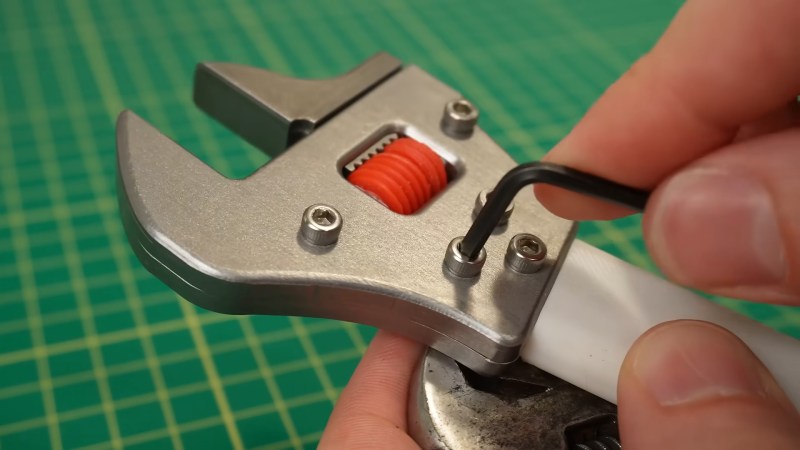
We’ve probably all got one item in our toolboxes or chests that we really, really don’t like, but find too handy to toss. For [Someone Should Make That], that item was the bolt-rounding adjustable wrench. Rather than continuing to gripe about it, or alter his habits to make greater use of the full wrench set he also owns, he decided to build a better mousetrap. By mousetrap, we mean adjustable wrench.
It took a couple of iterations on-screen before he hits on a solution that seems to work quite well indeed. The problem [Someone] had with his adjustable wrench was one of physical slop: once adjusted, there’s just too much play in the mechanism, which results in rounded-off bolt heads. [Someone]’s CNC’d solution takes inspiration from the CNC machine that manufactures it: he’s using spring-loading in the adjustment screw akin to what you find in the anti-backlash nut on your CNC mill or 3D printer’s ball threads. The tension from the springs keeps the wrench tight to the bolt, and that keeps [Someone] from rounding them off. Speaking of 3D printers, he prototyped in plastic before machining, and the screw in the end product stayed that way. It would be interesting to see how well that holds up.
Not only do we appreciate that it’s solved a common problem many of us have, the ethos of “this angers me, so I shall hack it” is one we support 100%, so do give a watch unless you’re one of those people who absolutely can’t stand videos, even when they’re spring-loaded to have no slop. There’s some good tips for beginner CNC operators in there, too.
This isn’t the first time someone’s tried to reinvent this particular wheel, though the last version we liked was a ratchet.











I’ve never had a problem with that actually? Usually they’re so sloppy and loose they flop right over and not hurt it at all if its too tight and then I get off my lazy ass and find the correct wrench.
Admirable build but – yeah, it’s a lot of work to avoid learning the process of using the damn tool properly.
If you have a problem and think an adjustable wrench is the solution, you suddenly have two problems.
Heh now, you can always use one as a hammer ;)
total bait and switch – ooh, i pre-loaded the jaws, now they can only resist as much torque as the spring setting is – great for toffee bolts (i mean that literally, on a hot day), but not much else.
I assume the preload is towards the open position, so it shouldn’t cause an issue.
That’s what I assumed, with my complete lack of experience with CNC (other than 3D printers). You bias for maximum slop, and then it never becomes slightly wider than what you set it to, right?
watch and learn the hard truth about your ignorance :)
Or just buy a better quality one…
Adjustable wrenches have no place in a workshop. They are good for emergency toolkits, but nothing else.
I tend to concur. They are, however, better than Vise-Grips, and I’ve seen alleged professionals use those as wrenches.
Then you’re gonna love Crescent’s locking adjustable wrench
i just need too many varieties of spanner. metric / english X open wrench / closed wrench / socket X all the sizes. if i had every combination i might never use an adjustable wrench (or i might at least feel bad for using one). but i simply don’t. they come in handy a lot of times. i would never deprive myself of such a useful tool.
but, i mean, yeah, i’m careful about how i use them. and for some tasks, they’re just unsuited.
they are suited to those working with soft metals such as a plumber. those jobs have a low enough torque requirement that their tendency to widen under pressure isn’t a problem.
i seldom use them for their intended purpose. i kept one in my bike toolkit since i was a professional bicycle assembler, but i dont think i ever used on a bike.
I find parallel pliers are able to do the odd bolt job. I use the largest one from the German brand that starts with a K.
Adjustable wrenches make acceptable hammers and fine door stops.
You mean Kitkat?
Break me off a piece!
For some stuff they are a decent compromise – I rarely have need of spanners bigger than 19mm but for the odd drain plug or hydraulic fitting one big adjustable does them all for a fraction of the price of a set that covers 22-40mm
Strong disagree. They’ve got their uses for some of us, but if you’re using it regularly, you need to think about getting better tools.
99% of the time I use a Socket set. But very occasionally I can’t get the socket on the bolt/nut because of how it’s positioned or how much bolt protrudes beyond the nut. It’s rare enough it doesn’t justify a full set of spanners (in metric and imperial), and a ln adjustable wrench is fine.
They’re also great for things that aren’t actually a proper size – whether because they’re badly made, or are obscure enough you won’t keep a spanner for, or not technically a bolt/nut.
Also the super-wide ones are invaluable for plumbing and tightening weird over-sized couplers. And they’ll only ever be tightened a few times, so rounding off isn’t an issue.
The solution to the adjustable wrench is a plier wrench. In my opinion.
Cool build though.
a good set of channel locks is fine if all you need to do is hold the bolt side while you ratchet on the nut.
I recommend checking out the Knipex Pliers Wrench products. Used them on automotive and cycling projects with great success.
If the spring pushes the wrench open instead of closed then this would reduce the slop. The article makes it sounds like the spring is pushing the wrench closed, but I didn’t watch the video to check.
Btw you can reduce this problem by being careful to put the wrench on the bolt so that the force between the adjusting part of the wrench and the bolt is closer to the main body of the wrench. Much less slop that way.
I mean for any adjustable wrench it makes a difference if you flip it over so the force on the moving part is closer to the main part of the wrench.
Bahco.
The joke in technical theater class that we always pulled on freshmen was to tell them to retrieve a left-handed, metric adjustable wrench.
I used to know a guy who called adjustable wrenches “Swedish nut lathes.”
In several European languages they’re called an “English key” (eg “Clé anglais” in French). I’m not sure why, but I assume it’s derogatory to us English :)
Some thoughts from a lifelong aircraft mechanic (where adjustable wrenches are verboten). Buying decent adjustable wrenches will mitigate slip off a lot. Regardless, adjustable wrenches, even of the highest quality, will have a bit of free play. Simply actively thumbing the worm screw to hold the freeplay out will stop this problem, as it takes tremendous force to backdrive that adjuster worm screw. All this said, a superb hack indeed, well done.
Same here – I just use my thumb as the pre-tensioner and make sure that as you put the wrench on the nut you actually tighten it up snug to the fastener, not leave it slack.
Virgins struggle with adjustable wrenches. Chads reach for their Knipex 86 pliers.
Seriously, if you don’t have a pair or three in your toolbox, you’re an idiot.
Maybe even better. Best of both worlds combined (and rock solid). It is called “Verstellbarer Rollgabelschlüssel mit Verriegelung” – 9 €
https://www.lidl.de/assets/gcpdf6ebaaaeafe448abd777bccc317dc55.jpeg
I wiggle the handle and force the wheel tighter till all the slop is gone (it’s a good tool) as well as deep throat it and no problem as long as there is easy access. Now it won’t come off at all or very easy, so back off the wheel and repeat… if you don’t do this each time you round off by the left in slop.
Whenever I tighten a bolt (or screw) I’m in my head saying the mantra “tight, tighter, loose”, “tight, tighter, loose”,”tight, tighter, loose”.
So whenever I’m loosening a bolt that won’t move as expected, upon the slightest hint that the tool might slip I instantly start to think about accidentally snapping it’s head of, changing a 1 minute job into a 1 hour job. Regarding adjustable tools in general, if used properly and carefully they have their value. A better tool doesn’t necessarily make you a better at your job but it sure can make the job a lot easier. A horrible tool can cause a horrible job, but if it’s the only way to get you back on track when your life is on the line, what do you do?
It’s a great gimmick. But these adjustable wrenches need to go the way of the dodo. Ok sure, wera joker wrenches are decent but no one can afford a set of those. So just grab parallel pliers from knipex or whatever company has cloned the knipex one and you’ll be set for life. One of my motorcycles has a 32mm nut on the rear axle. It’s a hardtail and the only thing keeping the wheel in the right position is that nut. I grab the knipex parallel pliers and I can stand on it (i’m a fat) to loosen or tighten it. I’ve never rounded one off. Wouldn’t do that with an adjustable wrench.
Interesting solution but as already said, the answer is Knipex.
or the ancient stillson wrench. it’s weird that it is so similar a design to the crescent wrench, yet works so much better. i’ve hit mine with a force multiplier on many occasions.
Seeing this it makes me think back at the post from years ago that spoke to design intent and the adjustable wrench was one of the products discussed.
https://hackaday.com/2016/01/18/whats-in-a-tool-a-case-for-made-in-usa/
In defense of slop…Jamie Hyneman’ article for Pop Mech
https://www.reddit.com/r/science/comments/9cfc6/mythbuster_jamie_hyneman_admits_that/
https://www.scribd.com/document/129427907/Popular-Mechanics-2009-09