
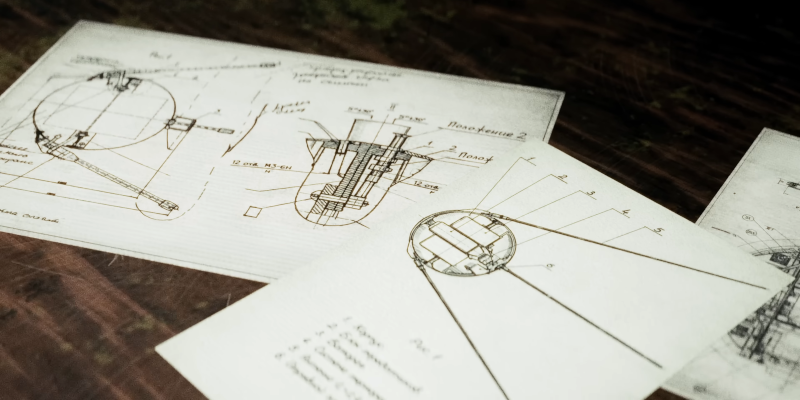
If you are an American of a certain age, you know the Soviet Union launched the first satellite, Sputnik, beating the United States to orbit. You might even remember ham radio operators tuning into the satellites beeping. But you probably haven’t heard much about the team that built the vehicle, the problems they had, or the clever design choices they made. [Hoog] has a video that details the birth of Sputnik. You can see the video below.
The original plan was to launch a massive space lab, but it proved too ambitious. Keep in mind that in the late 1950s, you didn’t have tiny computers, high-density power sources, or advanced materials, and no one really knew what to expect in the Earth orbit environment. Even the viability of radio from the ground to orbit wasn’t a given. But Sputnik’s 1-watt transmitter did the job.
The event was part of the International Geophysical Year, but despite the agreement of international cooperation, the backdrop of the Cold War made politicians in the United States incite fear among Americans that the “Reds” were able to fly something over the United States both undetected and unopposed. Secretly, the US was pleased, as it wanted to fly spy satellites over the USSR, and this paved the way, since it could hardly complain if the US did the same thing the Soviets had already done.
The whole thing started the space race, which eventually led to the moon landings. It seems impossible that Sputnik was only 69 years ago. That means 70 years ago, there were no manmade satellites orbiting the Earth.
Watching the video, we’d hoped for more details about the internals but there just wasn’t time. However, we’ve covered that before (the main link is dead, but the detail links are still very interesting). The IGY was, for the most part, a great international cooperation, although few of its accomplishments are as memorable as Sputnik.












I was born in the Summer of 1957 and so I am slightly older than Sputnik. I was going through my father’s ham radio logs recently and on one of the pages from October 1957 I saw a notation that he had heard Sputnik. I knew he had heard it, but it was fun to find the actual log entry. Even more amazing, I found the page from 7 Dec 1941, where he noted that the Japanese had attacked Pearl Harbor and all hams were being ordered off the air. The next entry in his log was five years later, after he got out of the Navy.
Isn’t it interesting that a gap in a log, itself, can speak so loudly?
Your story is a reminder that, in the end, history isn’t necessarily about dates, places, or even the events themselves. Ultimately it’s about people.
Vanguard was ready to launch we just had too many cooks in the kitchen. IGY was on, we could have beaten the reds. Young enough I knew about IGY but wondered what the fuss was about “spit-nick” or anything dash nick.
First American launch became a well known and filmed “Flopnik”. So no, you were not fully ready.
Any quite old people, even not an americam, remember that !
Unrelated, but related, the word “sputnik” has too literal meanings, “satellite” and “travel companion”. GPS/Beidu/Glonass/Galileo are really “travel companions”, IMHO.
Sputnik is a pretty good name I think, since I think most people on the planet can pronounce it somewhat decently and most transliterations probably sound similar enough for other to recognize it.
And it’s short.
A not very deep dive into oldest satellite still in Earth orbit – our little grapefruit, Vanguard 1:
The spacecraft is a 1.46 kg (3.2 lb) aluminum sphere six inches (150 mm) in diameter, with antennas spanning three feet (0.91 m). It contains a 10 mW, 108 MHz transmitter powered by a mercury battery and a 5 mW, 108.03 MHz transmitter that was powered by six solar cells mounted on the body of the satellite. Six 30 cm (12 in) long antennas, 0.8 cm (0.31 in) diameter spring-actuated aluminum alloy aerials protrude from the sphere.
https://cdn.mos.cms.futurecdn.net/a8FEjkHgfAKPNzE8ugrgnK-1200-80.jpg
Having been in the amateur satellite tracking hobby in the past I suspected this since Sputnik itself was so small:
Were the visible passes of Sputnik over the US actually the much larger R-7 rocket’s core stage?
Yes, the visible passes of “Sputnik” that Americans saw over the US were actually the much larger R-7 rocket’s core stage (also called the second stage in Soviet terminology), not Sputnik 1 itself.
Key facts confirming this:
Aspect
Sputnik 1
R-7 Core Stage
Size
58 cm (23 in) diameter sphere, 83.6 kg (185 lbs)
26–30 m (85–98 ft) long, 280 metric tons fully fueled
Visibility
Too faint for naked eye; visible only with telescopes/binoculars
Visible with naked eye as bright star-like light
Why Korolev made it visible:
Soviet designer Sergei Korolev deliberately put reflectors on the R-7 core stage because he knew Sputnik 1 would not be visible to the naked eye. He wanted the mission to be visually spectacular and politically impactful.
The core stage easily dwarfed its 185-pound cargo, making it visible to stargazing Americans below. Experts estimate that most people who claimed to have seen Sputnik in orbit actually saw the much larger and brighter booster.
Ukrainian