
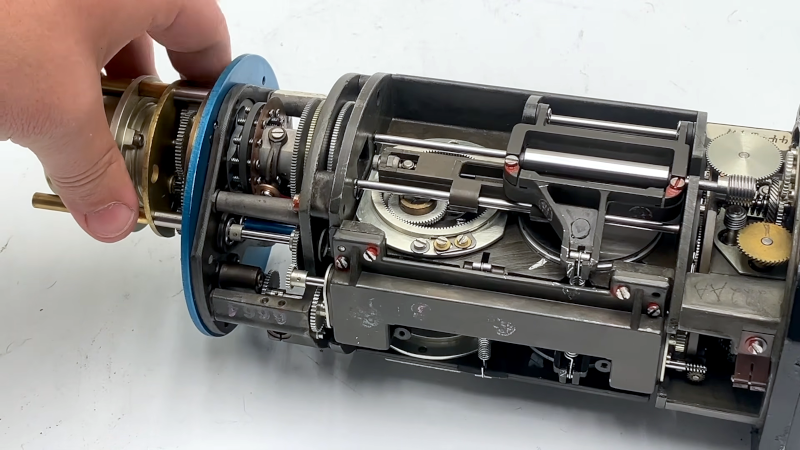
When you think of a computer, you probably don’t think of a tube full of motors and mechanics. However, as [Our Own Devices] shows, the Bendix AN5841 API Computer, an air position indicator computer, is exactly that. Using mechanical integrators and data from other analog systems on an airplane to provide key flight data to a pilot. You can see the video below.
These devices were made for military aircraft, including the B-29. It is odd that speed data can be derived from a pump that balances pressures using a fan. The video does a good job of explaining exactly how that works.
The way engineers used mechanics to convert physical measurements into analog computations is nothing short of amazing. You have to wonder how you dream up this kind of stuff. Perhaps mechanical engineers wonder the same thing about electronics. But we sort of doubt it.
We are glad our computer doesn’t have any flexible shafts or rotating disks to do math. But we do love looking at ones that did. Some analog computers used voltages instead of mechanics. This video made us think of the M13A1 ballistic computer and, of course, the Norden.












We were much smarter back in the day.
Strange that you think it doesn’t take smarts to design and build hardware and software to do this job in a modern context, i.e. digital v.s analog
Yes, those folk were very, very smart, and clever. Why do you think contemporary folk aren’t just as smart or clever?
Modern software development is a filthy plateau of mental Ethiopia. To do things that we used to do on Elwro 800 with memory count in dozens of KB modern programmer needs a massive gaming rig with 12-core CPU and at least 32 gigas of RAM because otherwise his Electron-based IDE will stutter like any other Unreal 5 game. This is not progress. This is a total regress and in case modern CPUs start to fail those “programmers” will not know what to do or how to diagnose stuff like bad signals or capacitor failing.
Same intellect with more advanced tools. The engineers that developed these devices are the same engineers that now land rockets vertically. Progress platformed upon prior progress. It’s obvious to many. Not to some. A vibe coder now is no different than a script kiddy before. Both would just as likely tout their success as skill. Neither put much effort into the success they profit from but off the backs of the real developers. But on the other hand, the doctors and inventors of today wield their intellect with much more powerful tools today, creating blockchain, very complex procedural generation, and machine work so precise it looks as though two pieces put together were truly one till they’re manually separated.
I am a declining boomer. Competence and respect for elite intellect ended with the many idiots of my generation, and continues to get worse. Although China may be a (limited) exception.
latimes.com/california/story/2026-05-27/uc-math-professors-demand-return-of-sat-for-stem-admissions
There have always been ways of getting undereducated people into programs they shouldn’t have been. Look at every sports program and most business versions of classes. This has nothing to do with “elite intellect” and everything to do with where money ends up coming from.
Note that writing competency dropping is directly related to kids not learning to write longer papers, which teachers don’t have time or manpower to grade. These policies come from politics, not the school district though. Again, follow the money.
Sad, but true
No, modern gear just needs less maintenance and calibration.
“Our youth love luxury. They have bad manners and despise authority. They show disrespect for their elders and love to chatter instead of exercise.”
This is mis-attributed to Socrates circa 400bc but it appears to be from an academic work analysing ancient texts of that sort of age – proof that the older generation have bitched about the new generation since the dawn of time.
Smarter, yes, but also there was far less distractions back then. Today, we are consumed by consistent distractions that make us less likely to achieve even a smidgen of what we could have “Back in the day”!
Whe I see &read this article for interest & knowledge, I also find it very disturbing. Regardless of how modern or antique the technology may be, I often think, in terms of National Security – even tho I don’t use or work with these technologies, that the enemies of this Great Country (USA), often comb the internet for technology that would help them advance & give them ideas on how to improve what they get and buys them time & brainpowerfor other things. I may come from a Cold War mentality, but I hate to see other countries supercedeor steal technology or anything else, we may have. Especially countries like China, Russia, etc. & Others that oppose our way of life.
Formerly great country, perhaps.
This is an even more ridiculous perspective than it used to be. Nobody will bother making a copy of this. If you are worried about Chinese sand Russian espionage maybe look at how production of most modern equipment like this takes place in China at least in part due to outsourcing. That could have been prevented, but it was more important for businessmen to get rich.
8-|
If China or Russia want to copy these things that would significantly reduce the accuracy of their bombers and presumably work in the favour of your “great” country.
just philosophically, i couldn’t possibly disagree more strongly. humanity is a brotherhood. engineering is a delightfully social activity. we all build on top of eachother, and sharing ideas — in both directions — is euphoric. where would i be without the giants? if i grow large enough, shouldn’t someone stand on my shoulders too?
anyways that’s the thesis of this clickbait corner.
This was obviously built before the age of practicality, if I never hear that word again I’ll be happy, things don’t have to be practice to work, sometimes it’s just better, because we didn’t care what ot took to make it, and we just made it anyway. Sure cost is an issue but we made the best stuff, before the age of practicality.
Getting rid of mechanical computers was purely an issue of cost and reliability, which are practical considerations, but consider that what replaced this wasn’t even one device but a dozen, and GPS thrown in for good measure.
Why don’t we have “vibe machining”?
I suspect it’s because machining failures are more evident to the lay person than software failures.
Maybe if software test suites made grinding noises or emitted smoke when tests failed…
Try to hack that device. Good luck with a remote attack. One day in the future we will building these again to prevent AI from destroying us…
Nah. Physical manufacture requires too long of an attention span, and won’t pay off until it’s both complete and correct. As long as there are distractions available, few can develop the focus and attention span necessary to design and build complex physical solutions.
Worse, with a long lead time, every physical attack is far more damaging. Opportunity cost is a thing, and a smoking pile of rubble that took a year to build is a bigger loss of opportunity cost than a smoking pile of rubble that took an afternoon to build. You lost a year of “what I could have built”, not a day.
Sad but true.
I worked on similar in the Navy. Up to the early 2000. First they were a wonder if mechanical engineering. Also good riddance, the hour’s spent maintaining the mechanical systems was huge. Especially as they aged or lubrication dried out. Also in mixed systems radio’s with mechanical tuners would shed metal and sometimes cause internal shorts. Still a major Marvel’s just solid state free’d up space and weight for more freedom to be transported and dropped on non freedom locations.
Aaaaarrrggghh!
Apostrophe gore.
https://en.wikipedia.org/wiki/Apostrophe
I’ve built this stuff for 40 years with Garrett Air-Research, Allied-Signal and Honeywell Inc. Not for the B-29, but devices just like it for many other aircraft.
Things change and advance. I suspect that we still have the engineers that could design this and the machinists who could build it. However, what’s the point? How many of us in the USA know how to kill and butcher a hog? Not many, but how necessary is it to know this in today’s world?
I applaud those who developed this device and the ones that succeeded it.