
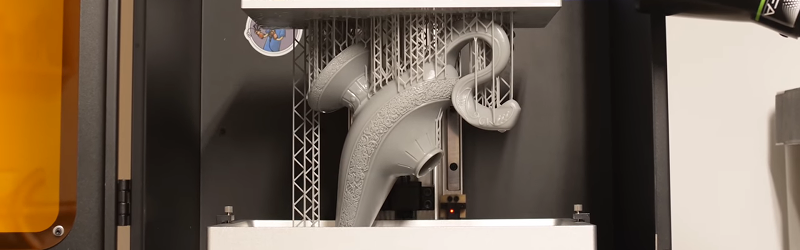
Generally the idea with photopolymers as used with resin 3D printing is that the process only works in a single direction as with all thermosets: after polymerization under influence of UV light they become an inert lump of plastic. Being able to turn these lumps back into resin would of course be ideal, as it would make recycling incredibly easy. Here depolymerizable resin turns out to be a thing, with 3Dresyn being one company that sells additives and resin which enable this (found via Fabbaloo).
These additives and resins come in essentially two flavors based on which temperature they depolymerize at, which can be at either 80°C or 150°C. This comes at a cost, of course, with the ready-to-use resin coming in at an eyewatering €833.00 for a 1 kg bottle, a factor only slightly helped by the reusability aspect.
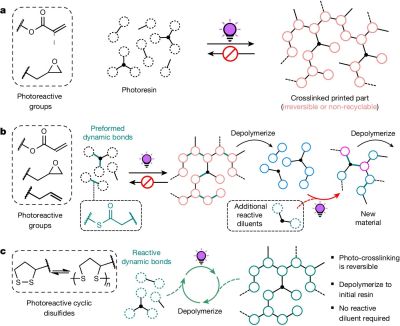
From a more technical perspective this depolymerization feature is fascinating, as it addresses the one aspect of thermosets (like SLA and epoxy resins) that thermoplastics have as advantage, especially from a recycling view. This type of circular photopolymer appears to be quite novel, with an article by [Machado] et al. from 2024 claiming to have demonstrated the first resin that can be photopolymerized, depolymerized and subsequently again photopolymerized in a closed loop.
In the demonstration by [Machado] et al. the depolymerization is achieved using dynamic disulfide bonds, with the pulverized printed samples put into a 2-methyl-tetrahydrofuran (MeTHF) solvent. After heating at 80°C for 3 hours with an inert atmosphere, most of the photopolymerized material had returned to its original, pre-printing state. In a more recent 2025 study by [Bo Yang] et al. an approach using catalytic thermal dissociation of dithioacetal bonds was explored.
Based on the available information by 3Dresyns it would seem that their product is closer to this latter approach, with depolymerization requiring putting the part into an oven at the target temperature for up to an hour, presumably in some kind of suitable container. This is said to target elements like sacrificial molds, reusable tooling and jigs that would otherwise be discarded, or need to melt like a thermoplastic instead of acting like a thermoset. Whether a solvent like MeTHF is required as in the two cited studies is sadly unclear based on a quick scan of the site.
Thanks to [SpillsDirt] for the tip.












This would be great for metal casting as the refractory mold can have the 3D plastic master removed easily with little waste?
I suspect you’d end up with a great deal of resin goo left in the refractory with something like this. Might be worth a try but given the print and castable waxes that do really burn out exist, are not that expensive and won’t end up picking up the containments from the plaster…
Id be happy if a company would just come out with a mSLA resin that doesnt inhibit platinum cured silicone.
I could print, mold in tin cure silicone, cut, wax inject, gang mold in platinum cure, cut again….but tin cure isnt readily available in clear and I hate blind cutting molds.
So Im stuck with print, cast a metal master, finish, master mold, cut, wax inject, gang mold, and cut again. Just to get a design production ready.
Look up inhibitx
Its a cure inhibitor that you paint over the SLA part. It works; we frequently cast platinum cure silicone parts in resin molds at the place I work.
Tried it, and several other “protective coatings” We didnt like the results. while they do prevent the silicone molds from being inhibited by the resin, it does diminish the surface quality of the mold sufficiently to require us to polish the waxes before making a gang mold. When you compare the coated resin mold with a mold made with a polished wax master the difference is night and day. One is clear the other has a hazed surface. Its easier for us to just metal cast a master and work from there until someone produces a resin that is compatible with platinum cured silicone.
Try AMD-3 from Ameralabs. I have had great success and many in the film industry use it for molds.
That would indeed be gamechanging. if you even do printed wax, there’s a burnout schedule from molds with wax. it’s not something you just get done in an hour it can take like 10 hours depending on what kind of thing you’re doing.
if I could pour in a chemical that forced the compound to de-link, and instantly wash out completely, that would open an entire new field of casting technology on demand
The price being so high is in part due to the fact that this particular resin is a biocompatible photopolymer certified for skin or internal medical use. A general purpose Depolymerizable Resin would likely be significantly more affordable. Bio-positioned 3D resin always come at a serious premium.
That’s a good point, yes. So far it seems pretty niche, targeting such specific markets makes sense in that context.
Looking forward to seeing this applied to standard resins too. Even if a 1 kg bottle ends up more expensive than regular standard/WW resin by 2-4x you could make the argument that it’s worth it. Definitely wouldn’t be crazier than some specialty resins you can get as a hobbyist today.
The ,main reason I tiplined fabaloo and HAD about this material was hopes that the coverage and discussion would encourage some of the hobbycentric resin suppliers to consider offering a depolymerizable resin.
To me the real appeal to this sort of resin, once its available in cheaper general purpose resin formulations, is that all of your supports can be depolymerized, filtered, and used again. ALL part NO waste.
Forgot to include the positives/benefits of
Being able to print multiple iterations, keeping the best one and recycling the less desirable attempts
and being able to recycle failed prints
This would be great for a semirigid robot.
Add fibre-optics and heating elements, perhaps subdermal inflatable bladders and the robot could adaptively change the shape or softness of it’s feet for example or brace/go limp in preparation for an impact.
Granted it’s currently pretty slow, but something like “Polymorph” can melt fairly quickly. perhaps with the right additives the transition time could be reduced,maybe by making it more thermally conductive or holding it’s temperature close to the hysteresis point. Or perhaps Polymorph could be changed into a photopolymer.
This would be ideal for a long spaceflight mission for being able to fabricate simple tools and replacement parts ‘in flight’, and being able to recycle the material when no longer needed.
That’s funny: The reforming disulfide bond trick is the same one that’s used in the permanent wave (“Perm”) hair styling products & techniques.
Better living through chemistry!
While it sounds nice, I suspect that the end result will be an inferior resin, as any contamination on the surface of the part will end up in the resin. In practice, very little thermoplastics are actually reused because of the contamination, and because separating different plastics is hard.
The biggest issue with thermoplastic recycling is that repeated heat cycles damages the crosslinked structure of the polymerchain. This avoids that issue by reverting back to an unpolymerized state and forming, for all intents and purposes, a fresh new material.
As for surface contams, that is why it is recommended/required that the depolymerized “syrup” is filtered before reuse. After reading a dozen or so papers on various depolymerizable resin chemistries over the last week, it seems that very few exhibit any change in properties over successive uses. Those that do generally require the addition of some component of their resin mixture other than the base monomer/polymer. A few chemistries are repolymerizable immediately while others require the resulting “syrup” to be reactivated by adding catalysts, photoinitiators, etc.
Normal resin can be found for less than USD $15 per kg. If the reusable resin costs more than a couple times that, then it’s not worth it. I didn’t see anything about how many times it can be reused, but I’m sure it degrades a bit each time.
According to the research papers Ive read as long as it is properly filtered there is no change in material property with repeated use. Depolymerization/repolymerization isnt like melt/remelt. The polymer chain is being completely broken down and rebuilt with each cycle.
As to your “normal resin” being so cheap, this particular offering is intended for skin contact/internal use. Its a biomedical resin. These are always MUCH more expensive. 3dresins products are also typically higher in price as they are specialized resins produced in much smaller volumes than the cheap imported from asia hobbyist resins.
While it might not be worth it to you to pay more for resin than a fast food lunch, there are plenty of us willing to shell out 10X+ your quoted price for quality resin with specific material properties. Just look at the pricing of Formlabs resins, and those arent even reusable.