
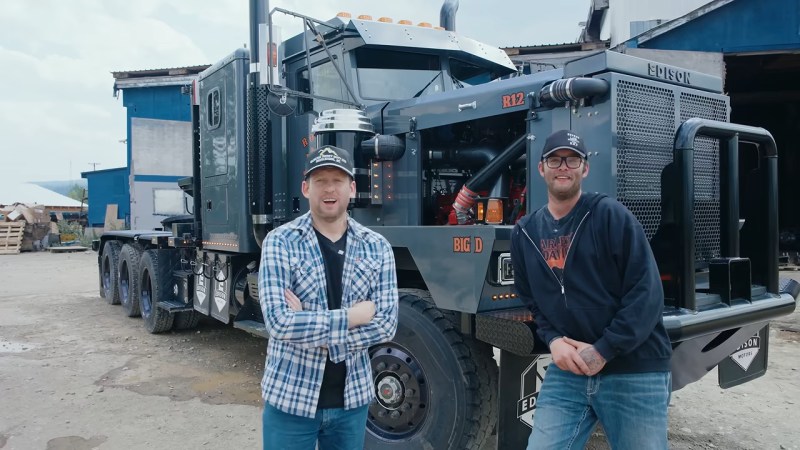
We’ve been following Canadian startup Edison Motors for some time now, but their latest offering caught us a bit off guard — their BDE series truck will be offered first without the electric hybrid drive that first piqued our interest. They make a good case for why in the video below, in which the production prototype tows around a junked Nikola semi as a sort of memento mori of what Edison does not want to end up as.
Now, make no mistake: Edison Motors is going to be selling the series-hybrid version of these big rigs eventually. That truck will have a Scania diesel rated at 500 kW driving electric motors rated at a combined 1800 kW peak power — that’s 2400 ponies. Along with the diesel generator those ponies will be driven by a big o’l battery, but none of that is in the truck in the video. It’s the same cab, and the same frame, but in order to get some revenue in while jumping regulatory hurdles and working the kinks out of the hybrid drive, they put a conventional Cummins diesel and 16-speed transmission in the “Big D” as the truck is known.
The business case makes sense: they don’t want to have their single new product hit a snag, possibly require a recall, and fall into bankruptcy the way the electric truck company Nikola did. The conventional drivetrain also lets them prove their engineering prowess to companies that might like the idea of a Made-in-Canada truck, but be nervous about new technology from a new company.
If you want to know more about the whole diesel-electric scheme, we covered that last year. Edison also has plans to offer its hybrid drive technology for smaller trucks in kit form, which is perhaps the most exciting part from a hacker perceptive.
Thanks to [Keith Olson] for the tip!












i feel like we might be running out of inventors to name vehicle manufacturing companies out of. what’s next, the Braille Fortuna?
Imagine Goatse Trucks brand with their unique red steering wheel.
Their marketing slogan could be: Stretching the imagination.
Great, now I’ve thought about how a Goatse steering wheel might look…
Thought about? I am printing it as we speak
Oh gawd…. Thanks for that visual throwback. At least I wasn’t eating.
There’s got to be some academic who could write a critique or analysis about the differences between ages where inventors name the worlds they create after themselves, those who name them after Greek mythology, those who name things PDX-FG-128J17, and those who name everything after the first group of inventors. It seems to follow a cycle.
FUMO Motors–steaming mad at Musk
Especially in French, in the postwar period companies were very apt at having names like SAGECA which would be an acronym for Societe Anonyme (French for LLC) General Engineering Company Amiens (a city)…
In the Netherland, especially before the war, there were a lot of companies that had a “spoken acronym” as name. For example, the national colonial company (NK) became “Enka” – like Standard Oil became Esso.
Their name is actually a play on them being inspired by Tesla’s failures with commercial trucking. iirc motto is literally “stealing Tesla’s idea”.
Why not ALSET or ALOKIN? This method worked well for ADZAM (Belgian Philips subsidiary).
Also a dictionary can be useful, that has already been done in the car industry: HORCH → AUDI
tl;dw two dudebros talking about awesome great totally amazing something and how they will this and that. So far they managed to develop a truck with functionality and ergonomics of a KrAZ 255 from the 1970s.
You say that like it’s a bad thing. Consider what type of trucking they did before they started the company. Would a Cascadia survive that? No. Even a Granite would split a door shell in half before the first season was over.
When the stakes are high functionality and repairability take precedent over form.
Them let’s look at the practical engineering and design. A small company like Edison Motors would not have the budget to design and build custom bodywork and interiors like the big players in the industry. Plus plastic and fiberglass wouldn’t survive as long on a severe duty vocational truck.
If it can recapture the repairability of the machinery from those bygone days, that might be enough for it to be worthwhile. Maybe I’m just being optimistic; I don’t have to lay down the cash for a semi one way or the other
Go talk to their waiting customers and you’ll see they’re building exactly what industry wants. Easy to repair, easy to modify, easy to keep running when downtime can cost millions.
Why didn’t they get one of the happy customers to talk about the thing then?
Every loser can produce tons of “I will this”, “I will that” babble. Very few deliver.
Would you trust the review, or just say they paid it anyways?
I don’t know but it still would be better than some rich white guys spewing PR bullshit.
I think you’re glossing over a LOT of detail differences between this and a KrAZ – just because it’s mechanical and simple, the technology and build are going to be, well, at least 50 years ahead even if it’s still mechanically simple.
That Cummins motor is going to be vastly more powerful, efficient, reliable and smooth than the Kraz for starters.
Maybe go meet a farmer who made the mistake of buying a John Deere.
I see these startups largely doing “catalogue engineering”. Pick a driveline, engine, battery etc. etc. and get it all together to make a vehicle.
It’s a terrible way to do product development- but investors are in a hurry. Too much of a hurry to really build up a company, engineering and manufacturing team.
Marketing videos to lure in more investors is the new norm. Fake videos aside, Nikola was doing the same thing.
What comes first? The tech, the product or the marketing hype?
The majors do an awful lot of catalogue engineering. They just have internal catalogues as well as external ones. Cummins powers an awful lot of vehicles, of various makes. So did Detroit Diesel and Cat. Look at car and start looking for parts made by Bosch. Bet you there’s at least one in the braking and steering systems. Interiors? Loads made by Adient, formerly Johnson Controls. Look at what parts Ferrari steals from other marques.
To say that catalogue engineering is a bad or unusual thing exposes ignorance of the way the automotive industry has worked for decades. No one makes all their parts in house. No one does all their own design work. Even Tesla, as “vertically integrated” as they lie about being, needs parts, IP, and expertise from vendors like Panasonic. The modern day is parts bin engineering and industrial lego, covered in sleek, cosmetic body panels.
Catalogue engineering is ok, when the interface between your product and the catalogue part is specified in a way you can swap out the catalogue part without reengineering or recertifying the rest of your product. As far as I can see this is largely not the case today, and the complaints about the results are well known to the readers of this site.
That’s a big ask for certain parts, and I’m not sure when it’s ever been true.
Edison’s engineering is probably the best I’ve seen in this, at least with the earlier prototype Topsy– they were looking at swapping out e-axles, battery modules and generators from different vendors. At one point they were talking about user-specified options for that, but it’s very understandable they intend to lock down the production model to a combination of parts they know work well.
I think in the direction of https://en.wikipedia.org/wiki/Einheitslokomotive with lots of common parts swappable between different types and several manufacturers. As always, you have to find a healthy middle ground between everything-is-custom and no-own-engineering. On first glance, Edison looks promising to me.
Catalogue engineering, not sure you have experience or understand it.
Off the bat, the prices are higher than if your own, and the parts are generic and never quite the function or size you need.
Look at a regen function and the impact on the ABS and you will see you are in the mess of the catalogue. It’s a safety function, needs the vehicle’s dynamics and significant road testing.
If you want firmware changes to an ECU, it’s very costly and slow, and depends upon forecast high sales volumes to pay for it.
Big players such as Bosch and Continental amortize their software development costs over the thousands of ECU’s you have committed to buying from them. They won’t assign a dedicated programming team just for you, small fry.
A vendor simply hacked the Cummins ECM, it was much easier lol.
Why? if a product can be made with cots components what is the added value of developing them yourself?
the only reason to not do “catalogue engineering” (which all the big manufacturers also because it makes sense), is if you want to spend a lot of time developing you own expensive special sauce that you hope to sell at a great markup
Which is how you end up selling two identically built, equipped, and optioned cars but one is $50,000 and the other is $75,000. The difference? What hardware the software allows you to use.
Eg. Heated Seats on a subscription service.
I get where you’re coming from, there’s a lot of hype in the hardware investment spheres, but “catalogue engineering” with COTS components to prove a concept is an excellent, and efficient, way to start generating capital. Especially for the much steeper R&D costs of turning out a genuinely new thing. It proves to investors you have the engineering chops to turn mass-energy-balance math into a product, while being innovative under constraints.
Burt Rutan is famous for it. He kept a desk drawer full of Legos to brainstorm with, which is kind of catalogue engineering for kids. A lot of his aircraft were made with industry standard components that were already proven by other airframes, or from other engineering fields entirely. The Rutan-Quikie use an 18-horsepower lawnmower engine.
I’d much rather see a new company’s all mechanical 1-ton pickup made with proven modern components before I see their untested new take on electromotive diesel engines.
(piqued)
I have seen a few electric trucks on the road here in Australia.
Mostly Volvo
I had a colleague that did 100km single trip to work. He lived next to the highway and work is also next to the highway. He bought a brand new hybrid and quickly found out why it made no sense at all. A few months later he replaced the car for a conventional car as the hybrid was just too expensive to run. The fuel economy was terrible. That’s the problem with trucks. You want an engine that doesn’t rev high, that lasts forever and that can run for years without any issue. A hybrid system sounds nice but for the majority of cases, it’s just dead weight that will increase fuel consumption and pollution. This is especially the case in the USA and Canada where this truck is designed for as this truck design is too long for EU regulations.
I work for an offshore company and we got ships that are diesel electric. It’s great for work ships. You go out the harbor, do the work, go back, you need tons of electricity, maneuverability using pods, putting it in a position for work, having cranes etc run. Diesel electric is perfect for that. But we got other ships that are designed for long distances, such as ocean going tugs. They are just pure diesel power as it needs to be as efficient as possible and a hybrid system just brings down efficiency. My employer does a ton of evironmental programs, supporting tons of causes, invests in new technology with new fuels, new engines, etc. But long distance and hybrid just isn’t possible.
So the only reason to buy a hybrid or even full electric truck, is if you only drive short distances on known routes. Great for things like, a short distance between a factory and a warehouse. But for the average trucker, it would be a disaster. The “110 kWh LMO batteries charged on a 740 V” gives you what, 20km of range on a loaded truck. It’s just not great.
It looks extremely good though. Just for looks, it’s a solid 10/10. And don’t get me wrong. I applaud the effort. Especially when I read things like “We use common, off-the-shelf parts wherever possible. If it breaks, you can fix it without a laptop and a subscription.” and “Parts you can fix with a wrench.”. That’s just amazing. I hope they succeed and I think offering a normal version with a normal engine is absolutely the way to go forward. A hybrid for the few that need them, I doubt it’s a viable business model but I applaud the effort.
Yes you are definitely correct about hybrids. They only work for special conditions. They are especially bad at highway driving but better in city.
You are however incorrect about full electric trucks and many companies have proven that. If you look at city busses the case for full electric is so extreme that it is very hard to get a new diesel bus in Australia.
“…If you look at city busses the case for full electric is so extreme that it is very hard to get a new diesel bus in Australia…”
That doesn’t counter Bob’s point. Rather, it’s evidence in support.
Buses follow prescribed routes on prescribed schedules– and work in conjunction with an active support infrastructure (the city’s garages, mechanics, and tow trucks) to assure continued servIce when things go wrong.
This, and similar known-route and known-schedule applications, like postal trucks (which also have a built in support infrastructure), is the only use case where electrics might shine.
Comparing OTR trucks and a city bus is apples and rocks, man.
Diesel-electric locomotives is the appropriate comparison.
the point of a hybrid is that you can use a smaller more efficient engine because it only needs to handle the average load, the peak loads a handled by the battery. This of course won’t work if average and peak loads are too similar
We will see! There’s a reason the railroads have been using this kind of drivetrain the last 90-odd years, after all.
My take is that 20km on battery isn’t much, but if you get a big chunk of that range back every time you go down a really big hill thanks to regenerative breaking– and don’t have to suck up wear on your drums where jake brakes are banned– the savings should speak for themselves. Add to that a genset having a longer maintenance interval to a motor driving a transmission and, well– we’ll see.
You may well be right that the “conventional” version outsells the hybrid and becomes their bread-and-butter, but we’ll see.
yeah it makes me wonder why railroads are so fond of diesel-electric
no clutch … and when diesel-electric was developed there were no suitable transmissions with the required power that would fit in a locomotive (these came later, when better materials were available)
And complexity. Trains need more driven wheels for traction, so the mechanical coupling gets more complicated with more parts that cost more money and all the extra bearings and gear pairs down the line waste power to turn.
How is this a hack?
“All mechanical” makes it sounds like it will come with a big spring and winding key. Or be powered by a compressed air tank.