
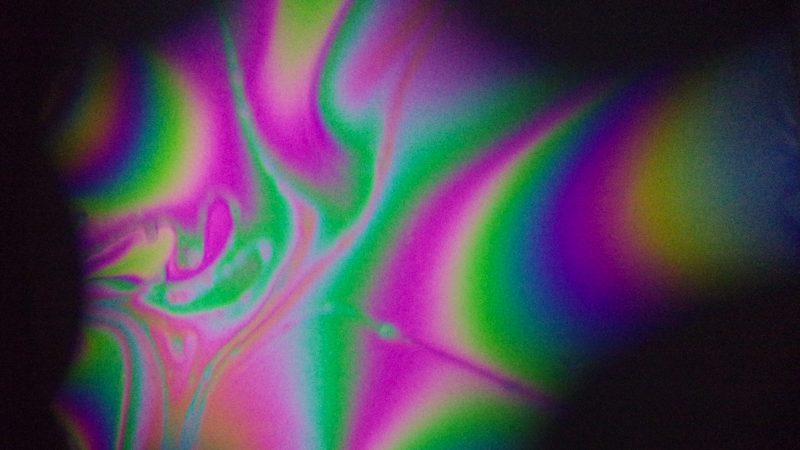
We feature a lot of fun projects with LEDs and lasers and all kinds of light effects going on. Most of these are very digital. However, there are a great many ways to make beautiful lighting effects without ones and zeros. The Maelstrom Lamp from [Michele Lorenzi] is a great example of that.
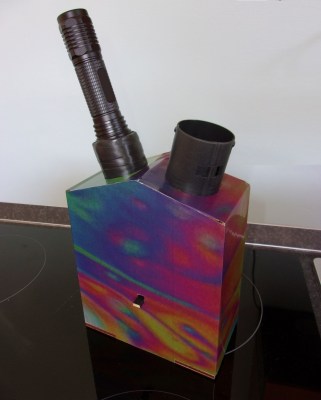
The concept is decidedly old-school. The lamp uses a delicate, thin soap film stretched across an aperture as its primary optical element. The varying thickness of the film across its surface leads to constructive and destructive interference when white light passes through it. This creates a kaleidoscope of color; the same effect you might have seen when an oil slick forms in a dirty puddle.
In this case, though, that effect is projected with the aid of a powerful 800-lumen flashlight and some supporting optics. [Michele]’s write-up does a great job of explaining the finer design details that maximize the vibrancy of the effect, from the waviness in the gasket that supports the soap film, to the optics that focus the torch beam.
If you’re looking for some suitably psychedelic lighting effects for your next house party, you really ought to build one of these. We’ve featured some other fun classic lighting effects before, like these wonderful bubble lamps.












Oil ones are crude, but this is a pretty slick design.
I remember some ’70s artists using shallow glass dishes on overhead projectors to do a similar thing. Not sure if it was soap or oil, but they added dyes and used various implements to stir and swirl.
Sounds like that would pair well with acid.
You, sir, know what you’re talking about.
It did. Quite well, indeed.
Like…..totally….man…..farrrr out.
it was colored oil + colored water base. The glass dishes still sell, but they are pricey. Works best with acid and eerie early PF albums.
Sounds like oil if they used dye.
And you’ve just reminded me we had small wave tanks on OHPs in lectures. Was always amazed they didn’t leak into the projector!
We did this in my middle school art class. It was oil and water and various paints. It was a fun aside our teacher did. We were making books and were doing the inside flap swirl pages. You would swirl the solution around and touch the paper to it and insta cool effect :) It made an impression on me because I remember it so clearly these ahem many years later :)
Thank you Zoe for the wonderful article! I just want to add ont thing: watching the colour patches move and change slowly is very soothing; because I work in a psychiatric facility, I’m doing some research on the therapeutic potential of this object.
If you guys are at all interested in building it you can find all the data on the hackaday page of my product. However, there are two components that are not easy to source so I’m thinking about selling them on Tindie if I see there’s sufficient demand; so feel free to leave a comment, here or on my page. Thanks everyone for your interest!
This being HAD, I blithely assumed “Simple Object Access Protocol” from the title.
This is better.
British electronic artist Floating Points toured with a system that blew a large bubble over a subwoofer then projected the colors out to a large projection screen.
As the bass moved the speaker cone, it’d cause the bubble’s surface to wiggle and sway about, making for instant sound-reactive visuals.
https://www.youtube.com/shorts/XYEeT7Z51Xw
That’s very interesting, thank you for showing it to me! I had thought of adding sound to the device but that’s too complicated for me..
Back in the late 70s I had this fascinating art toy that I got in a Sydney Royal Easter Show show bag. It was a white octagonal plastic plate about 12cm dia with a 8 to 10cm circular clear window set in the top side. when the opaque flexible membrane back side was pressed, it generated all sorts of bright swirly oily multicoloured patterns just like those 60s psychedelic spotlight / projector lights.
I had fun with it until one day I left it in the hot sun and the liquid inside went completely clear, showing the black background of the membrane. Putting it in the fridge didn’t fix it. I had no idea what chemical it used but thought it might perhaps be a liquid crystal, as I’ve had LC calculator displays go black when they too got hot.
I’ve tried looking for a similar toy on eBay and Google Image search but come up with nothing.
that is a {‘B’, ‘o’, ‘n’, ‘*’} was my first thought. put on the deep purple