
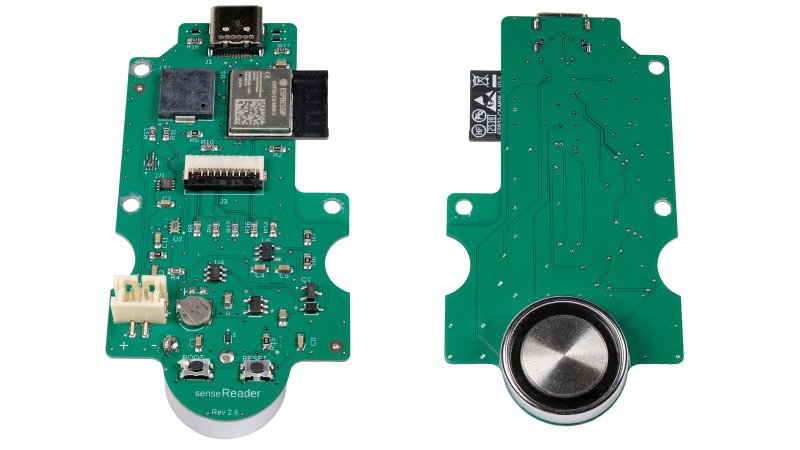
iButtons are microchips housed in small, round, metal containers, and are similar to coin cell batteries in appearance. Among other things, they’re used for logging data in industrial contexts, particularly where it’s desirable to track parameters like temperature over time. [Geoffrey Wells] has worked with these sensors, and decided that the aging solutions for reading these devices are too cumbersome and out-of-date. Thus, he designed ChillPoint as a more modern solution.
As you might have guessed by the name, [Geoffrey] was inspired to build a rig specifically for inspecting iButton data loggers in cold chain logistics applications. It’s built around an ESP32-C6, which has a 1-Wire probe on the front for communicating with the target device. On contact, the reader dumps all the data, storing it on its own flash storage. The data can then further be accessed by connecting to the ChillPoint handheld device over its own WiFi access point, upon which it hosts a web UI for access. The handheld can be used for scanning iButtons single-handed, while a smartphone, tablet, or laptop can be used as a screen to monitor the results live.
The project is nearing completion, and [Geoffrey] says both the hardware and software will be open source once it’s all said and done. Anyone interested in adding a ChillPoint to their toolbox should keep an eye out for its upcoming CrowdSupply campaign.
If you find yourself working with these devices on the regular, this project may be appealing to you. We’ve looked at iButtons many times over the years. The Java Ring was probably the coolest.










I built a surprisingly similar device last year, but mine was a one-off and not nearly as polished as the one mentioned here.
The ESP32 in my device writes the data into an influxdb while providing some debugging via MQTT.
I also used a SSD1306 oled display to show the highest value and its timestamp.
Very interesting! FWIW a Flipper Zero as the mean to read iButtons also
My understanding is that support for the Maxim-Dallas “1-wire” interface is reasonably widespread(not like i2c or SPI widspread; but shows up in a lot of places here and there were the cute trick to cut one signal line out is desired and speed doesn’t really matter) and they sell a variety of ICs that use the interface and come on various ‘normal’ packages.
It’s specifically ibutton readers that have kind of anemic support, since (while you have to like the conceptual elegance of just using what is basically battery packaging tech to durably encapsulate an IC) they never really broke out of their niche and the supporting ecosystem tends toward fairly low volume/infrequent refresh(some of it quite nice in the sense of being able to survive a zillion mating/unmating cycles in unpleasant environments; but often without modern niceties.)
If you are willing to bodge the ibutton connector(or just tape a couple of wires, the contact points are big) interacting with them is not so bad.