
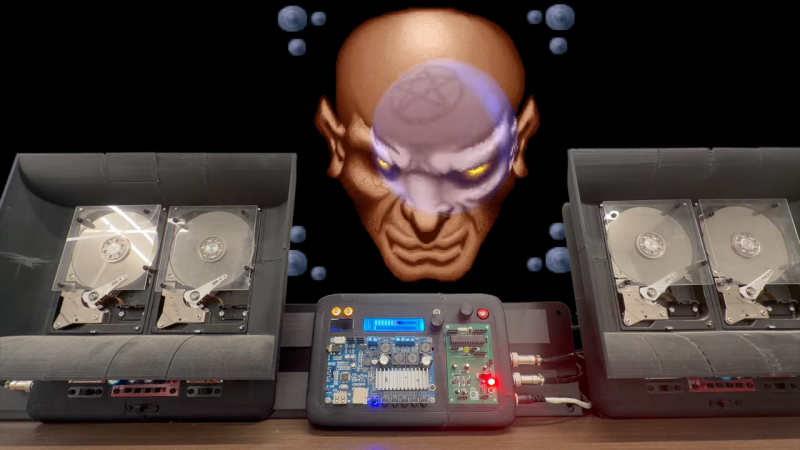
Second Reality is a legendary demoscene release by Future Crew, which won Assembly 1993 with its technical and artistic mastery. [Niv Singer] decided to give the classic demo a spin on a rather unconventional sound system with a particuarly techy twist.
Hard drives are great for storing data. They’re designed for this purpose. What they’re not designed for is acting as speakers, but you can hack them into acting that way if you’re so inclined. For this project, [Niv] pulled apart a whole stack of drives, so they could be repurposed in this way. The principle is simple enough—just feed audio to the coil driving the head, and it will vibrate and wiggle around, creating soundwaves in the air. It’s not particularly effective, and you get limited volume with a terrible frequency response, but that’s half the fun. [Niv] actually took some of this into account, too. Four Western Digital Caviar 500GB drives were chosen for this build, two for the left channel, and two for the right. Each channel had a crossover, allowing one drive to handle low frequencies while the other handled higher ones. For a further nice touch, the platters spin with the beat as well, with [Niv] providing a great explanation on how this was achieved with the use of some nifty PWM tricks.
Files are on Github for the curious. We’ve featured plenty of hard drive speakers before, too. Video after the break.












There was a thing…. Long ago… They called it SENSURROUND.
A monster set of Cerwin Vega servo speakers… 6x 1200 watt cabs…
If you attach those arms to PISTONS…. you get the same thing.
You are using normal voice coil action from the position voice coil, now you have to attach a transducer to capitalize on your available movement.
Look up how Cerwin Vega hooked up those motors and you can radically increase your resulting SPL.
I remember when AfroTechMods did this 20 years ago, back when he was a student (before he put up his current semi-serious web site).
https://afrotechmods.com/tutorials/2015/06/25/hard-drive-speakers/ — is his current link, though I bet I could find the original in the Archives (complete with “rare squirrel pr0n” –you had to be there).
On this system the largest sound generating element is the 1″ or so of the FPC strip that carries the signals…
The arms, are designed to be a quiet as they can so most of the output is coming from that band circuit strip.
I had a look at the idea, the signal motion you have going on there, You need a shaft mounted ~ 1/4″ from the pivot to directly drive a piston… The remaining arm can later be cut off to avoid the inertial distortions and clean up the signal transmission even better.
You don’t need to change a single thing, Just translate that back and fourth motion to up and down and add a piston over the top, If you do it right you can use the parts you have already to add a spider and surround element to that which you have…. Thin a cap with a passive radiator but a centre block and pivot for the transfer arm you use… then your arm motion is moved to the piston… You should get some 80dB increase over the ~ 2 cm area you have to move air now.
I want to say “Use LEGO parts to move the motion…” Think Low mass, Like chopping off the bottom arms you can’t see to reduce inertia. Simple levers using the high tolerance LEGO pins and collar and the block with the hole to pivot….
Think about it….
Good Stuff you have.
https://youtu.be/uT0JOIPxyE8 – Back in the day on the Amiga floppy drive
RIP Floppotron