
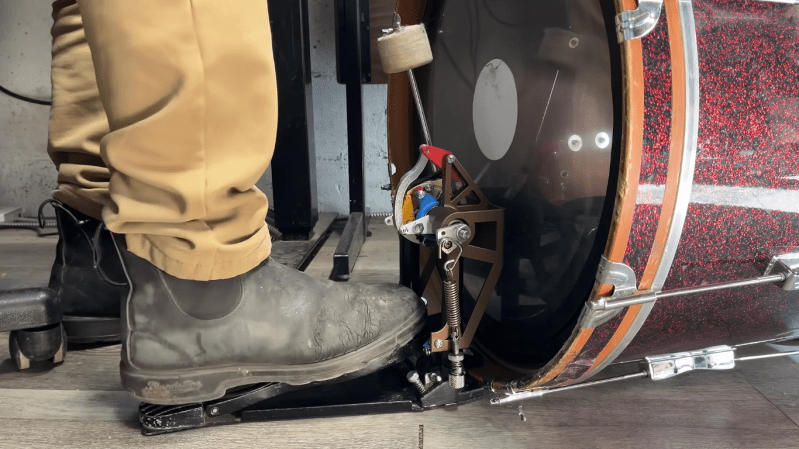
For as popular as the piano is in music studios, homes, and schools, it almost defies logic. Compared to a guitar, harmonica, or drum set, pianos are incredibly complex machines that can have somewhere on the order of 8,000 moving parts in a case that can easily weigh hundreds of pounds and which often responds quite poorly to seasonal changes in temperature and humidity. But for putting up with all of these downsides, musicians are rewarded with an instrument that uniquely responds to touch, style, and emotion. A big reason for that is that mechanical complexity, and [Super Valid Designs] is attempting to bring that design to a drum set.
Compared to the complex machinery that connects the movement of a piano’s key to its hammer striking a string, a kick drum pedal is much simpler. It can only bounce off of the drum or get “buried” where the beater remains pressed up against the drum after hitting it. [Super Valid Designs] wanted something with a bit more finesse and control, so he first 3D printed a mechanism that throws the beater towards the drum head and then disconnects it mechanically from the pedal, so that it rebounds even if the pedal stays depressed. The next steps were more difficult, which involved making sure the mechanism reset itself in a repeatable way, without making too much noise of its own. This involved trying out a few different ideas and printing a massive amount of subtly different linkages, but in the end he’s left with a machine that nearly replicates all of the parts of a piano’s escapement,
The end goal of this project wasn’t simply to reproduce piano mechanisms on a drum set, though. [Super Valid Designs] hopes to make a kick drum that’s much smaller than those found in traditional kits, and since smaller drums respond poorly when the beater remains on or near the drum after striking it, a mechanism like this will dramatically improve the performance of the smaller drum and help reduce the requirement for perfect technique. And, maybe in 50 years or so, these types of escapements will take over the drumming world just like the piano escapement took over keyboards after its invention in the 1700s. Some simpler piano actions have been built before, but the complexity seems to be a requirement for all of the tasks they need to do whether its for a piano or a drum.












The answer is obviously a fly-by-wire pedal and beater.
The piano and kick drum works in completely different way – in the piano the string vibration is excited by a hammer and is silenced by a damper. It’s basically mandatory to detach the hammer’s felt from the string after the initial strike to prevent the hammer from unintentional silencing of the string. The whole piano action mechanism is quite ingenious and effective in allowing this kind of control of the sound attack, sustain and release.
In the kick drum the sound is excited by the beater head (the one striken by the pedal hammer) and the resonant head. The oscillation is much much shorter than the piano string. Basically, even if you forcefully press the hammer into the beater head, the extracted sound is roughly the same (for non-musicians) as the resonant head also emits sound. In the drummers’ circles there are different styles of playing (depending on personal preferences, style of music or teaching school) that either allows, prefers or discourages the hammer embedding in the beater head. But this control is learned by the drummer and can used at will – an experienced drummer can decide whether, when and how to strike the beater head, including to intentionally embed the hammer, thus creating a different sound on purpose.
For a drummer, such piano-action-style pedal would feel like loss of control.
Disclaimer: Yes, I’ve studied drums in a music college.
This is a really nice idea! I’d love to see it tried by fast and technical drummers like Jojo Mayer
I’ve played acoustic drums for some few years and no, you’d probably want to keep the classic kick pedal as it is. The longer you play the drums, the more obvious it becomes why so.
Sometimes your first “kick” has to be swiftly followed by the second gentle semi-kick that dampens or completely muffles the booming of the first one. At other times you need the kick to be definite/short, so you press firmly with each kick making sure there is no after-booming.
Exactly. And yes, there are multiple nuances in playing drums.
One nuance is the sound extraction, or expressiveness, as you mentioned.
Another one is in the ergonomics – playing the drum pedals with our feet and using our hands requires a stable posture and keeping a balance (you start feeling this when you approach the 4 way coordination textbook). This means the pedal can/will carry some slight weight during playing (I’ve seen people even jumping/kicking the pedals hard). And a little more on the ergonomics – the drum pedal and the hammer are both quite inert, even if you buy ultra-light/fast brands. This forces you to learn how to sway/swing the hammer in advance so the sound comes on-time.
Again, all this experience becomes incompatible with the piano-action pedal, without making things easier, and taking quite a bit of control out of your… feet.
But I agree that the idea is fun and the author deserves a credit for exploring it and trying it out.
Electronic would definitely make some things easier, but I think the whole point here is improving the mechanics without losing the natural response of an acoustic kick. I’d be curious to try it and see how different it actually feels