
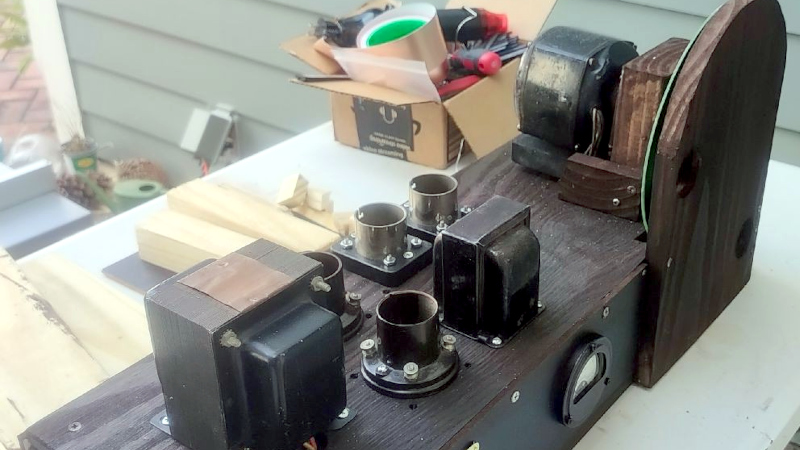
There are many experimenters who have had a go at a mechanical television, and though there are a few challenges, it’s a relatively straightforward project in 2026. A hundred years ago though it was still beyond the cutting edge of technology, and that’s where [Paul Kocyla] is placing his build. It’s a mechanical TV system, using only parts that would have been available in the 1920s. The project isn’t finished yet, but we suggest following along for some fascinating insights into developments in early electronics.
As it stands he has a wooden chassis, a period power supply and amplifier, a synchronous motor, and of course the Nipkow disk that makes it all possible. The electronics aren’t quite finished, and he’s yet to source a neon lamp. This last part may be particularly tricky, as there were specific flat-plate neon lamps made for this application. It’s interesting to find that the motor would synchronize to the grid frequency and would need to be restarted a few times for the frame to be in the right place.
His last posting contains a particularly interesting nugget of information for anyone using tubes. The amplifier carries a 120 Hz hum, something difficult to trace. The culprit is the early tubes with directly heated cathodes formed from the heaters themselves; they had such a low thermal mass that they would “blink” at 120 Hz if fed with AC. A set of period copper oxide rectifiers solve this by feeding DC to the heaters. There’s a YouTube series to follow, and we’ve placed the most recent one in which he fixes the power supply, below the break.
Back in January, we marked the hundredth anniversary of mechanical TV’s invention. Meanwhile, some of us have been known to experiment in this direction too.












In this 1933 8-part series on building your own tube TV they are still talking about the debate between mechanical vs electronics:
https://hackaday.com/2022/04/10/retrotechtacular-a-diy-television-for-very-early-adopters/
There were cabins for real-time video telephony in Germany (Berlin, Leipzig) in the 1930s, using CRTs.
That’s roughly 90s years ago, not 100. Big difference, of course.
https://www.youtube.com/watch?v=X3cV2Qj4M3g&t=176
It’s the forbidden era of lizard-people who came in late 1933 and disappeared fully during May 1945.
The 120Hz hum was to be expected. The UX-201A is a battery tube with a 5V filament that wants a 6V lead accumulator and a rheostat. The voltage drop across the filament also provides part of the grid bias, so any AC component on the filament goes directly into the grid. And heater polarity matters, such tubes are built asymmetrically on purpose. Modern battery tubes aren’t much different in this regard.
Early directly heated AC tubes had very thick filaments with unusually low voltages, sometimes down to 0.6V, to minimize electrical and thermal side effects.
I wish people would understand the “prolly” isn’t a word.
It prolly is, now.
Innit now.
Like all funny mouth noises, gestures, and runes, once there is a sufficient consensus, it is now real. Quite disturbing, I know.
What bothers me personally is the fact that consensus can change, therefore meaning and usage can change. It’s a glitch in the wetware, no patch available.
It’s not a glitch but intended.
You’re fkin right brotha! :-D
But that’s how we roll here.