Ultra-Long Range Flights To Ease Australian Air Travel

Pity the poor Australians. Isolated on a jagged hunk of land far from everywhere else, these industrious people have to take two-legged flights (or more) to reach a great many destinations in the northern hemisphere. It’s expensive, time consuming, and makes planning a trip a complete headache when wars break out around popular hub airports.

One airline is trying to solve this problem. The nation’s flag carrier, Qantas, has been hard at work on Project Sunrise. The goal is to run some of the longest non-stop commercial passenger flights ever, with great effort going into solving the technical and economic challenges involved.

Continue reading “Ultra-Long Range Flights To Ease Australian Air Travel”

Ask Hackaday: Could Rating Airlines Stop Flights From Spreading Diseases?


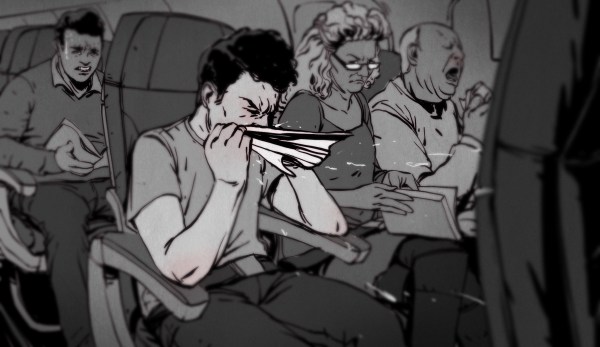
A few weeks ago, I found myself the victim of flights from hell. My first flight was cancelled, leaving me driving home late at night, only to wake again for a red-eye the next morning. That was cancelled as well, with the second replacement delayed by a further hour. All in all I ended up spending a good ten hours extra in the airport surrounded by tired, sick, and coughing individuals, and ended up a full 16 hours late to my destination. On the return, I’d again tangle with delays, and by the weekend’s close, I’d contracted a nasty flu for my trouble.

All this had me riled up and looking for revenge. I had lost hours of my life to these frustrations, and the respiratory havoc claimed a further week of my working life. It had me realizing that we could surely improve the performance and hygiene of our airliners with a simple idea: a website called Flights From Hell.

Continue reading “Ask Hackaday: Could Rating Airlines Stop Flights From Spreading Diseases?”

Sharkskin Coating Reduces Airliner Fuel Use, Emissions

The aviation industry is always seeking advancements to improve efficiency and reduce carbon emissions. The former is due to the never-ending quest for profit, while the latter helps airlines maintain their social license to operate. Less cynically, more efficient technologies are better for the environment, too.

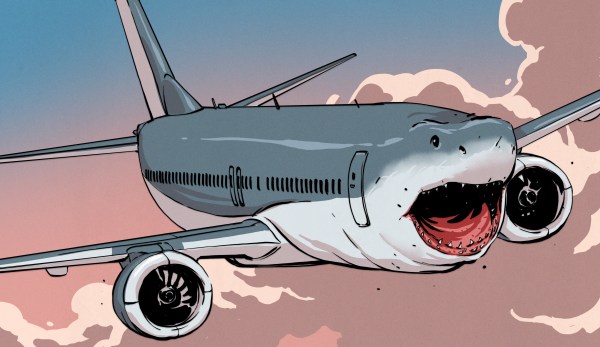
One of the latest innovations in this space is a new sharkskin-like film applied to airliners to help cut drag. Inspired by nature itself, it’s a surface treatment technology that mimics the unique characteristics of sharkskin to enhance aircraft efficiency. Even better, it’s already in commercial service! Continue reading “Sharkskin Coating Reduces Airliner Fuel Use, Emissions”

Truss-Braced Wings Could Bring New Look To Runways Worldwide

Airliners have looked largely the same for a long time now. The ongoing hunt for efficiency gains has seen the development of winglets, drag reducing films, and all manner of little aerodynamic tricks to save fuel, and hence money.

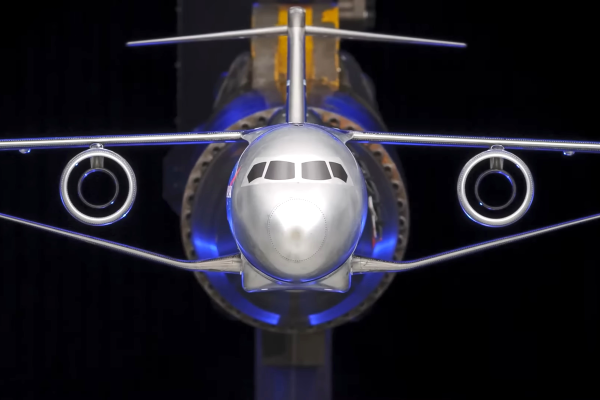
Boeing now has its eye on bigger, tastier goals. It believes by switching to a truss-braced wing design, it could net double-digit efficiency gains. It’s working together with NASA to see if this concept could change the face of commercial aviation in decades to come.

Aspect Ratio Matters

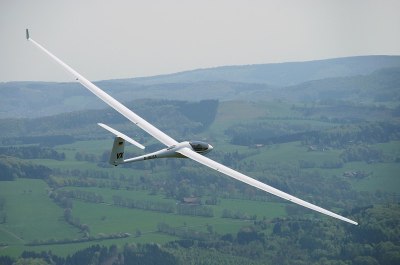
The ASH 31 glider features wings with an aspect ratio of 33.5, and a lift-to-drag ratio of 56. Credit: Manfred Munch, CC-BY-SA 3.0

The key goal of using a truss-braced wing is to enable an airliner to use a wing much thinner and narrower than usual. These “high aspect ratio” wings are far more efficient than the stubbier, wider wings currently common on modern airliners.  But why is aspect ratio so important, and how does it help

If you’ve ever looked at a glider, you will have noticed its incredibly long and narrow wings, which stand it apart from the shorter, wider wings used on airliners and conventional small aircraft. These wings are said to have a high aspect ratio, the ratio between the square of the wingspan and the projected area of the wing itself.

These wings are highly desirable for certain types of aircraft, as lift-to-drag ratio increases with aspect ratio. Any wing that generates lift also generates some drag, but this can be minimized through careful wing design. By making the wings longer and narrower, and thus higher in aspect ratio, the wing tip vortices generated by the wing are weakened. This reduces drag on the plane, and quite significantly so. Continue reading “Truss-Braced Wings Could Bring New Look To Runways Worldwide”

Airlines Seek Storage For Grounded Fleets Due To COVID-19

Ask any airline executive what their plans were back in January 2020, and you’d probably get the expected spiel about growing market share and improving returns for shareholders. Of course, the coronovirus pandemic quickly changed all that in the space of just a few months. Borders closed, and worldwide air travel ground to a halt.

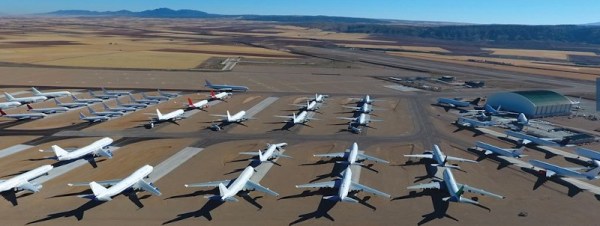
Suddenly, the world’s airlines had thousands of planes and quite literally nowhere to go. Obviously, leaving the planes just sitting around in the open wouldn’t do them any good. So what exactly is involved in mothballing a modern airliner?

Continue reading “Airlines Seek Storage For Grounded Fleets Due To COVID-19”

If You See Anything, Say Something? Math On A Plane

Remember September 2016 2015? That was the month that [Ahmed Mohamed] brought a modified clock to school and was accused of being a terrorist. The event divided people with some feeling like it was ignorance on the part of the school, some felt the school had to be cautious, some felt it was racial profiling, and others thought it was a deliberate provocation from his possibly politically active parents. In the end, [Ahmed] moved to Qatar.

Regardless of the truth behind the affair, this month we’ve seen something that is probably even less ambiguous. The Washington Post reports that a woman told an Air Wisconsin crew that she was too ill to fly. In reality, she was sitting next to a suspicious man and her illness was a ruse to report him to the crew.

Authorities questioned the man. What was his suspicious activity? Was he assembling a bomb? Carrying a weapon? Murmuring plans for destruction into a cell phone? No, he was writing math equations. University of Pennsylvania economics professor [Guido Menzio] was on his way to deliver a speech and was reviewing some differential equations related to his work.

[Menzio] says he was treated well, and the flight was only delayed two hours (which sounds better in a blog post then it does when you are flying). However, this–to me–highlights a very troubling indicator of the general public’s level of education about… well… everything. It is all too easy to imagine any Hackaday reader looking at a schematic or a hex dump or source code could have the same experience.

Some media has tried to tie the event to [Menzio’s] appearance (he’s Italian) but I was frankly surprised that someone would be afraid of an equation. The pen may be mightier than the sword, but a math equation won’t (by itself) down an aircraft. I’ve heard speculation that the woman might have thought the equations were Arabic. First of all, what? And secondly, what if it were? If a person is writing in Arabic on an airplane, that shouldn’t be cause for alarm.

It sounds like the airline (which is owned by American Airlines) and officials acted pretty reasonably if you took the threat as credible. The real problem is that the woman–and apparently, the pilot–either didn’t recognize the writing as equations or somehow feared equations?

Regardless of your personal feelings about the clock incident, you could at least make the argument that the school had a duty to act with caution. If they missed a real bomb, they would be highly criticized for not taking a threat seriously. However, it is hard to imagine how symbols on a piece of paper could be dangerous.

While the mainstream media will continue to focus on what this means for passenger safety and racial profiling, I see it as a barometer of the general public’s perception of science, math, and technology as dark arts.