
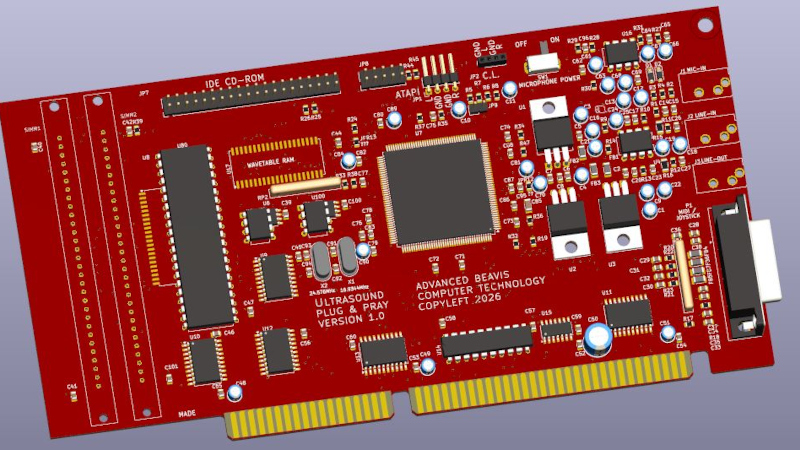
Many older hackers will have at some point gotten rid of an old piece of hardware that they later ended up regretting. All those ISA cards were next to useless back in 2006, but now their relative rarity plus the popularity of retrocomputing makes them sought-after. But if it’s a sound card you’re after then never fear! [Schlae] has got you covered, with the Beavis Ultrasound. It may have a name reminiscent of a ’90s cartoon series, but it’s a clone of the Gravis Ultrasound from back in the day.
There is of course a snag, to build one you need an AMD AM78C201. Assuming you’ve found one in a surplus supplier though, the rest of the card is analogue, some glue logic, and a ROM for samples. There is also a GAL for driving the IDE CD-ROM interface, from the days when sound cards came with such things.
New ISA cards are cropping up here from time to time, such as this very handy storage and network card.











Uhuhuhuhuh… cool!
” Note: I have not generated the fab package since I have not actually fabricated the board and tested it for functionality. Build this board at your own risk. ”
Say no more….
Well, it’s a first commit from yesterday. The project is OK, but HaD may have waited a bit for it to settle down first before covering it.
The only reason I’m not outright ignoring it is because it was designed by schlae, aka Eric Schlaepfer. Prior projects include the a fully documented Sound Blaster 1.0 reproduction named the Snark Barker. Much higher likelihood of this being real, despite the possibility of mistakes.
Wow they cloned the clone ARGUS 🥱
Make Covox. It was my first “Soundcard”.
Last time I created one of those, it was just a bag of resistors soldered directly to the connector.
It isn’t as neat as a nice PCB, but works just fine (as in: as fine as a Covox could be 8-) ).
Serdashop has many of them, search for CVX4 or Picovox if you want something more evolved that use the paralell port.
There’s also the Disney Sound Source, which was a more intelligent LPT DAC.
Then there’s the stereo-on-one circuit, a stereo version of the Covox Speech Thing.
It’s supported by at least one DOS game (a Tetris game), besides MOD players.
Commercial Covox plugs included with games were Intersound MDO and LifeSize Sound Enhancer, for example.
They had volume control or other extras.
The DOS player “MOD Play Pro 2.19” supported up to four DACs, one for each MOD channel.
It had an ASM section for custom soundcard code, too.
MOD Player XT is often used by users of 8088 PCs.
Soundcards with a Covox compatible DAC included the Rainbow Arts PC Soundman
(Adlib card with a resistor DAC at custom i/o address) or the Aztech Sound Galaxy 16 Pro (fully Covox Speech Thing compatible).
More information
https://www.vogons.org/viewtopic.php?t=35543
https://www.vogons.org/viewtopic.php?t=57885
https://www.mobygames.com/attributes/attribute/43/
Old ISA cards were slow and crashed often but at least they didn’t have built-in telemetry like we have now.
My Video card is quite quiet. Now the software on top, that could be a different matter, only a setting away.
I don’t know, I had never issues with ISA cards per se.
Just some IRQ conflicts with serial ports and ISA modems.
Like, moving COM3 on an ISA modem from IRQ 4 to IRQ 10 or 11,
so COM1 wasn’t locked up when using the modem (the modem offered jumpers for IRQ 9 to 11).
But that had nothing to ISA bus, but was more about software limitations (DOS/BIOS) and resource conflicts.
On an electrical side, ISA was just fine, I think. The 16-Bit version, I mean.
The 8-Bit part was missing some bits such as zero wait state mode and so on.
ISA was very friendly for prototyping, that’s why industrial mainboards still have an ISA slot.
“Many older hackers will have at some point gotten rid of an old piece of hardware that they later ended up regretting.”
Maybe, but one of the more recent problems I had with older hardware is their components self-destruct, and sometimes make a mess aggravating the problem.
At some point, you gotta learn advanced electronics troubleshooting and repair skills to maintain aging hardware.
At some later point you’ll find out, that all available spare parts already died from boredom by sitting in drawer for some decades. The rare survivors will emit magic smoke after a short time, because they are just as old as the broken parts they should replace and have the same manufacturing defects.
At least this improves your cursing skills.
Protip: They make new capacitors.
Yeah, but they stopped making DTL and some TTL before they managed to produce reliable plastic DIP cases.
The capacitor plaque was in the late 90s and 2000s (’99 to 2007).
Condensers made in the 80s and earlier were usually fine.
There are many people who do a recap for no reason and accidently substitute old high-quality condensers by cheap modern condensers.
ISA era hardware was in common use up to the end of life of Windows 98 or Windows for Workgroups, at least.
So that’s 2006 and 2008, respectively. These systems also involved DOS knowledge, still.
So it’s not like young people in their 20s or early 30s couldn’t have had worked with DOS at some point, too.
Computer rooms or music rooms in schools likely still had one or two Windows 9x PCs left.
Windows XP (EOL 2014/2019) also still supported ISA PnP hardware,
which includes the Sound Blaster AWE series and some later variants of the SB16 (and SB32).
The Gameport, OPL3 FM Synthesizer and MPU-401 were also supported by XP still.
Someone could plug in dedicated ISA cards (Plug&Pray or not) of those
and the generic XP drivers would see them if the standard i/o ports were used.