
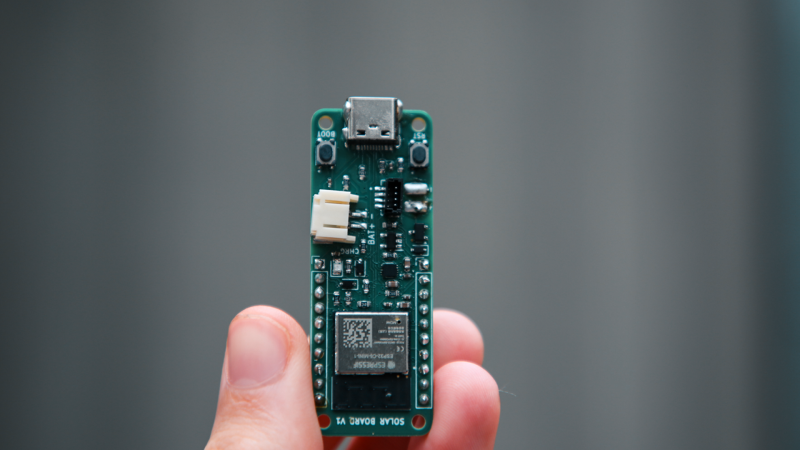
There are a lot of ESP32-based development boards out there– and why not? It’s a versatile chip that can be used in all sorts of situations, and people want boards to match them. Not finding one to his liking that was specifically built for solar powered IoT projects, [Narrow Studios] rolled his own. Well, designed it; like most these days, he’s outsourced the manufacturing to PCBWay, which is where you’ll need to go if you want one.
Why might you want one? Well, if you have similar goals in mind to [Narrow Studios]. He’s put an ESP32-C6 Mini on the board, which means it’s got most of the IoT communications protocols you might be interested in — bluetooth, wifi, Matter, Thread, and Zigbee, too. Ten 10 IO pins have been broken out, plus I2C on a QWIIC connector, which gets you a whole ecosystem of sensors to easily plug into. The “solar” part is justified by the inclusion of a BQ25186 linear battery charging IC from Texas Instruments, with the designated solar power input protected against reverse voltage in case you– like this author– have let magic smoke out by hooking things up backwards. Is it embarrassing? Yes. Does it happen? Also yes, so putting protection on the board is a nice feature. [Narrow Studios] released a video that we’ve embedded below discussing his design choices and demonstrating the device, but the project page can give you the gist.
Of course there’ve been plenty of solar-powered projects to feature the ESP32 here before– you can even use it for maximum power point tracking— but this dev board might be exactly what someone is looking for to build their next IoT project, so we’re thankful to [Narrow Studios] for the tip.











That’s a pretty good project, and I’m impressed by the overall build and quality given that he is a relatively young maker. Good job.
Like most things in life, we tend to learn through experience, so I would like to add a few points of advice that I’ve discovered through my own trials and errors. The ESP modules have a keepout area that should extend from the edge of the metal can (there’s a silkscreen line on the underside) to 15mm around the rest of the PCB antenna. The pins in the module part of the board surely have traces that also overlap that keepout area. It doesn’t look too bad, but that’s what’s in the datasheet/tech ref manual. I guess the antenna is being attenuated by some small %.
Secondly, that pin layout looks good on a breadboard, and maybe it was designed with some specific enclosure in mind, but if attached via pin sockets, I can imagine anything connected to that end of the board could leverage the pins right out of the sockets like a see-saw. The screw holes would solve this issue if using standoffs to help prevent movement, but the module side also has the screw holes in the keepout area, so nylon screws would be better for that side.
Some thinner solder would also help make soldering easier. Its possible to use thick solder to do fine soldering, but it’s easier to do fine soldering with thinner solder for sure. If you’re not trying to make things more challenging for yourself, why not try to make them easier? if cost is the issue, I understand completely and if you come across a few extra bucks, give it a thought.
That’s all I’ve got. Great job on the dev module. That’s a big step for any maker.
oops.. “that end of the board” was supposed to be a reference to the USB connector end. I could have transitioned to my first point about the keepout area a little more smoothly too.
Anyone know a cheap hack to run esp8266 on ONLY solar (no battery)?
The brown out causes it not to boot.
This never happened with msp430 chips. But i want wifi now. I don’t want to mess with batteries outside.
You’ll need a large supply capacitor for ESP8266, as they are very bursty – have a look at the esp-01 programmer board/adapter: they have a 1000uF cap for this reason.
If the brownout is stopping boot, rather than causing a reset, you could hold the esp in reset until the rail reaches an appropriate level. This can be done with a microcontroller monitor IC, or a comparator and voltage reference.
while acknowledging you don’t want to mess with batteries, I just note they make all-in-one USB-out solar panels for outdoors with integrated battery for ~$35. I get them for free from work; even the cheapest ones power my outdoor ESP32C3/C6 boards through a week of thunderstorms/snow without issue (and some are now pretty scratched up from years of animals clawing and tree pieces falling, but is still far more than enough power generation/storage for puny ESP32s).
link?
i googled ‘solar battery usb’ and found a bunch, or at least one product spread across a bunch of vendors
looks like a very good project and the https://www.ti.com/product/BQ25186 chip does look interesting..
Pity HaD doesn’t have a proper discussion forum, as then 1) things like this wouldn’t be lost over time, 2) we could have a proper chat about the project, and 3) we could organise around geographical location to get things like this made in ”bulk”..
+1 for having a proper old-school forum. That could be so nice for project discussions, reference/best practice designs etc.
Agreed, sort of.
We used to have one, and it just kinda languished and we pulled the plug.
This kind of project-specific discussion was also the idea with the chat and stack over at Hackaday.io, but then that only works “right” for projects hosted over there.
I think a lot of folks end up discussing on social media platforms as well, but that goes dark as far as searchability and archiving.
For projects that get a daily post, the comments work ok-ish. They’re always going to be here, and it’s open, which is a plus. But the format isn’t super conducive to long back-and-forth.
not really – and you wouldn’t need that many people to make it work (spam would be the bigger issues…)
It’s also hard to find old projects on HaD, or ones ranked on how popular they are (ie comment count) – or indeed find any of your own comments to see if anyone has replied to them…
Be aware that the BQ25186 has a watchdog which has to be petted regularly via i2c, otherwise it reverts to default values. This is especially relevant when putting the MCU to deep sleep.
So either you regularly pet this (there are more) watchdog or you simply disable it.
The best part of this is the BQ25186 chip, unlike the crappy Chinese fixed-output-voltage charging solutions used by every other solar ESP32 board I’ve ever seen, this allows the host CPU to change termination voltage. That said, I don’t like having that be software controllable vs. having it set with resistors.
If you have reasonably sized solar, you do not need huge amounts of runtime. What you DO need is good calendar lifetime for your project, and this requires terminating charge early (at 4.0-4.1v instead of 4.2v), which sacrifices runtime for calendar life of the battery.
i still don’t understand qwiicc connectors (which, like diahreahahah, i have to look up every time before attempting to spell). four conductors do not require such a subminiature connection, which limits available power in addition to making it unnecessarily difficult to manually install or repair. far more useful than qwiicc would be a compact grid of pins with 2.54mm spacing with the I2C pins all hooked up in parallel, allowing the easy installation of multiple (say, four to six) I2C devices using ubiquitous (if a bit flakey) DuPont connectors.
Board should have same pin-outs as AdaFruit Feather standard, it would open to more boards that support same pins!!!!