
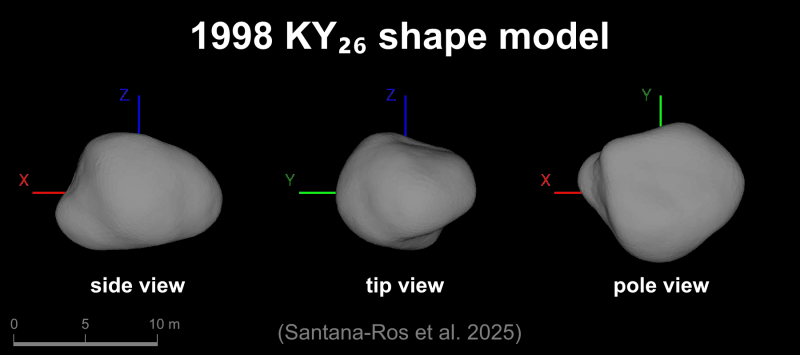
Launched in 2014, Japan’s Hayabusa2 spacecraft completed its primary asteroid sample return mission all the way back in 2020. But with the main spacecraft still healthy, the intrepid little probe was assigned new missions — such as its future investigation of asteroid 1998 KY26, a rather unassuming 11 meter diameter rock.
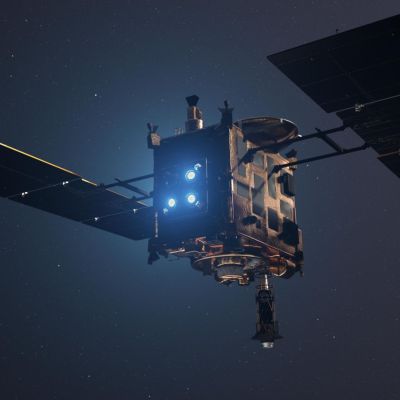
Earlier this month Hayabusa2 flew by the 450 meter 98943 Torifune at a distance of 800 meters, close enough to get an up-close look of its surface of mostly silicate minerals. With the spacecraft flying past at around 5 km/s, this posed some challenges with tracking, especially since its systems and instruments were not designed for high-speed tracking.
With that mission now complete, 1998 KY26 – first discovered in 1998 – is next on the menu, though this will have to wait a while. Currently it’s estimated that the two will not meet until July 2031.
Once they do meet up, after Hayabusa2 zips twice more past Earth, it’ll be another major challenge for the by now rather degraded spacecraft. Its sensors have suffered radiation and other types of damage, while its ion engines are quite depleted. The goal at this target asteroid is to enter orbit, deploy its last target marker and projectile, before attempting a landing, probably at one of its poles.
As likely the final mission for this spacecraft it’ll be very educational in many ways, not the least of which is that of planetary defense, but also that of deepening our understanding of these asteroids and the many varieties that we share space with.











I’m sorry, orbit? Of an 11m asteroid? I wasn’t aware such a task was feasible. Amazing if so.
There was another landing on a comet back then.
https://simple.wikipedia.org/wiki/Philae_(spacecraft)
My guess would be it’s more of a co-orbiting situation. It could match orbits with the asteroid but have a slightly different eccentricity that takes it around the target, couldn’t it?
The Hayabusa2 should be making the (unheard) sound of a Hayabusa engine as it tootles through the universe.
(Okay, maybe have the sound played only if the ambient light levels suggest that it has been taken onboard some spacecraft.)
Yes, but someone has to paint a Suzuki bike on the asteroid, otherwise it won’t try to reach it to overtake it.
It’s hard to take seriously the idea of “orbiting” an object when its escape velocity is less than 5 millimeters per second!
But that means your 1-week orbit can be just 100 meters away.
I wonder how it holds itself together: its rotation period of 5.35 minutes means most of its surface is going faster than escape velocity. There can’t be any gravel on its surface: It has to be a solid chunk of rock.
It wouldn’t really be a case of land, I guess it’s more of a hold on tight situation, without a precise landing, it could cause rotational instability. The last thing they want is a tennis racket like inversion.
Who knows what they’ll find though, from the futures perspective, baby steps to strange new worlds, even if it seems big today.
There’s that thought of someone looking back trying to imagine what it must have been like to see certain things for the first time.
I just keep thinking womp-rats. I know, I know, it’s 11 meters, not two … maybe it’s a cross between Spinal Tap and womp-rats? A womp-rat that goes to 11?