Hayabusa2’s Next Target Is A Tiny 11 Meter Asteroid

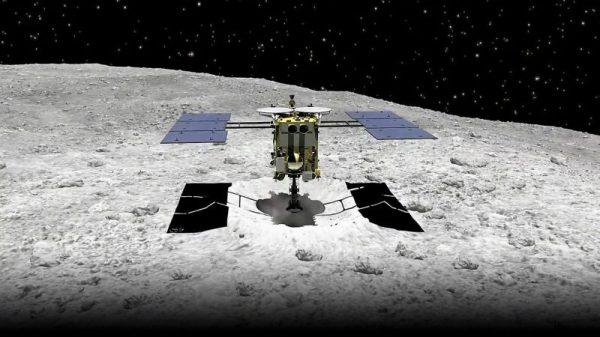
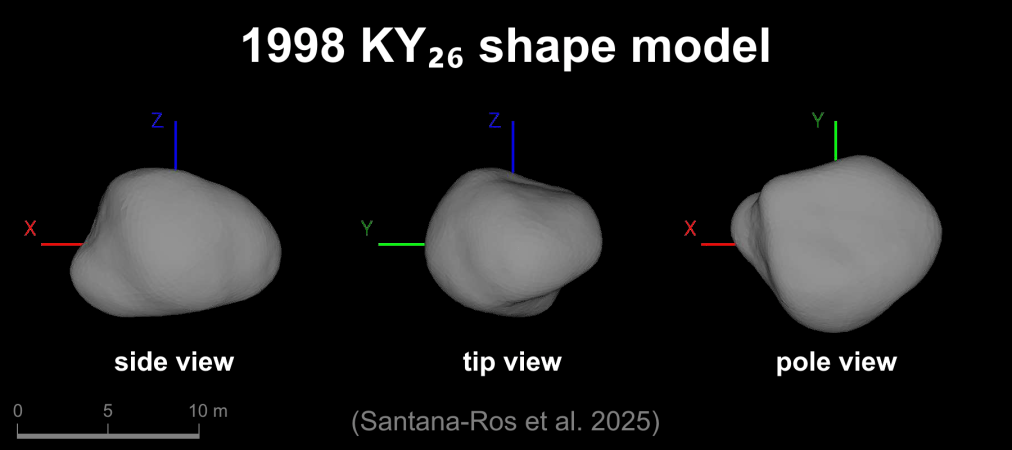
Launched in 2014, Japan’s Hayabusa2 spacecraft completed its primary asteroid sample return mission all the way back in 2020. But with the main spacecraft still healthy, the intrepid little probe was assigned new missions — such as its future investigation of asteroid 1998 KY26, a rather unassuming 11 meter diameter rock.
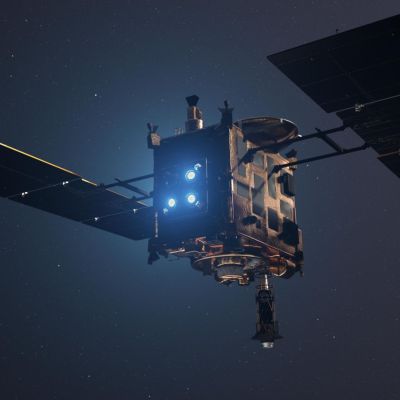
Artist impression of Hayabusa2 firing its ion thrusters. (Credit: DLR, Wikimedia)

Earlier this month Hayabusa2 flew by the 450 meter 98943 Torifune at a distance of 800 meters, close enough to get an up-close look of its surface of mostly silicate minerals. With the spacecraft flying past at around 5 km/s, this posed some challenges with tracking, especially since its systems and instruments were not designed for high-speed tracking.

With that mission now complete, 1998 KY26 – first discovered in 1998 – is next on the menu, though this will have to wait a while. Currently it’s estimated that the two will not meet until July 2031.

Once they do meet up, after Hayabusa2 zips twice more past Earth, it’ll be another major challenge for the by now rather degraded spacecraft. Its sensors have suffered radiation and other types of damage, while its ion engines are quite depleted. The goal at this target asteroid is to enter orbit, deploy its last target marker and projectile, before attempting a landing, probably at one of its poles.

As likely the final mission for this spacecraft it’ll be very educational in many ways, not the least of which is that of planetary defense, but also that of deepening our understanding of these asteroids and the many varieties that we share space with.
Life Found On Ryugu Asteroid Sample, But It Looks Very Familiar

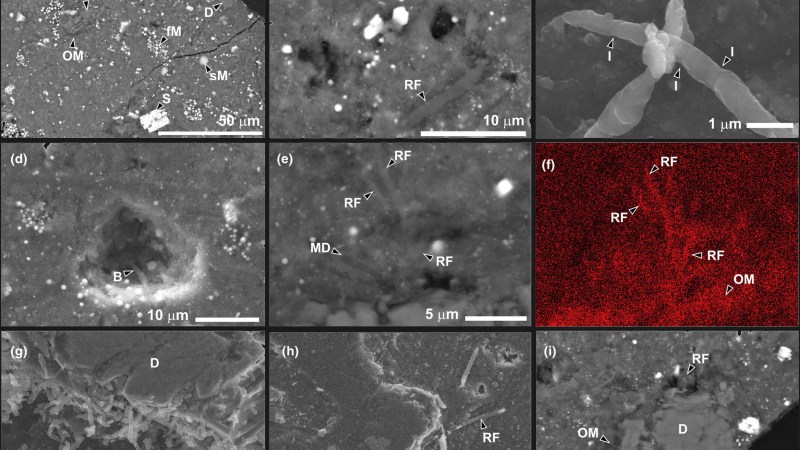
Samples taken from the space-returned piece of asteroid Ryugu were collected and prepared under strict anti-contamination controls. Inside the cleanest of clean rooms, a tiny particle was collected from the returned sample with sterilized tools in a nitrogen atmosphere and stored in airtight containers before being embedded in an epoxy block for scanning electron microscopy.

It’s hard to imagine what more one could do, but despite all the precautions taken, the samples were rapidly colonized by terrestrial microorganisms. Only the upper few microns of the sample surface, but it happened. That’s what the images above show.

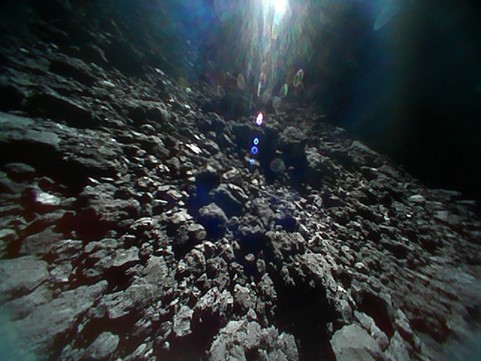
The surface of Ryugu from Rover 1B’s camera. Source: JAXA

Obtaining a sample from asteroid Ryugu was a triumph. Could this organic matter have come from the asteroid itself? In a word, no. Researchers have concluded the microorganisms are almost certainly terrestrial bacteria that contaminated the sample during collection, despite the precautions taken.

You can read the study to get all the details, but it seems that microorganisms — our world’s greatest colonizers — can circumvent contamination controls. No surprise, in a way. Every corner of our world is absolutely awash in microbial life. Opening samples on Earth comes with challenges.

As for off-Earth, robots may be doing the exploration but despite NASA assembling landers in clean room environments we may have already inadvertently exported terrestrial microbes to the Moon, and Mars. The search for life to which we are not related is one of science and humanity’s greatest quests, but it seems life found on a space-returned samples will end up looking awfully familiar until we step up our game.

The Science Of Landing On An Asteroid

Exploiting the resources of the rock-strewn expanse of space between Mars and the outer planets has been the stuff of science fiction for ages. There’s gold in them ‘thar space rocks, or diamonds, or platinum, or something that makes them attractive targets for capitalists and scientists alike. But before actually extracting the riches of the asteroid belt, stuck here as we are at the bottom of a very deep gravity well that’s very expensive to climb out of, we have to answer a few questions. Like, how does one rendezvous with an asteroid? What’s involved with maneuvering near a comparatively tiny celestial body? And most importantly, how exactly does one land on an asteroid and do any useful work?

Back in June, a spacecraft launched by the Japanese Aerospace Exploration Agency (JAXA) finally caught up to an asteroid named Ryugu after having chased it for the better part of four years. The Hayabusa2 was equipped to answer all those questions and more, and as it settled in close to the asteroid with a small fleet of robotic rovers on board, it was about to make history. Here’s how they managed to not only land on an asteroid, but how the rovers move around on the surface, and how they’ll return samples of the asteroid to Earth for study.

Continue reading “The Science Of Landing On An Asteroid”