
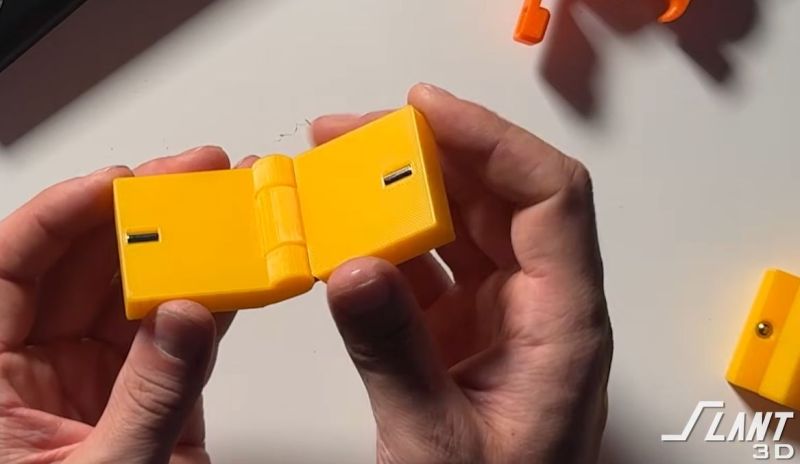
Magnets are awesome, so it’s no wonder we love to add them to our 3D prints. Doing so in a way that will actually last is harder, with thermal creep being one reason a simple friction fit will loosen over time, and using super glue to hold a magnet in place can be messy. In a recent video, [Slant 3D] covers seven ways to install magnets in 3D prints without resorting to glue, along with the advantages and disadvantages of each.
With friction, the argument is that you can still use them, but you’d want to use something like cylindrical magnets rather than flat magnets to increase the friction with the thermoplastic. Using an arbor press rather than human primate hand power is also beneficial.
Rather than installing magnets halfway through a print with all the logistics that entails, you can use side slots to install said magnet into, which is much easier, but as with all embedded magnets, you get that plastic barrier between the magnet and its target.
Other methods involve using a bit of extra material that you need to push the magnet past, using something like an arbor press, so the magnets should never just fall out. A wildcard here: spherical magnets, which can be locked in using a similar method, while automatically orienting themselves to an opposing magnet.
The final tip is to never use two magnets in a magnetic lock. Instead, use a cheaper ball bearing or a similar plain metal part on one side instead. Magnets tend to be much more brittle than whatever stainless steel ball bearing or washer you can use on the other side.
Of course, people will always try to install magnets during an FDM print, but before they try to do that anyway, they really should learn about the fascinating ways in which magnets can ruin print beds, destroy nozzles, and otherwise make a total mess of a print. Magnets seem magical. Maybe they are.












Lol Slant3D. If he’s not re-inventing the dowel, he’s posting some other idiotic rage-bait.
According to the first 22 seconds of that highly informational video, the number one issue with magnets is that one needs glue to glue them in, followed by them not having “the right experience” and the magnets adding “so much extra effort and cost”.
Obviously those issues are solved by an arbor press.
This isn’t unique to Slant 3D, but a wider issue with the content on Youtube. Tutorials with missing steps, projects builds which start with cutting up parts while forgetting to mention what they are building, because A then B without a causal relationship, out of order steps, etc. I’m aware not everyone is able to find the issues in a script, but often you feel it when things aren’t right.
You’ve picked a few fine examples. Where I wouldn’t even know what an experienced magnet is. To me, he is mostly a sales person for his services, attempting to convince you his way is best. He does so by choosing words which help selling there is a ‘wrong’ way, versus what he likes best.
When I structure a story with many examples, I start by laying out the examples and demonstrating what are the negative and positives of each. As there is no one size fits all in engineering. I’m not there to sell stuff, I just want to help other engineers experiment and decide for themselves. There is a use case for each of the magnet examples.
As for magnets, ‘metal on metal contact’ with a clear snap puts more strain on the magnets than you may like, reducing the longevity. Several of his engineering examples don’t sit flush. And yes, industry can sell you metal dowel pins in any size you need, and they are quite cheap.
Magnets! How do they work?
Maybe I missed it, I was watching at high speed… But if I caught this right, cylinders and spheres both can be pressed in well. And spherical magnets cost more. But cylindrical ones you have to make sure to align north to south (with two magnets).
Ok.
Why not mix and match?
Use a cylindrical magnet on one side with a ball bearing on the other?
You get the easy, press fit construction.
You only buy one, less expensive cylindrical magnet.
And you don’t have to worry about lining up the poles right.
i’ve always inserted magnets after the fact and never had any trouble securing them…it really just takes wanting to solve the problem and then it’s solved.
I’ve found E6000 is perfect for gluing magnets assuming you’re not trying to pick up heavy things.
Yes I realize the entire thread is about not gluing magnets but maybe he’s just using the wrong glue :-)
Sure, inserting magnets in your home projects is no big deal, but remember that Slant3D’s main target is people using their print farm to produce large batches or on-demand print-and-ship. Minimizing the post-processing is a huge win for that market.
Of course, you may question whether that market is viable in the long term, and whether the solutions presented are the best choices. That’s a different question.
So in summary, glue is a fantastic solution, just be slightly careful.
Metal + one large magnet takes up more room and is less cost effective than just using two magnets that are half as strong.
If using the “cylindrical retention clips” at 5:30, do not purchase magnets with an “axial” magnetization orientation. Instead purchase magnets with a “diametric” orientation. They will hold stronger and self-orient every time. Other than aesthetics, there is ZERO reason for spherical magnets. It is a more expensive and weaker option with no upside.
“premium”, it’s 3d printed mate…
I always cover a magnet with a piece of electrical tape to protect it. Also works with fridge magnets to prevent them scratching the door.