
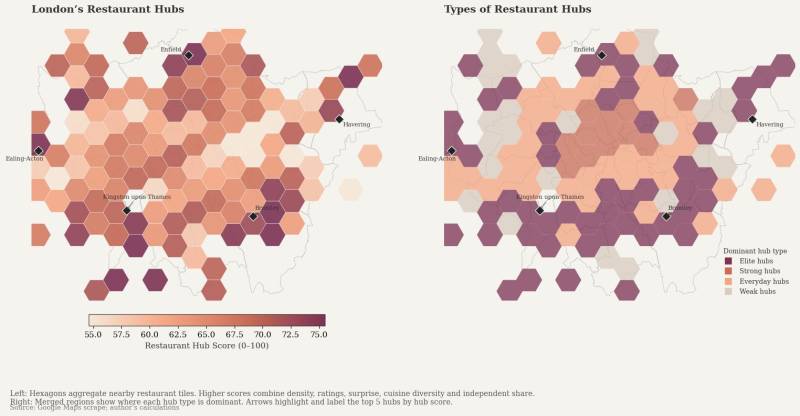
We all know that Google and other big players pick and choose what information people see, but we sometimes overlook it outside of the search and social media space. [Lauren Leek] decided to take a look at how Google Maps picks winners and losers in the restaurant scene in London.
Building a machine learning model to determine a new restaurant recommendation (as one does), [Leek] uncovered interesting, and perhaps concerning, elements of how Google Maps ranks restaurants. Broken down by relevance, proximity, and prominence, many new restaurants face the issue of not drawing traffic without reviews and vice-versa causing a vicious cycle. Relevance and proximity are fairly straightforward, but what goes into “prominence?”
[Leek] found that “it is not just what people think of a place – it is how often people interact with it, talk about it, and already recognise it.” This leads to chains and high foot traffic areas awash in reviews while more out-of-the-way places find it more difficult to draw traffic. Some of this is expected and would be happening even when word of mouth was the primary way to find out where to eat, but as with many things, the algorithm amplifies this, along with the undisclosed paid placement of restaurants in Maps results.
While still in its infancy, [Leek] built a public dashboard where people can sort restaurants in the city. The machine learning algorithm is designed to identify places that are hidden gems that punch above their Google Maps weight and may make you look like the trendy one (if you live in London).
Zooming out further, [Leek] found larger clusters that revealed restaurant “diversity, in other words, is not just about taste. It is about where families settled, which high streets remained affordable long enough for a second generation to open businesses, and which parts of the city experienced displacement before culinary ecosystems could mature.”
If you want to step outside the algorithm mayhem, how about a good old-fashioned Web Ring? We’ve also addressed what’s an AI versus an algorithm, and Cory Doctorow advised us on how to reverse course on the current wave of enshittification.












Great project! Looks like you can experiment with the code yourself to map your own favorite city
https://github.com/laurencleek/open_food_map
Google Maps / restaurant review system isn’t, and never was about the best food or restaurants.
It is however about the network effects created by crowds.
I think the author makes some assumptions that it’s wrong to do so, it then assumes independent restaurants are better than chains, and deserve more traffic. That communities of restaurants deserve more/less traffic etc.
What it doesn’t address is who the audience is. If Google Maps brought each restaurant exactly the right amount of traffic it would serve the restaurants interest, but would it serve the general public? Would it serve the foodies? Etc.
It assumes there is a single audience with a single purpose.
I can think of an audience with a single taste…”B-brainsss”
Populist consumers?
The audience/product is us.
The customers are businesses willing to pay for our attention.
What is confusing?
Literally every single time Google has been called out for manipulating any result to it’s own (ad) advantage, evidence comes out to prove it true.
At this point it isn’t safe to give them the benefit of the doubt.
They are twisting and manipulating any and all results for the purpose of maximizing ad-revenue until proven otherwise by reliable 3rd parties.
You can trust when Maps tells you to turn left to get to your destination, because to that data is the hook that keeps users locked in.
Any other qualitative data about a location is just there to manipulate you and needs to be ignored.
This is why digital services that curate knowledge can be inferior to actual human intelligence. Google tells locals to eat at one spot which has high sales but low quality, and wont even show you a lesser known foodcart with authentic cuisine owned by locals.
Yelp reviews.
I give 1 star to the restaurants for adding automatic gratuity to checks.
And to fast food chains, like Starbucks, for asking to select tips BEFORE they provide service.
for restaurants, i live near downtown and foot traffic really defines my experience. if i see a new restaurant when passing by, i aim to check it out! so i don’t suffer from google maps that way, thankfully.
but generally, google maps has really gone downhill lately. i remember when it was new, sometimes it would act like it forgot where i was and a search for a local pizza restaurant would instead return a more popular one with a similar name that is thousands of miles away. some time around 2015, they mostly fixed that and i came to take it for granted. but in the last couple years, it has gone to a different kind of garbage.
for example, today i was looking for “first christian”, because even though i go by it every day, i have a hard time keeping track of all of the names of churches. but it gave me a few local results that had different names, followed by a 30-miles-distant result that had the same name. but none of the pinpointed results displayed on the map were the actual church, even though the actual one was an exact string match and very close.
i’m not sure what google is smoking…i assume they’re fighting some sort of arms race with AI SEO and they’re breaking everything as a side effect. but that was not a hard search, and yet it failed completely.
I’ve got this exact anecdote: I stayed in a hotel in an unfamiliar city and after a poor night of sleep, woke up needing coffee with no processing power. I opened up maps and typed coffee and one result came up: A chain I personally don’t like because of the temperature they serve drinks at (scalding lava hot). I looked all around and zoomed in and out on the neighborhood before giving up and asking for them to put ice in my coffee. TWO BLOCKS down the road was an independent coffee shop which was open. It only showed up when I zoomed down to the closest level and it had plenty of 4 and 5 star reviews. The difference is the chain pays for placement. Dang was I mad while I drove by sipping my terrible coffee.