
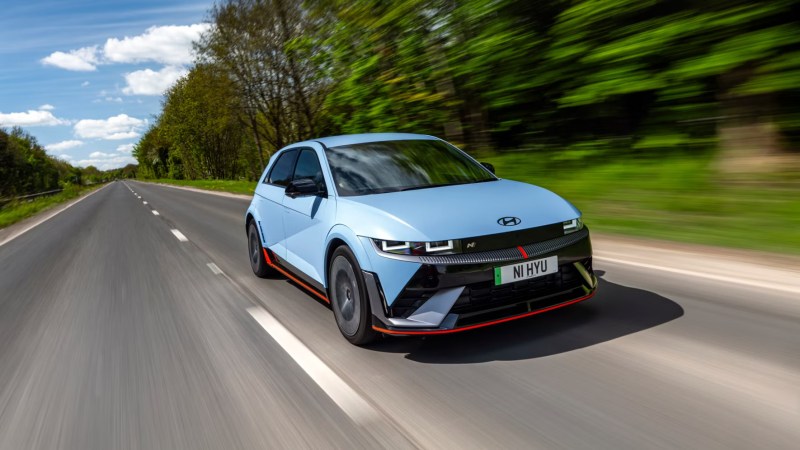
EVs are less mechanically complicated than their combustion kin, but that doesn’t mean they’re immune to component failure. The Integrated Charge Control Unit (ICCU) has been the main failure point in recent Hyundai/Kia EVs, and ICCU Observer is an attempt to log data from the systems to find the culprit.
The ICCU handles all charging and voltage conversion duties from 800 V down to 12 V in the E-GMP platform EVs from Hyundai, Kia, and Genesis. The main failure mode appears to be when the circuit charging the 12 V fails, eventually rendering the vehicle inoperable. While the rate of failure is relatively low, the exact numbers are unknown, and Hyundai has remained quiet on if they know what’s causing it.
Unsurprisingly, speculation is rampant with owners experiencing failures relaying similarities and differences to others with the same problem. In an effort to bring actual data to the process, [broadwall] has started working on an open data set of information collected over the vehicle’s OBD II port in an effort to pinpoint similarities between the vehicles that have experienced failures.
Hyundai is currently replacing the failed units under warranty, which have been recently expanded to 15 years in most markets, but that’s little comfort when you’re sitting on the side of the road waiting for a tow. These failures stand out in an otherwise easy to maintain platform, so hopefully this effort will lead to a permanent fix instead of merely swapping out for a new unit.
If you’d like to explore data analysis a little further, how about using astrophotography to detect exoplanets or learning more from Stanford?












Less mechanically complicated, that is true, no doubt.
The real problem is in the added electronics, which is way more complicated and will most likely be the reason that in about 100 years there will be no electric cars of this era in a drivable state in a museum, while the by the same time a 200 year old mechanical car will be perfectly fine and running. Just like there are already EV’s of a 100 years old in a museum right now, that because they have no electronics and require very simple tools to keep them running and even without mechanical drawings a good mechanic can figure out what’s wrong just by looking at it and some trial and error.
It’s not that electronics are bad in general, their only real problem is that they evolve too quickly to find a replacement part in the long run, sure there might be an equivalent for some of the parts, but not for all of of the parts. Although I’m sure there will be workarounds if you really want to, but although it may work, it won’t be the same. Just as the same discussion the retro scene is having when an FPGA replaces complicated logic circuitry. Then there is firmware… and the tools required to maintain/modify the firmware. Even today it’s difficult to keep a 10 year old development system running with all the cloud requirements and forced system requirements.
It’s the price we pay for progress in the same way that in about a 100 years we will be finding an ancient 300 year old perfectly working broom, but not a merely 50 year old working Roomba.
Car manufacturers, and home appliance manufacturers, have always faced the same problem: it’s possible to make a thing that is easy to repair and works essentially forever, but you can only sell it once.
Back in the day when cars were made poorly, had no rust protection, engines needed rebuilding every 5000 miles, the industry could survive by making the same car year after year, just replacing what was worn down. The industry was booming because the average car would only survive for 5-10 years of use.
Then consumers started demanding quality engineering and galvanized steel to avoid the hassle of constantly breaking down on the road, and the lifespan of vehicles increased dramatically. By the 80’s you had cars that could be driven a million miles on the original engine – but if you can only sell one customer one car every 25 years, you’re not doing much business.
That is why the industry adopted the yearly revision, where they “update” the model every year and chance some parts so they can retire the previous models and end support sooner. This keeps the 3rd party parts and services industry down as well, by forcing them to target many different models, each limited in their numbers so they can’t leverage economies of scale. Add some clever quality engineering to make parts with similar failure curves and you get cars that work trouble-free for a good while and then suddenly start to fall apart, one part breaking right after another just as you get the last fault fixed.
This has brought the average age when a car gets scrapped to just 14 years, but that’s not enough. The industry wants it back down to 5-10 years so they can keep a steady revenue stream with lower long term risks. They want the primary car buyers – the 20% of people who can afford new cars – to cycle through them faster, which means they have to make the old cars lose value faster as they age.
How do you do that? Simple: you put batteries and software in the car, and you add regulations like emissions zoning to kill off the still surviving older vehicles. Software becomes obsolete in no time with changing standards and requirements, and batteries have a limited shelf life no matter how well you keep them. The promise of mechanical simplicity and maintenance-free operation was a trap to get you to accept these dependencies, and the tool to force it down your throat is the lobbying for “environmental” policies that finally exclude any other alternative.
A throwaway car that few people can afford to own is not sustainable for the business either, but the industry can still force profits for now. It’ll be like this for another 5-10 years until people really start to complain, and then everybody will just make a heel-turn.
“Add some clever quality engineering to make parts with similar failure curves and you get cars that work trouble-free for a good while and then suddenly start to fall apart, one part breaking right after another just as you get the last fault fixed.”
It is the old story of the One Hoss Shay but the modern logic is that if a part lasts significantly longer than the rest of the vehicle then you’ve paid too much for it. A 500,000 mile engine is no good if married to a 100,000 mile frame. It is quality engineering, but driven by accounting.
That principle dates as far back as Henry Ford. Difference being, his target was making a car that his own workers could afford by cutting cost at every opportunity.
The modern approach is “adding value” by selling more features to compensate for the planned obsolescence, because the target buyer is richer than average. They know they’re getting a bad product, but since they’re swapping cars every 3-5 years it doesn’t matter. The fact that the car’s OS stops getting updates after 5 years and no longer connects to your favorite online platforms is going to be someone else’s problem.
There’s another point here; every car will have some parts that are consumable. Brake pads for example. For any consumable or easily replaceable part, quality engineering it to last a certain time shouldn’t matter, because you’d simply replace it whenever. If your headlight bulb goes out, you just put a new one in.
The point of “maintenance free” is to replace these parts with planned obsolescence: parts that last a lot longer, but when they fail they cannot be fixed. This creates the illusion of quality – you’re not fixing the car all the time, so it must be better – but it’s actually a ticking time bomb.
For example, laser headlights instead of standard halogen: 20 years down the road, where do you find this special non-standard part that is very expensive and hasn’t been made in the last 15 years? Your only source is cannibalizing other cars of the same model, which quickly whittles the supply down to nothing and rapidly reduces the number of such cars that can pass MOT inspection, because it’s often down to that one unobtainable part that everyone’s missing.
This is why you buy the most popular vehicle/platform. The parts stay cheap and available forever, and in addition the third party support sticks around because the market’s huge.
Car manufacturers rely on people wanting to stand out and not feel common and out of date. And this isn’t hyperbole, it’s flat out stated back when they started introducing colors other than black.
Fortunately I have. Unfortunately the mainstream market has shifted to selling all hybrids, and has been for a while, so the supply of cheap gasoline manual vehicles on the second hand market is now beginning to dwindle.
The problem? Hybrids have lithium batteries, and those are a ticking time bomb. For example, the lowest price I found for swapping a Toyota hybrid battery was €1000 but that’s just swapping in a salvaged 2015 battery which is 11 years old already. The general price range for a hybrid main battery swap that I can get is in the €4000-5000 and above, and that makes no sense when the car itself is only worth as much when it’s that old.
The cost of a “cheap second hand car” is creeping up towards €10k because of the unavoidable battery maintenance debt. If you’re going to be paying that money anyways, you’re better off spending it on a younger vehicle that still has years left on the battery and leave the 10+ year old EV/hybrids to the scrap yard.
Of course, to look on the bright side, this situation does have its benefits.
The green left has been arguing for decades that cars and driving should be taxed much more to reflect its environmental and social costs. When car ownership is reduced, we get less congestion and lower infrastructure costs, better air quality and fewer accidents, as well as renewed interest in politics by voters interested in expanding public transportation and other social programs that can be funded by the money we would save.
Reduced private car ownership also has a positive impact on property values and rents in urban areas because people will want to live closer to jobs and services. Business also benefits from more a concentrated supply of people, because it increases the demand for goods and services and reduces labor costs through competition, making greater revenue and profits.
There’s benefits for both people and business, so maybe owning a car and driving should not be cheap. Why should some poor fellow waste their money on a car when we would be so much better off if everyone took the bus instead?
The rust protection on 50s cars was the thickness of the metal. No paint – no problem.
Counterpoint: as EV parts become more popular the methods to repair and replace with equivalent parts will flourish.
In one respect EVs are more agnostic about parts, usually just requiring Voltage, Amperage and some CANBus or replacement control board to tell it to go.
^ this, all modern cars regardless of power source have a very similar level of complexity as everyone wants the same set of features / gimmicks in their car.
The actual EV drivetrain is way simpler than an ICE one – if you’ve seen how much electronics and plumbing it takes to make a modern ICE engine & transmission work and EV version is way simpler, and as you say the core of it is agnostic to the parts used – batteries, motors, and electronics do not need to be closely matched in the same way an ICE system requires.
In addition, no-one can point to the boogeyman of illegal emissions to stop people tinkering with an EV – if you hack it and tune it or modify it the emissions remain at zero no matter what you do, I predict the right-to-repair crowd will gain leverage as adoption increases and people seek to repair and upgrade their EVs.
In my Kia e-nero (‘21) I carry a lead-acid jump starter because the car occasionally lets the 12v battery go flat, seems to be a known problem if you look at various internet forums. You arrive to a completely lifeless dead car, but open driver’s door with a key and open the bonnet/hood and can then jump start the 12v battery. I don’t know why, but once I found the interior light on once I’d got it going again, but unable to reproduce by deliberately leaving it on.
Modern Lithium jump starters won’t do it, they do too much sensing before applying full 12v/max current and the car and battery sit there both turning on and off repeatedly, but the dumb lead-acid charger just applies 12v/full current and everyone is happy, car starts again after a bit of 12v battery charging.
I now have a USB cig lighter plug that displays the voltage, but I haven’t caught it yet not charging the 12v battery.
It’s still under warranty, KIA should fix it. If not, and you like to improvise, you could connect a small solar panel to the 12 V battery permanently, just to keep trickle charging it. You could even leave the panel inside your car, under the front windshield.
Most EV/Hybrids have very fussy battery management systems. Additionally, as of 2018 many manufacturers added a security layer to standard OBDII ports. Essentially, even with OBDII access the model specific error codes from CANt bus will direct the driver to take the vehicle to the dealership just in case something may be wrong with the battery. Most of the time a Dealership scan is the most expensive way to learn the battery coolant reservoir was a little low or the fan intake was clogged, tripped a permanent over-temperature alarm, and stranded a sucker in limp mode. Note too, that if you drive on a really rough road, it can also trip rough idle sensor alarm DTC on some hybrids. You can’t make this BS up if you tried.
Modern EVs pull a very old illegal scam called service Tying, and hide behind software terminology to make it sound more complicated. As a independent mechanic or vehicle owner you often no longer have a choice where to get equipment repaired/unlocked.
EV should last 99 years if built properly, but current EVs are their battery. You chuck the car when the battery wears out, as it is often too expensive to repair locked nonstandard proprietary power-packs.
You can read/clear DTC basic errors with a cheap “VGATE vLinker MC+ OBDII” tool for most cars, and “Car Scanner ELM OBD2” app for iOS/Android. BCAA insurance along with an accessory battery booster is recommended for driving an EV.
Best of luck
Thank you for clarifying. Wow, I had no idea things are that bad.
I’ve got a ’20 eNiro and I’ve had the 12V battery run down just by leaving the doors open. I charged the battery and it had a capacity of 12Ah. Idle load when you unlock the car is about 15A. So no surprise there. Basically, Kia fit crap 12V batteries. I’ve replaced it with a decent one and had no trouble since.
I bought a cheap Lithium jump starter and it works fine to start the Kia. You need one with an override button so that it skips sensing and just switches on.
Don’t keep your jump starter in the boot! If the 12V battery is dead you can’t open it.
There would be a very easy fix for modern vehicles (and many more products) becoming a very expensive paperweight over time:
Legislation that once a manufacturer ends service for a vehicle, they have to put all design documents and software (source code) into the public domain.
With that kind of information available you could keep the vehicle going for as long as its combusting ancestors.
I sometimes wonder about the psychology of people who report-bomb these comment sections. What do they gain from the trouble?
They’re so distressed that their Pollyanna world would come down by people having “wrong opinions”, that they have to try and cancel it. Not just put fingers in their own ears and go “la la”, but in everyone else’s as well.
Before anyone hyperventilates about EVs being unreliable and “computers” and how they want crank windows and carb’d engines etc….the ICCU failure issue affects around 1% or less of vehicles.
It’s one of the most popular EVs sold in the US which is why it seems “so bad.” 99.99% of Ioniq owners aren’t on web forums. If the problem were as prevalent as people claim, dealership lots
Meanwhile GM and Ford are recalling millions of ICE vehicles for fire hazards and Toyota is having to replace nearly every biturbo V6 they put into their trucks and SUVs because they weren’t manufactured correctly
I’m sure it’ll turn out to be nothing. These are all respectable companies and their EV offerings are top of the line, and they’re making good efforts to compensate the owners if anything ever goes wrong. These reported failures are so rare, I don’t know why they’re even making such a big deal of it – unless it’s someone trying to harm their reputation.
… you and I have extraordinarily different experiences with car manufacturers