
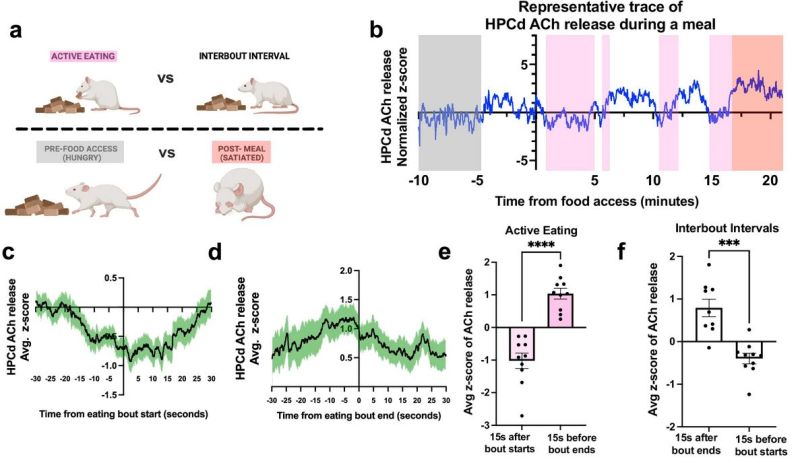
It’s been said for centuries that you cannot think on an empty stomach, and that love goes through the stomach. Although these may seem like merely cute jabs at the simplicity of human nature, recent research in rat models by [Logan Tierno Lauer] et al. indicates that the gut may be more influential in something as fundamental as memory formation and cognitive function than previously assumed.
Key to the gut-brain connection is the vagus nerve, an essential part of the autonomic nervous system that wires the brain into the body’s organs, including the gastrointestinal (GI) tract. It provides both sensory and motor fibers, so that the brain can literally sense the state of said GI tract, with various triggers as result. One of these is – as demonstrated in the paper – the release of acetylcholine (aCh) an important neurotransmitters in the CNS for cognitive functions including attention, memory and motivation.
Using in vivo fiber photometry it was found that during eating medial septum neurons released aCh, with various ways to impair this mechanism along the vagus nerve leading to this response disappearing. This also confirms earlier research that points the finger at a so-called early life Western Diet (WD) causing impaired memory and overall cognitive function, likely due this high fat and high sugar diet causing dysfunction in this aCh regulation mechanism.
Beyond once again reinforcing the need to eat healthily, this research also provides further insights in condition with declining cognitive function, such as Alzheimer’s and dementia.












as interesting as this is how is it a “hacK”?
There is a “hack,” but it’s of a more commercial nature than a lone maker.
A implanted device (like a pacemaker) called a vagus nerve stimulator can be used to treat both epilepsy and major depression. It provides a few microamps of current to an electrode wrapped around the vagus nerve in the left side of the neck.
They’re wonderful devices, my wife has one for depression and our nephew has one for epilepsy. They have been totally life-changing for both of them, as meds were just not working.
Hacking the human body. What could be more fun.
The website is called Hackaday. This is ambiguous as to what it actually implies. Is it a hack once a day being reported, or are we hacking some general day? I’d say it implies we get to read about a hack once a day.
This health related article is the supplemental article that hackers may find interesting, but it does not count towards your one hack per day. Enjoy!
Oh, you should give that “vagus nerve hacks”, “vagus nerve stimulation” topic a whiff.
For a while, it was the hot new alternative medicine thing particular people (for whom imo acknowledging that SARS-CoV2 sequelae were way worse than those influenza/HCoVs didn’t fit their world view).
While vagus nerve stimulation may help with some LC symptoms as that kernel of truth, it surely is not a cure.
(as for the link, see for example:
https://pmc.ncbi.nlm.nih.gov/articles/PMC10412500/ )
Better to have come across it here than to hear about how you can just magically massage away peripheral nerve damage and persistent inflammation first. Not that our fellow readers here may be the primary audience for such hopium, but there’s been so much of it around following the first couple of waves, circa 2020-2022.
So it’s not A hack, but def about one. Too meta? Idk.
Got incurable hiccups?
Do not go to the ER.
Why?
Doctor holds up a finger, you know where it’s going.
Because vagus nerve.
Or just fear, to cure hiccups.
Hackers like interesting science & engineering -today’s science tidbit is tomorrow’s “aha!” moment.
Does it really matter that much? I said it once and I’ll repeat: amazon.com is not in Brazil nor is it about a river but nobody complains.
My hack to improve acetylcholine would be the combination of Huperzine-A and Alpha-GPH. One helps produce the Acetylcholine while the other prolongs it. I could see this as a hack, as I have used it after my TIA. It’s a “bio hack”
I thought the vagus nerve what just the nerve that made you gamble.
When Elizabethans used rosemary, they experienced a tangible effect:
The Routine: Scholars wore rosemary garlands during exams, and people used it daily in hair washes and room sprays.
The Sensation: Breathing in the strong, sharp scent of rosemary causes a noticeable spike in mental clarity, alertness, and focus.
The Observation: They explicitly noted that when they smelled rosemary, they could recall facts faster and hold onto memories better.
What they recognized as a “magical” property of remembrance is exactly what modern science calls acetylcholinesterase inhibition.
“There’s rosemary, that’s for remembrance; pray, love, remember; and there is pansies, that’s for thoughts.”