
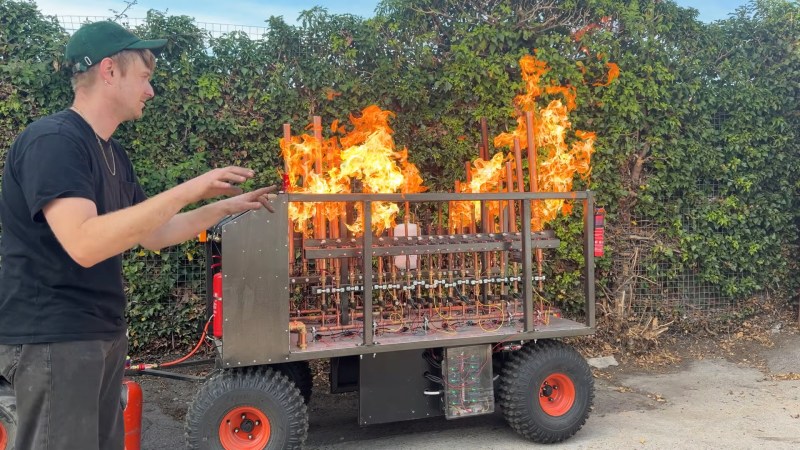
Most musical organs use air as their working fluid, but there’s nothing in the rule book that says they have to. Calliopes have used steam for 150 years now, while [Look Mum No Computer] has opted to go full pyromaniac and pump propane though the summer’s hottest new instrument.
Just like every steam or compressed-air organ we’ve heard, the tuning could use some work — though we have faith [LMNK] will get to that in due time — and just like the circus organs of yore, it sits upon a trailer for easy transport. That may or may not be to flee from fire marshals, because the whole point of the propane organ isn’t to waste flammable gas: it’s to burn it. The fire itself doesn’t make a sound; that’s the propane going through the copper organ pipes. Igniting it is just bonus, and what a bonus it is!
Said ignition is provided by regular spark plugs and ignition coils, like you’d find in any internal combustion engine. An earlier version used pilot lights, but those had an annoying habit of blowing out and were wasteful of propane to boot. This way the same MIDI signal that controls the gas valve can set the ignition off, and provide a light show to go with the sound. The video embedded below deals with building this new ignition setup, but he has other videos on the channel detailing other aspects of the construction. If you’re not so interested in that and just want a performance, jump right to 16:47 for the obligatory Toccata and Fugue.
Perhaps [LMNK] will write a theme tune for his museum of obsolete technology on this organ, with accompaniment from his rope-core drum machine, and effects on his tape delay synth.
Thanks to [the gambler] for the hot tip!












Looks great! Sound needs work
Trying to tune pipes for propane flame effects is tricky. It’s heavier than air, so any pre-existing instruments you use will sound flat. Plus, the guttering flame at the business end will introduce warble, and I never seen anyone figure out a way around it. It’s kind of a pleasant effect on the bass end, but on a calliope like this, it almost completely disrupts the note at times.
One way to avoid warble would be to use rotating-disk valves which offer much better response
It might be a volume thing, maybe an expansion tank to keep the pressure constant, or a higher volume regulator on the tank. The notes suffered when more than one note was playing
He’s working on added water jacket cooling, which has shown to be successful in testing. This phase was demonstrating success of the ignition method. Sam is an absolute madman, and a lot of fun to follow. Highly recommend him.
Total madness. What was that 1000-oscillator wall he built? It sounded like the world was getting invaded by hornets. Second this recommendation.
Should’ve had this in ESC.
It’s like a small version of Bastiaan Maris’s Large Hot Pipe Organ. :)
This music is fire.
Needs some tuning though. And maybe shut the pipe off after it’s played?
The pipes are shut off after each note finishes, but that means they’re still full of propane at ambient pressure, so they’ll continue to ‘dribble’ fire for a little while after.
Better than Stalin’s Pipe Organ -> https://medium.com/german-history/the-stalin-organ-20c3e46a18e0
I had the pleasure to visit Sam’s This Museum Is Not Obsolete in Ramsgate. It’s an absolute delight!
It’s on my list – I’ve got some old telecom stuff to donate to them.
Were you actually able to meet Sam? He seems like such a nice guy. I’m honestly more interested in his other channel,
Look Mum No EngineSomewhere on the Tube I’ve seen an historic organ flames and all with steady pitch and musical charm. Why bother building the whole thing when a single pipe shows severe problems? Hack one till it flies. On his channel it’s par for the course. I am surprised he has his hat on right.
find the in tune video one. i bet its samples!
Shouldn’t that be [LMNC]?
Look Mum No Komputer
I’ve read about but not heard a well voiced 3 octave pyrophone by Tokyo Gas.
Described a bit on the last page of this:
https://www.gasmuseum.jp/English_Information.pdf