
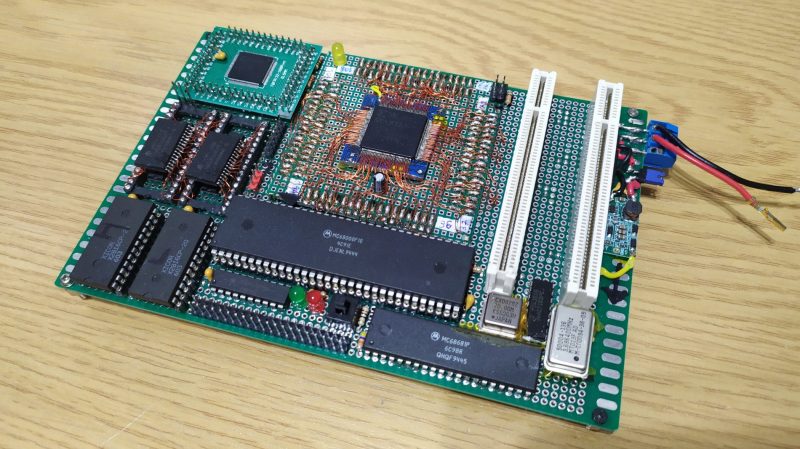
The Peripheral Component Interconnect (PCI) bus was first introduced all the way back in 1992. It quickly became the standard way to interface add-on cards on the PC platform, supplanting earlier buses like ISA and various other oddball standards. You wouldn’t expect to see a PCI bus on a Motorola-based machine, but [maniek86]’s homebrew rig offers just that.
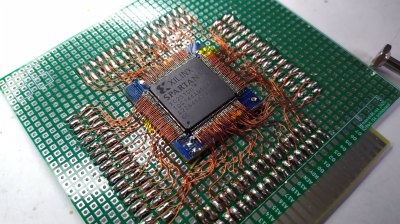
This computer is a beautiful piece of homebrew engineering, constructed out of protoboard and loose wires rather than any fancy PCB. At the heart of the build lies a Motorola 68000 running at 10 MHz. It’s got 1 MB of SRAM, 4 KB of ROM, and a MC68681P acting as a UART, timer source, and I/O controller. Where things get special, though, is in the inclusion of a Xilinx Spartan II FPGA (XC2S100), which acts as a PCI bridge. It provides the machine with two 32-bit 5-volt PCI slots which are interrupt capable, albeit with no bus mastering. A XC95144XL CPLD also sits present to act as glue logic to help lace everything together.
[maniek86] does a great job of explaining exactly why the PCI bus was hard to implement, and how it was pulled off in the end. The guide also covers how the system was able to interface various cards, from a PCI serial expansion to a Cirrus VGA adapter. It’s all good stuff.
We’ve featured other work from [maniek86] before, too, like this brilliant 486-based single-board computer. Video after the break.










kick ass
Mmmm… My spidey sense says this might be compatible with a Voodoo3/4/5 video card with enough effort (they don’t need bus mastering, are 5-volt compatible, and have documented hardware registers so it could be initialized manually even without a 6800k vbios).
Dooooooo it! Install a GPU that came out 21 year later than the CPU!
Stick a 5080ti on that beast and let ‘er rip
5080 uses PCIe and wouldn’t work on PCI bus even with adapter. PCI can work on PCIe slot with adapter though, your 25 year old Voodoo card could be used with Windows 11.
Not in Linux though. Maintaining existing code is too hard for modern Rust programmers to comprehend so they delete it instead.
apart from the fact that it won’t actually work in windows 11. and the fact that it’s easy to use it in linux you just can’t use the bleeding edge. there’s a more basic fact: it’s impossible to test it. no matter how much they might want to maintain ancient drivers and adapt them to use nested compatibility layers and/or bus adaptors, it isn’t possible unless someone actually has the hardware configuration you want to whine about not supporting. drivers for hypothetical hardware don’t work.
the upshot is, if you actually go through the effort to assemble frankenstein’s pc, then you can be that guy, maintaining and updating. that’s the linux way. and you can’t really do that on windows.
My impression is that when something is deleted, it usually means that no users cared enough to donate their time to maintain it. Maybe they cared just enough to complain on the internet.
And if that frees up enough engineering time for kernel devs to increase perf by 0.1% on modern hardware, that could reduce global data center usage by the equivalent of an entire power plant. So: is environmentally worth having a power plant running 24/7 just to let some retro hardware enthusiasts install the latest kernel on their legacy devices?
But Voodoo code is not executed by kernel running on modern ATI or NVIDIA GPU so your claim about 0.1% performance reducing the need for power plant is total bs. Linux kernel in its current state is simply a mistake that’s been kept alive far too long.
Microsoft realized Windows 98 is a dead end so they quit cold turkey and introduced Windows XP based on NT kernel.
Torvalds on the other hand is stupid and he stubbornly sticks to what he learned in college during the 1980s.
Windows 11 driver signing mostly kills that dream. And the lack of x64 voodoo drivers.
It was hard to run a voodoo even back in the win7 days, let alone win11.
There’s no clone of myself and I don’t care for marvel/DC.
Speak of the devil: https://www.phoronix.com/forums/forum/phoronix/latest-phoronix-articles/1653345-linux-7-3-lands-improvements-for-voodoo-3-4-5-vintage-atari-computers-in-2026
I’m working on a homebrew cpu, ala beneater… I wonder if I could so this? I was thinking about ISA bus, but PCI would be way cooler.
This is an impressive way to bridge a 68000 system with relatively modern expansion hardware. The FPGA approach makes a lot of sense here, especially given how much of the complexity is in handling the PCI bus rather than the CPU itself. It would be interesting to see what other PCI devices could realistically be made useful on a machine like this.
This reminds me of the old Amiga PCI adaptors which used FPGAs to bridge to the original system.