
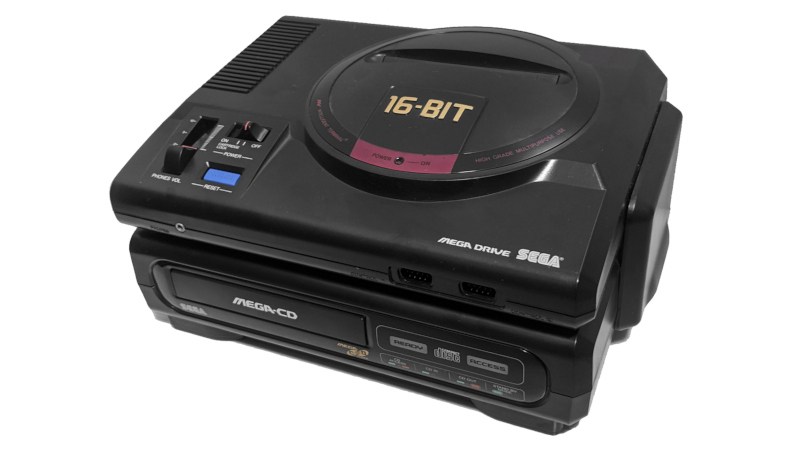
Over recent years there have been a range of classic 16-bit consoles coaxed into running familiar operating systems, with -nommu Linux being a favourite. But the 16-bit era had its own operating systems of note, and [1d4r3k] has brought one of them to a console that fit very much into a different 16-bit camp. It’s Atari’s TOS, on a Sega Mega CD.
We should in all fairness start by saying it’s not “real” TOS, but EmuTOS, an open-source drop-in replacement. So far it supports a serial keyboard device, a printer, and sound, and it mounts the CD or cartridge it booted from, a RAMdisk, internal backup RAM, and cartridge save RAM. We’re told in the tip email that there’s also been some work porting GEOS to the platform, and thus the GEOS software suite may be ported to it.
Sadly there are no images, so we can’t see it working, but trying it looks to be as straightforward as burning aan ISO or flashing a cartridge if you have the original hardware. We have no idea as to whether it would be any use given the specs of the Sega, but given that TOS ran on Ataris without a lot of RAM we suspect it might be. Meanwhile, here’s a Megadrive/Genesis running Linux.
Header: 軍事用懐中電灯, CC BY-SA 4.0.












This is genuinely a great hack, and right up my alley as a programmer who developed on both Atari ST and Sega Megadrive/Genesis systems.
The Sega Megadrive/Genesis only has 64k of RAM. The Sega CD has 128k, but as a bottom-of-the-line Atari ST had 512k, that’s really not enough.
The Mega RAM cartridge gives about 512k, which would be sufficient.
But now you are still talking about the Atari ST, where a lot of people access the hardware directly for speed and invited the OS for anything except disk access.
And the video and audio hardware is completely different between the two systems.
So it’s doubtful that anything is going to run on this unless specifically coded for it.
Then again, the “Magic Sack” somehow ran Mac programs on the ST, so stranger things have happened.
It’s a cool hack tho, definitely!
I always loved the Megadrive hardware, feeling like it was really the direction Atari should have taken with the ST hardware, since the Megadrive had tiled, dual layer backgrounds and sprites, which were hella fast, and the ST was stuck bit blitting bitmaps to 4 scroll planes, with all the bit shifts that entails, making it graphically rather slow. It’s almost like the Megadrive was a better spiritual successor to Atari’s 8-bit line than the ST was, which makes some sense, since the ST was the first new product of Jack Tramiel’s take over is Atari, and no original Atari people worked on it that I know of.
(Many of them worked on the Amiga tho, which Atari was originally supposed to release and lost in the takeover.)
It can be upgraded, though. 128 KB should be possible, at least.
May or may be not useful to users of 68010 MDs, also, if compression algorithms were used (Sonic 3 etc).
The RAM upgrade involves replacing PSRAM (pseudo static RAM) with real SRAM (static RAM) of higher capacity.
The replacement chips can be pin compatible, even, I believe.
An upgrade of VRAM from 64KB to 128KB is possible, too.
The Sega Teradrive had 128KB of VRAM, for example.
Hi, I feel similar about this.
That’s why things such as NVDI came to be or why TOS 1.02 (Blitter TOS) added support for that optional Blitter chip.
Because without one, the Atari ST’s desktop was a bit sluggish.
I also often consider that the Atari ST was a better Macintosh than the real thing.
The ST’s mono resolution of 640×400 was higher than Mac’s 512×342, for example.
Or the beeper. The Mac did sound in software, while the ST had an simple PSG, at least.
In addition, later Ataris had an AppleTalk compatible network port, even.
Btw, I also sometimes think that both Atari ST/MegaDrive and Amiga/SNES were corresponding counterparts.
The Amiga and SNES had a powerful or intelligent chipset and sampling sound,
while Atari ST and MegaDrive had higher CPU performance,
sound synthesis (FM, PSG) and a focus on higher resolution rather than high color depth.
“The Amiga and SNES had a powerful or intelligent chipset and sampling sound, while Atari ST and MegaDrive had higher CPU performance, sound synthesis (FM, PSG) and a focus on higher resolution rather than high color depth”
And then came the IBM PC which combined both, was cheaper and could be upgraded with aftermarket parts.
Uh.. no. That’s some crazy alternate timeline you’ve got going on there.
The IBM PC line was released four years before the first Amiga or ST. It lacked any kind of sound synthesis or sophisticated graphics acceleration hardware, and was certainly not cheap. Nor were there any affordable aftermarket parts to solve these deficiencies until much later, around the time that the Amiga and ST were discontinued. The first really successful PC sound card, the Sound Blaster 16, came out a few years after the SNES and Genesis, and cost as much alone as buying one of those consoles. And if you wanted graphics approaching what those could do, you’d still need to shell out more money for a VGA or SVGA card.
And although those could finally meet or surpass the consoles and Amiga on resolution and color depth, they still lacked all but the most basic hardware graphics acceleration – the CPU was almost always pushing pixels into video memory one byte at a time.
High-end PCs of the era could achieve impressive graphics and gaming experiences, but they did it through raw CPU power – an even more extreme version of the Genesis/ST approach.
The story would change by the mid ’90s, when 2D acceleration and cheaper audio hardware became widespread in the PC realm, but by then the situation was repeating all over again with 3D graphics. The slow but 3D-accelerated playstation and n64 could hold their own pretty well against much faster 486 and Pentium systems that had to do it all in software – at a fraction of the cost.
The full tower of power gives me the most awe. its very nearly a ps1.
btw tho, 64 KB Genesis WRAM + 512 KB Sega CD PRG RAM + 256 KB Word RAM = 832 KB
Hey thanks a bunch! What an incredibly detailed response. You definitely “get it.” The sega was begging for it.
Hey thanks! What an incredibly enthusiastic response. I share your admiration for Sega hw. You definitely “get it,” the sega was begging for it.
Hey thanks! What a incredibly enthusiastic response! I share your opinions and admiration of the sega hardware. You definitely “get it;” the Sega was begging for it.
As they say, 死鱼不是制作鸟笼的工具
Eh Luigi?
does this mean, sega is not actually a tool for making a bird-cage, after all?
good god. my bad
Today’s comments were brought to you by the numbers 5 & 6, and the letter K!
lol, welcome to the hackaday comment section. we’re extremely opinionated, mostly nice, and we don’t have the ability to edit any comments.
its ok. i actually have DSL in all fairness
aan to an