
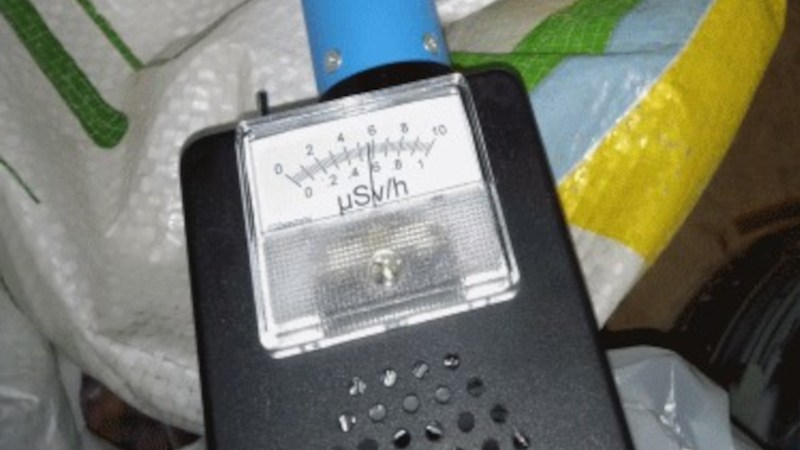
These days, it’s plenty easy to build a Geiger counter with a microcontroller that has a nice fancy display and a simple digital readout for how many radiations you’re likely sucking up into your delicate fleshy body. But you can still do things the old fashioned way, as [ludens] demonstrates with this analog Geiger counter project.
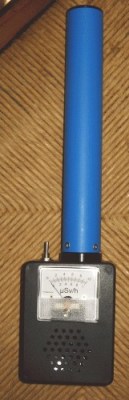
With a goal of measuring low-level radiation sources and the normal background levels on Earth, [ludens] selected a large Geiger tube for its sensitivity—a Chinese J306β in particular. It’s rated to output 88 counts per minute at the average background level, or 8 counts per second when exposed to 1µSv/h. It’s quite a large device, measuring 200 mm long and 18 mm in diameter, and it sticks out on top of the device like a big fat antenna.
Since the large tube puts out plenty of counts at even low levels, [ludens] decided it would be easy to average the output with a simple analog low-pass circuit. Everything runs off a single AA battery, with a power supply built to step that up to 5 V for the ICs and 400 V for the tube itself. CMOS Schmitt triggers are responsible for running the show, with an old-school analog dial showing the reading.
There are two ranges to use, depending on the magnitude of the radiation source—1 uSv/h, and 10 uSv/h. The high range isn’t particularly high, but as [ludens] notes—”If anything I find pegs that scale, I prefer to run, instead of measuring exactly how much radiation there is! So I don’t need a higher scale than 10µSv/h.”
If you’ve ever wanted to build a Geiger counter that has that classic Cold War feel, this is a great way to go about it. Alternatively, you can always go the more modern route and build something digital and networkable for logging purposes.












The Mighty Ohm is another Geiger Counter project you can build. It uses an actual Geiger-Mueller tube . It too runs off 2AA batteries.
This one looks cooler though, which is highly important
ironically, a Geiger tube detector is intrinsically digital, not analog. Its output is pulse-density modulated. The circuit here is a digital-to-analog converter.
Huh I was about to ask what happens if it registers two particles at once and the answer is it can’t, it’s blinded to the second particle, so its output truly must be binary. Yep, you’re right.
First step to making a home made Geiger counter? Buy a Geiger tube from the store…
You can certainly make your own tubes at home if you have the equipment to do it.
I did that. But I’ve used no ICs. Just bought the Geiger tube and built a cascade of condensers to create the voltage.
I’ve used a loudspeaker instead of an analog meter, also.
That way, I could hear the background radiation “tick” from time to time. :)
Handy to see if any radiation gets through the lead-lined house.
How much radiation is inside said enclosure depends on how old the lead is. https://en.wikipedia.org/wiki/Low-background_steel#Other_low_background_materials
as a follow-up note to [Paul]’s interesting post, this might not be the best device for checking up on the radiation from your house’s lead shielding itself. When radioactive lead decays, it primarily emits beta particles, and unless they’re particularly high energy beta particles, they won’t even make it past the plastic housing around the Geiger tube.
Sure, the analog circuitry is important, but, at least on the American side, it doesn’t really say “Cold War” unless it’s painted Solar Yellow. Using a metal tin with embossed lettering helps too.
If you prefer USSR chic, I think there were some fashionable green and brown options as well.
In the late 1960s I acquired something very similar to this from a Government Surplus shop in Meadow Lane, Leeds. The electronics had been removed but the meter and Geiger Muller tube were still in place, and I was able to get it sort-of working again. The GM tube had a thick glass envelope and the case was diecast aluminium so it was only ever going to respond to gamma radiation, and I was never able to find a gamma source to test it with. I quickly tired of listening to cosmic rays and I’m not sure what happened to it.
It now seems that what I had was a “Meter, Dose Rate, Portable, Trainer, No. 1”. Details at https://civildefensemuseum.com/southrad/brit-meter-1.html
Micro-Sievert, that newfangled stuff.. 🙄
Not too long ago, Mili-Rem was the default scale.
Measurements done in Chernobyl were recorded in rem or milirem, for example.
In old (or then-young) Germany, “Röntgen” was once used before.
https://simple.wikipedia.org/wiki/Sievert
https://simple.wikipedia.org/wiki/Roentgen_equivalent_man
https://simple.wikipedia.org/wiki/Roentgen_(unit)
This makes me wonder, what’s the absolute highest voltage that can be obtained using a AA cell. Not just in one big spark, but sustained for some reasonable useful period, say a couple of hours.