DIY Weather Stations Report In From Chernobyl

You’re probably not going to hang out around Chernobyl any time soon. Still, knowing the conditions there can both satisfy your curiosity and provide scientific value. To that end, [Yury Ilyin] has spent the last couple decades installing homebrew weather stations across the Exclusion Zone for his own interest. 

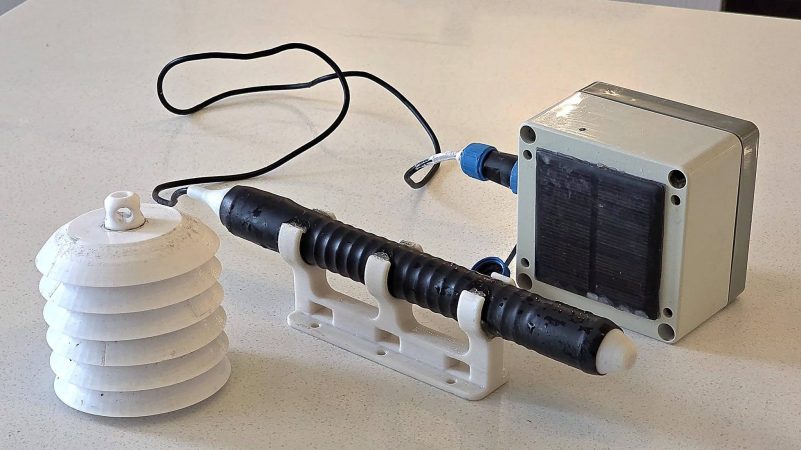
The remote weather stations that [Yury] builds all follow a similar design. Each runs on three 18650 lithium cells, charged via a small solar panel. Most of these cells were salvaged from old laptop battery packs. These cells are used to power a GPRS or WiFi communications module, along with a temperature, humidity, and pressure sensor, and a Geiger counter, because, well… it’s Chernobyl.

He has been lucky enough to keep costs down by finding an old generation GPRS SIM card that could be cloned and used across multiple devices, and thus far has had no trouble receiving signals from his many distributed stations. He’s been able to use his sensor network to track the gradual decline of radioactive emissions in the area from Cs-137, as well as keep an eye on the local weather conditions in an area few ever tread.

[Yury] has built over two dozen of these devices, and several have passed the test of time—with the lithium cells and cellular hardware surviving both high and freezing temperatures as well as the ravages of rain and time. He’s continued to refine the design over the years, starting out with an ATmega644 running the show, and later upgrading to STM32 microcontrollers.

We’ve explored distributed radiation sensor networks before, too, as well as many a remote weather station. Continue reading “DIY Weather Stations Report In From Chernobyl”

Making Audible Sense Of A Radiation Hunt

The clicking of a Geiger counter is well enough known as a signifier of radioactive materials, due to it providing the menacing sound effect any time a film or TV show deals with radiation. What we’re hearing is the electronic detection of an ionization event in a Geiger-Muller tube due to alpha or beta radiation, which is great, but we’re not detecting gamma radiation.

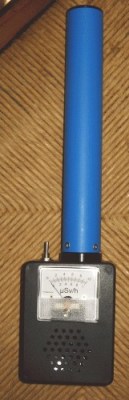
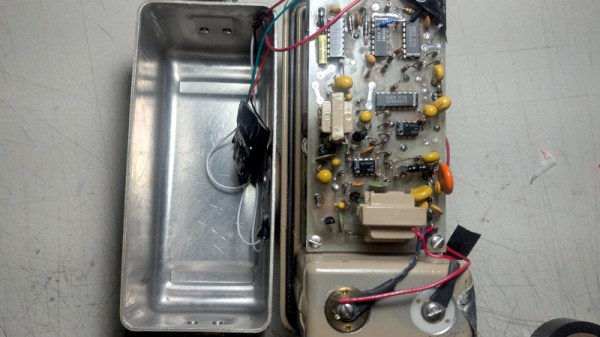
For that a scintillation detector is required, but these are so sensitive to background radiation as to make the clicking effect relatively useless as an indicator to human ears. Could a microcontroller analyse the click rate and produce an audible indication? This is the basis of [maurycyz]’s project, adding a small processor board to a Ludlum radiation meter.

When everything sounds like a lot of clicks, an easy fix might be to use a divider to halve the number and make concentrations of clicks sound more obvious. It’s a strategy with merit, but one that results in weaker finds being subsumed. Instead the approach here is to take a long-term background reading, and compare the instantaneous time between clicks with it. Ths any immediate click densities can be highlighted, and those which match the background can be ignored. SO in goes an AVR128 for which the code can be found at the above link.

The result is intended for rock prospecting, a situation where it’s much more desirable to listen to the clicks than look at the meter as you scan the lumps of dirt. It’s not the first project in this line we’ve brought you, another one looked at the scintillation probe itself.

Building A DIY Muon Tomography Device For About $100

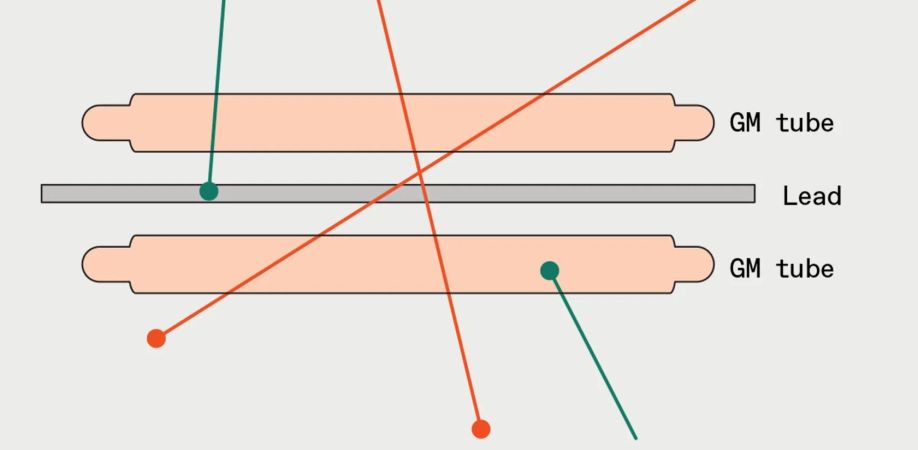
Muon tomography, or muography, is the practice of using muons generated by cosmic rays interacting with Earth’s atmosphere to image structures on Earth’s surface, akin to producing an X-ray. In lieu of spending a fair bit of money on dedicated muon detectors, you can also hack such a device together with two Geiger-Müller tubes and related circuitry for about $100 or whatever you can source the components for.

The reason for having two Geiger-Müller tubes is to filter out other much more prevalent sources of ionizing radiation that we’re practically bathed in every second. Helped by a sheet of lead between both tubes, only a signal occurring at the same time from both tubes should be a muon. Specially cosmic ray muons, as these have significantly more kinetic energy that allows them to pass through both tubes. As a simple check it’s helpful to know that most of these muons will come from the direction of the sky.

The author of the article tested this cobbled-together detector in an old gold mine. Once there the presence of more rock, and fewer muons, was easily detected, as well as a surge in muons indicating a nearby void from a mine shaft. While not a fast or super-easy way to image structures, it’s hard to beat for the price and the hours of fun you can have while spelunking.

ESP32 Brings New Features To Classic Geiger Circuit

There’s no shortage of Geiger counter projects based on the old Soviet SBM-20 tube, it’s a classic circuit that’s easy enough even for a beginner to implement — so long as they don’t get bitten by the 400 volts going into the tube, that is. Toss in a microcontroller, and not only does that circuit get even easier to put together and tweak, but now the features and capabilities of the device are only limited by how much code you want to write.

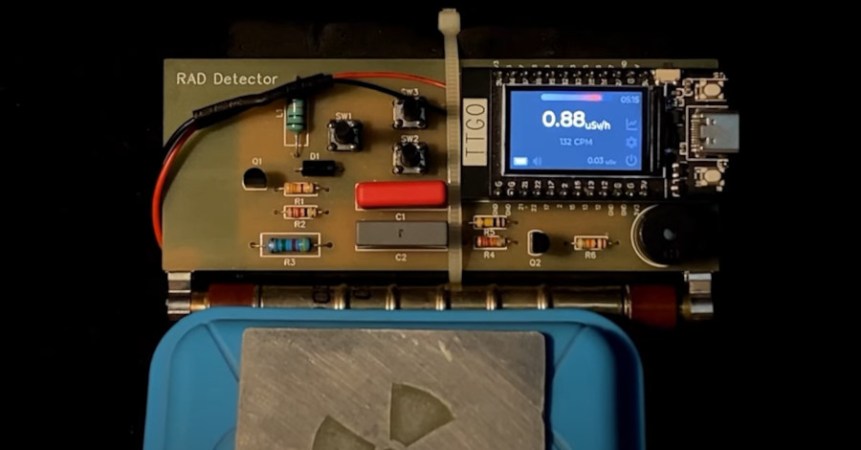
Luckily for us, [Omar Khorshid] isn’t afraid of wrangling some 0s and 1s, and the result is the OpenRad project. In terms of hardware, it’s the standard SBM-20 circuit augmented with a LILYGO ESP32 development board that includes a TFT display. But where this one really shines is the firmware.

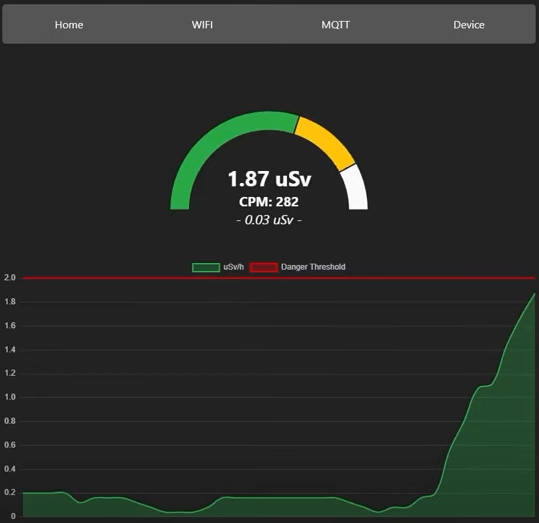
With the addition of a few hardware buttons, [Omar] was able to put together a very capable interface that runs locally on the device itself. In addition, the ESP32 serves up a web page that provides some impressive real-time data visualizations. It will even publish its data via MQTT if you want to plug it into your home automation system or other platform.

Between the project’s Hackaday.io page and GitHub repository, [Omar] has done a fantastic job of documenting the project so that others can recreate it. That includes providing the schematics, KiCad files, and Gerbers necessary to not only get the boards produced and assembled, but modified should you want to adapt the base OpenRad design.

This project reminds us of the uRADMonitor, which [Radu Motisan] first introduced in 2014 to bring radiation measuring to the masses. This sort of hardware has become far more accessible over the last decade, bringing the dream of a globally distributed citizen-operated network of radiation and environmental monitors much closer to reality.

Continue reading “ESP32 Brings New Features To Classic Geiger Circuit”

An Open Source Firmware For Cheap Geiger Counters

It is a time-honored tradition: buy some cheap piece of gear and rewrite the firmware to make it work better. [Gissio] managed to do just that for a cheap FS2011 Geiger counter. Apparently, the firmware will also work with some similar Chinese models, too.

The new firmware boasts an improved UI and multiple measurement units, including Sievert, Rem, and counts per minute or second. You can hold the measurement or compute a dose or average rate. The new firmware also has a host of customizations and can accommodate different tubes.

There are, however, two really key features. First, the new firmware offers about 40% more battery life than the stock version. Second, there is now an onboard nuclear chess game! That way, you can enjoy yourself while you are getting irradiated. There are also a few suggested hardware mods that are optional to improve measurements and increase the buzzer volume, among other things.

If you get a Geiger counter, you might be surprised at what things are slightly radioactive. If you don’t need the microcontroller, you can make a workable counter on the cheap.

Continue reading “An Open Source Firmware For Cheap Geiger Counters”

Detecting Radiation For Fun And Profit

It used to be that every well-stocked doomsday bunker had a Geiger counter. These days, you don’t have to have a big tube-based meter. You can inexpensively get a compact digital instrument to handle your radiation detection needs. [DiodeGoneWild] reviews and tears down such a unit from FNIRSI. The case looks like several other similar instruments we’ve seen lately, so presumably, someone is mass-producing these handheld meter cases. You can see the video, below. The meter reads the absolute radioactivity and can also measure cumulative exposure.

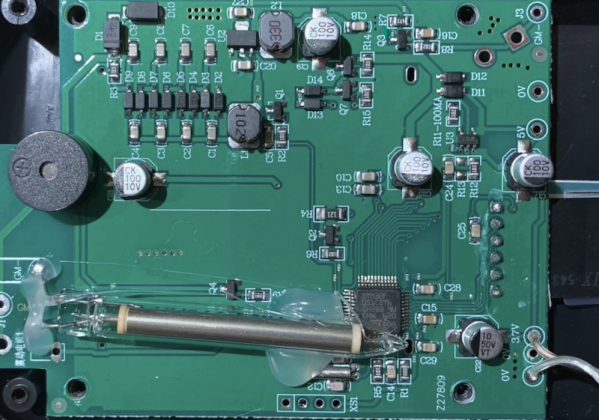
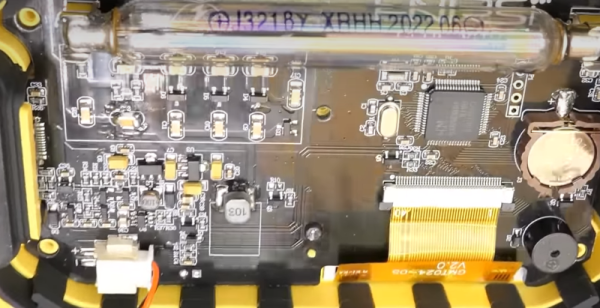
After measuring a few common radioactive items, we get to the teardown. Inside, of course, is an ordinary tube. A few screws reveal a typical rechargeable battery, a fairly simple PCB with a microcontroller and battery backup for the real-time clock. A lot of the board is involved in multiplying voltage up to the several hundred volts required for the Geiger tube.

The other side of the PCB has only buttons, a vibration motor, and, of course, the LCD. We don’t know how you might test the relative accuracy other than comparing it to a known-good meter. The bare tube was, of course, more sensitive without the plastic cover, but that could be calibrated out, too.

A Geiger counter doesn’t have to have a lot of parts. Either way, a surprising number of things will set them off.

Continue reading “Detecting Radiation For Fun And Profit”

A black PCB with an ESP32 and an SBM-20 geiger counter

Flexible Radiation Monitoring System Speaks LoRa And WiFi

Radioactivity has always been a fascinating phenomenon for anyone interested in physics, and as a result we’ve featured many radioactivity-related projects on these pages over the years. More recently however, fears of nuclear disaster have prompted many hackers to look into environmental radiation monitoring. [Malte] was one of those looking to upgrade the radiation monitor on his weather station, but found the options for wireless geiger counters a bit limited.

So he decided to build himself his own Wifi and LoRa compatible environmental radiation monitor. Like most such projects it’s based on the ubiquitous Soviet-made SBM-20 GM tube, although the design also supports the Chinese J305βγ model. In either case, the tube’s operating voltage is generated by a discrete-transistor based oscillator which boosts the board’s 5 V supply to around 400 V with the help of an inductor and a voltage multiplier.

Graphs showing temperature, humidity and radiation levels
Data can be visualized in graphs, together with other data from the weather station like temperature and humidity

The tube’s output signal is converted into clean digital pulses to be counted by either an ESP32 or a Moteino R6, depending on the choice of wireless protocol. The ESP can make its data available through a web interface using its WiFi interface, while the Moteino can communicate through LoRa and sends out its data using MQTT. The resulting data is a counts-per-minute value which can be converted into an equivalent dose in Sievert using a simple conversion formula.

All design files are available on [Malte]’s website, including a PCB layout that neatly fits inside standard waterproof enclosures. Getting more radiation monitors out in the field can only be a good thing, as we found out when we tried to detect a radiation accident using community-sourced data back in 2019. Don’t like WiFi or LoRa? There’s plenty of other ways to connect your GM tubes to the internet.