
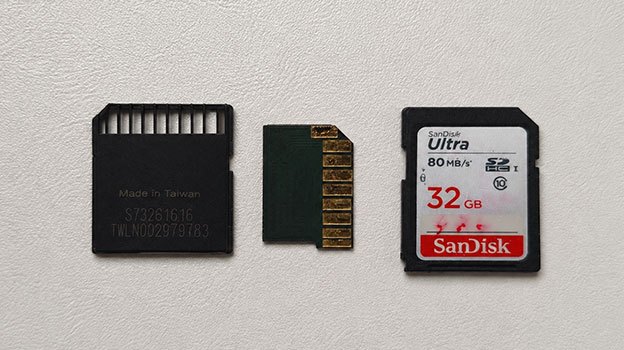
A nice thing about SD cards is that even in their non-micro format they are conveniently small. This is however a bit of a problem when an SD card stops working, as they are not exactly designed to be easy to service, or to recover data from. There is however a very good chance that the Flash memory and controller are still fine, and it’s actually one of the passives on the tiny PCB that failed, as with the 32 GB SD card that [Yevgeniy Kapishon] recently diagnosed and recovered data from for a customer.
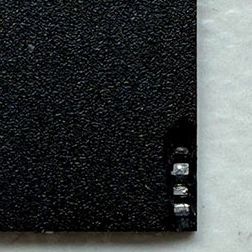
A big hint during initial diagnostics was a clear short between the supply rail and ground, but as became clear when taking the SD card apart, this one was built as a monolithic package, without exposed components on a PCB as in older SD cards. Correspondingly an X-ray machine and thermal camera were used to figure out what was inside the package, and where the short was located.
By combining the hot spot image with the X-ray it was determined that the problem was with some passives near the edge of the package. Some careful material removal later two miniscule capacitors were found to be the culprit and gently removed. With this the short on the power rail vanished, and the SD card started working again.
Having a shorted MLCC or similar passive component is a very common failure mode in general which can cripple even the most expensive device. Even if SD cards still aren’t really repairable, it’s at least reassuring to know that in many cases the data is fairly easy to recover once you have identified and removed the offending part.












Huh I didn’t even know there were any caps in there. Well that’s good to know. Just something I never really thought about.
Yeah sdcard spec requires being able to yank the card at any time so the caps are to let the card finish up if it was in the middle of a write.
Similar too crystal oscillator passives in USB thumb drives.
Got a bunch of wonky ones around here still waiting to be tested for borked quartz resonators.
32gb sdcard. Mmh $22.99 on the sandisk website. So I wonder how much the xray and thermal imaging cost? What was so important on that sd cart to spend that kinda money to say professional photographer don’t use 32gb cards usually anymore.
The blog shows it’s photo’s in this case. It’s easy to imagine photo’s from a loved one that has passed away where you would be willing to spend a couple of hundred dollars to get these recovered.
bitcoins wallet keys?
Would be interesting to see if a brute force of this would work. From the thermal image the capacitors appeared to heat up more than the traces leading to them. If the information on the card wasn’t worth all the intricate and $$$ effort, I’d try using a power supply set to the normal rail voltage and very slowly crank up the current limit until the capacitors cook themselves to an open circuit.
Ceramic can take a lot more heat than a PCB. If the PCB chars, it will become conductive and short the power rail.
I’d argue that a charred PCB under the capacitors turned to carbon PCB would’t become an issue.
I don’t know the details of how ceramic capacitors typically fail to short. But if they are heating up, that tells me it’s a relatively high resistance short. From experience, burned to char through hole resistors typically measure very high. I’d use thermal camera and monitor the board while heating up the caps till they burn open enough to allow the rail voltage rise to an operable voltage.
In my real world experience the only applications where a charred PCB causes more problems than the overheated/failed component itself is in high voltage, or whatever voltage is enough for it to follow the carbon and flash over. In this SD application, it’s a very low voltage.
However, I now know what my next experiment will be if I ever find a shorted ceramic cap!
Just dig out your xray machine and thermal camera to find the problem components.
So why did you read it?
So… like most hacks?
This is a good use for a 2A 1V power supply.
It’s not really a tutorial website
I had to recover data from an early 32gb sdcard many years ago only tool I had was an arduino and would only talk in spi mode slowly. 4 days to pull an image in hex dump!
It might be another challenge again if it was one of those WiFi enabled SD cards, they really do pack a lot into those.
#badcaps. Com… 😂
I placed my dud SD card on a small anvil and reduced the thickness of it by about a millimetre or slightly more. Several bashes did the trick and the card gave no more trouble!
New challenge!
QRP transmitter made entirely from parts scavenged out of old SD cards.
@N2CQR, @KK4DAS & N6QW… thinking of you!