
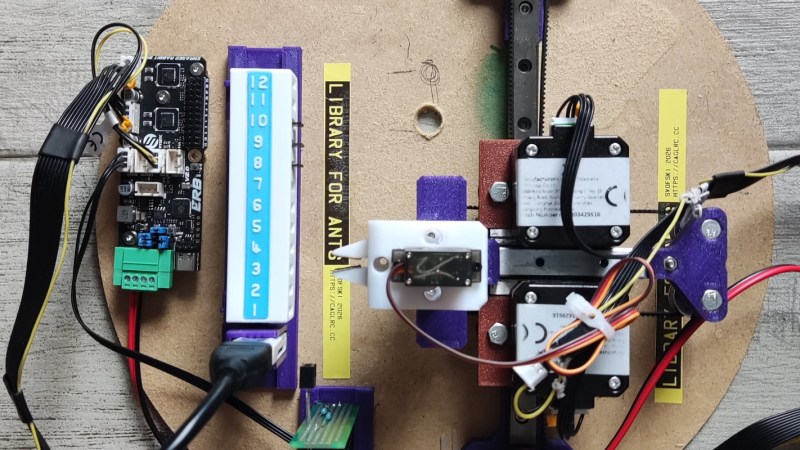
Many of us have noted a tremendous price increase in many computer components for some mysterious reason. Whatever this cause is will be debated among the various modern philosophers and Diogeneses, but regardless of cause we all still have to live in this world and make do. That turns us towards getting maximum value from the things we already have rather than trying to go out and buy more computer components right now, like [svofski] using his vast swath of existing microSD cards to build an SD card library.
The library is based around a tiny robotic arm that can physically grip the cards and move them in and out of a reader. The first iteration of the arm involved rotating the two pincers, but this turned out to be overly complicated and [svofski] eventually settled on a design resembling a rack and pinion that slides the two pincers together instead. With the gripper sorted out, it’s placed in system called T-bot arrangement, similar to coreXY kinematics, that lets it pick and place among 12 microSD card slots.
Many of the parts in this build were directly from or inspired by 3D printers, making it relatively simple with so many parts available. [svofski] didn’t build it for a specific use case, though; mostly it was constructed out of fascination for robotic tape changers which perform a similar function. But for anyone who actually needs to duplicate a large number of SD cards, or other types of removable media, this could prove to be a fairly handy robot.












Not how I would have done it but definitely cooler than how I would have done it. And they picked the objectively most correct music for the demonstration video.
Hard agree on the sound track. In fact this sent me down a rabbit hole that ended with me order Hackers on disc!
Hack the planet!
Library for ants, hunh? So, Fourmilib!
Ok, I’ll show myself out.
i get doing this with, say, floppy disks back when that was the affordable medium. or maybe CDs or perhaps even video or data tapes. but a microsd card holds so much data it is rare for me to segment my storage across multiple cards. also, 640k should be enough for just about anyone
The television station tape robot from the movie Hackers springs to mind.
Sort of air gapped SD cards, but not really.
Zoolander
If you go that routr with detecting the cards, combine it with a qr code and a camera instead of a proximity sensor?
A card can be identified by sticking it into the reader and reading its disk label.
microSD cards are really small. Consider that the gripper also holds the card by its edge, thus covering part of its minuscule surface. There’s not that much area left to write on.
In addition to barcodes I considered other ideas as well:
– using a camera to just oversee the storage bay and detect which cards are present in storage
– adding reflective dot patterns to the edges of cards, so basically a micro-barcode of sorts
– shooting IR light from behind the storage bay and detecting cards by blocked light
But simply picking a card and bringing it to a reflective sensor does the job and looks fun, so it won. I think the other methods are also interesting to try, but implementing them could have extended the project time indefinitely. To be honest it already took much longer to complete than I anticipated, even without advanced features.
Let’s see if it inspires others to build a more robust and feature-rich microSD card library.
Oh, I thought this was like #include <SD.h> [slaps forehead]
heh, i mean…what a hack
reminds me of something i did that was much less of a hack. circa 2005, i owned a decently large pile of HDDs that i felt like i’d paid a lot for, and which still left me always wanting for more space. so i built a PC with a cheap motherboard that had a good number of both IDE and SATA channels and a giant tower case with space for a dozen drives in it. thinking i would put all of these disks in it to have them all online at the same time. obviously, very soon after developing this solution, i bought a single HDD for a reasonably low price that had more capacity than all of those put together, and the whole mess became e-waste overnight.
weird to see that kind of mentality coming back, but i think it will be just as short-lived. the thing is, even if i’m stuck with the drives i have for a good long while…that’s a lot of storage. for a long time i was riding moore’s law in HDDs and always hitting the limit but i fell off of moore’s law a long time ago and i haven’t been bumping into limits.
back in 1965 (in the US ARMY), I tried to learn Russian. I had one Russian dictionary; an Army English-Russian/Russian-English Electronics dictionary. Over the next few months, one thing was very apparent: The US was VERY far advanced in Electronics compared to the Russians; The Russians were VERY far advanced over the USA in terms of inventiveness and making their older technology do awesome tasks.
I love it when people show inventive solutions.
Absurd madness, but it is the right kind of madness and I like it.
Interesting, I once thought about doing something like that.
I my idea the cards were stored flat in a X/Y grid, maybe even shingled for higher density, and the “reader” would have been a set of pogo pins on a plotter like assembly…
or you could fit the cards into a carousel, view-master style, and the pogo contacts only have to move up and down….
I thought about a carousel too, it kinda seems more practical but maybe less spectacular.
Another idea was to have the cards fixed in place and bring the receptacle instead.
But I like your pogo pins idea the best. If it was for a practical application, I think that one would have won.