
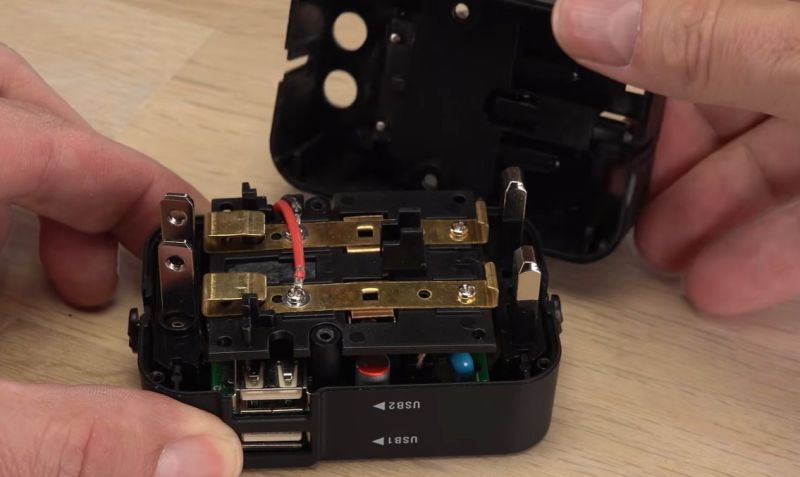
The world’s refusal to standardize on a single type of mains power outlet has led to a vibrant market of so-called travel adapters, all of which try to outdo each other in convenience and universality. This comes at the cost of complexity, something which ultimately reflects in the price. The cheapo $9.26 universal travel adapter that [Brainiac 75] got off an online retailer’s site is thereby a good example of how safety suffers if the overarching goal is to ‘make it cheap’.
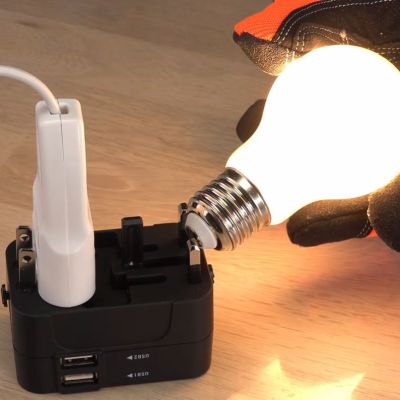
The first exciting discovery is that when you plug any of its three sets of connectors into an outlet, the others become live at the same voltage. This would suggest that they’re just wired together, a fact soon confirmed with a quick resistance check between the respective prongs. Though to the adapter’s credit, the prongs are not live when fully retracted into the enclosure. Yet as demonstrated in the video, the retracting of prongs is not enforced, so mistakes here are possible.
The adapter also has two USB ports that claim to provide 5 V at 2.1 A, with as it turns out no hard cut-off. This is probably the best part of the adapter despite not featuring any advanced charging features. After opening the adapter, you can see that the sliding mains prongs connect to a central bus bar when either unfolded or extended, which is definitely straightforward, but doesn’t enforce that only one type of prongs can be used at any given time.
To make it safer, [Brainiac75] removed the less useful US and UK plugs, taping over the empty holes. It’s now just a USB charger with a universal mains port to plug random non-EU plugs into, which is probably relatively safe and a better idea than really using it as a travel adapter.












What always made me wonder about those travel adapters ist that they don’t mention different voltages or any need for step-up or step-down converters.
Or maybe they did and I didn’t notice, not sure.
As is, such a travel adapter can merely be used for modern devices with switching-PSUs that can do 120/240v and 50/60Hz automatically.
Even a switching-PSU of a desktop PC can’t do that yet (still has 120/240v switch).
Those of us from 220/230/240V countries understand this very well. It’s North Americans – yes, including Canadians – who don’t seem to understand it. Not just me saying this: when I’ve asked for an adapter at hotels in Asia for example, they ask “American”, and I say no. Then they say “good, then I don’t need to explain we are 230V here to you.” Japanese people, who are at 110V, also seem to just know this too, and they run at 100V.
Also, I just checked every PC desktop PSU in my office which was designed in the last 10 years, and every single one was autovoltage. Pretty much everything here, excepting those things which have AC motors, seems to do 110V-240V. AC motors, mostly found in large whitegoods and high torque thingss like blenders, are the exception for obvious reasons.
Hi, I’m from Germany and back in the 90s I still had such confidence in my fellow citizens, too.
Back then, after re-union, people were very awake, interested in new technology and considered repairing their stuff.
We still had toy stores with educational toys, such as construction kits.
The “do-it-yourself” movement from the 1970s and 1980s still going strong, too.
We still had CBers and hams using veroboards for building home-made devices.
However, by the 2010s or so I’m nolonger sure about all of that.
If I watch my neighbours or walk through my city I get the feeling
that people are less and less interested into how things do actually work.
It seems that since smartphones have appeared,
people assume that everything around them somehow works “automagically” and is plug&play.
That they assume the society cares about the thinking part for them.
About PC PSUs.. I didn’t know that, thanks. I assumed they still had the red little slider..
But I haven’t seen a new PC since early 2010s, because everything stagnated.
It was nolonger interesting to me, it seemed as if x86/x64 was a dying platform.
The enforced TPM/SecureBoot and the removal of CSM (BIOS) looked like the end of the free x86 PC platform (grateful, there’s CSMWrapper now).
Tell me any device you travel with which isn’t plug an play?
The number of devices are vanishingly small, really it’s blow driers, hair straighteners and curling irons. And at least one of those is provided by every hotel anyway.
As for your “free” comment, the TPM is literally under user control as is Secure Boot. You are the master of the keys of your device, not someone else. Even when you run Windows you can do it without using Microsoft’s key, MS provides instruction on how to wipe the standard keys from UEFI, how to generate custom keys, and how to sign the bootshim and load it into the UEFI.
Yes, “still”. But for how long? How long does it take that opt-in becomes opt-out?
Such new technologies are often advertised as being optional until they become mandatory.
And after a few years, users got so used to it and nolonger remember that it once was optional.
Then, no one complains if the option gets removed altogether.
Just like when CSM aka Legacy Boot was removed.
In a truely tech-savy society, an upcry would have been the result.
Because the classic BIOS, by contrast, allowed the OS to have full control, more or less.
– SMBIOS and SMM did already do certain things in background (laptops running DOS could go standby through this trick).
In addition, things like VESA VBE BIOS, VBE/AI (audio) and VBE/AF aimed at helping standardizing things for everyone.
https://handwiki.org/wiki/VESA_BIOS_Extensions
Anyway, the BIOS/CSM itself was fairly basic and had no built-in networking support.
It didn’t have malware or backdoors, any OS was allowed to boot.
The PC could be booted using a selfwritten hobby OS, no certificate was required by some mega corp (Windows 11 demanded for an upgrade just recently).
UEFI firmware, just like DRM, wasn’t developed for the needs of the user.
It was developed for companies and an industry.
The addition of TPM/SecureBoot was just the cherry on top (Vista’s Bitlocker once looked like a reasonable technology using it).
And it added unnecessary complexity to the platform.
A better alternative would perhaps have been Open Firmware, as used by Power PC PCs/Macs.
It was a simple, but thought-through firmware with a boot menu and a command-line interface.
That being said, the problem with modern PCs sits much deeper.
There are running systems within inside the CPU or motherboard that have total control over a PC.
For example, the intel managment engine (IME) ran a copy of Minix that had control/overview over the motherboard’s peripherals, including the ethernet card.
It was running even if the PC was powered-down (via standby power).
(Sorry for being a bit off-topic. The last one was power related, at least.)
Having moved from the US to the EU a couple of years ago, I was surprised to find that my HP laser printer did not have such a modern, switching power supply.
Surprised by the white smoke and black ichor that leaked from the printer when plugged in!
And surprised when HP refused to repair it for any amount of money…
Wireless charger for electric toothbrush. 230-240V only, and it’s only a couple of years old. Surprised the hell out of me. Yes, hotels provide hair dryers, but my partner – a medical aesthetician – wouldn’t touch a hotel one and brings her own. I have not seen even a five star hotel provide curling irons or hair straighteners. 🤷♂️
Obsessed with Americans award
Hi! I don’t mean to argue, but personally I must confess I occasionally find the Americans to be pretty weird, too.
Not bad, just weird. So I’m guilty, too, I guess. 😅
Because many things are so strange from an European or an International point of view, not to say the very opposite.
I guess that’s why we take America as a comparison or counter-example so often.
And the North American mains and the whole power-grid do look so.. archaic.
That doesn’t mean it’s neccesarily bad, it surely has some latest hi-tec controlling it in the 2020s.
And the adventurous in-house wiring and the wooden power poles with free hanging wires are so out-of-this-world!
Again, it’s a big old land, so that might be justified.
It’s just.. Many of these big power-outages weren’t possible in countries of Europe.
That kind of “domino effect” in a blackout doesn’t happen as much in Europe as it does in America (not sure about Canada).
We don’t have a whole coastline going dark because a transformer blew in a power plant, in short.
The worst thing over here was that recent blackout in Spain..
But Spain is a thing in its own, maybe.
No idea how well or orderly they built their infrastucture (by German standards).
You seem fine, that’s no big deal and it’s certainly your right. It’s more the traits of the guy I was replying to: any subject an excuse to rave about the unique ignorance of the American, or whatever. That’s also his prerogative, but he ought to know it comes off as bitter and off-putting. You don’t come off that way.
I enjoyed when half the nation lost it’s power for a few days several years ago. I kind of needed the vacation! I lived in apartments back then and everyone came outside. There were bonfires, beer, grilling and people playing guitar. Normally everyone just kept to themselves and went about their business.
I guess some people did die though… dependent on machines for medical reasons, stuff like that so I can’t really wish for it to happen again.
What I really wish we had was your higher voltage. Then it would be easier to run a welder or heat water quickly.
Literally every electronic gadget I travel with can charge or be powered with anything from 100 to 240 volts. And that wasn’t even a feature I was looking for when I bought it. And technically the mains in the US are 240 V with a center tap “neutral” giving 120V.
“Literally every electronic gadget I travel with”
good for you, I’m pretty sure you do not carry an ordinary low-tech hairdryer considering that would make the 100V – 240V discussion much more interesting.
It’s not that there are so many devices that are autovoltage that make it easier, it’s the exceptions that cause the problems/confusion. If every device you plugged into a foreign socket would explode (or not work at all), people would learn/remember much faster, well most of them.
You don’t typically travel with them; but laser printers are the common IT exception.
All the electronics are typically running from a little universal switchmode PSU, as you’d expect; but the fuser has decent odds of being heated by something resistive(long tungsten-halogen lamps seem fairly common) directly connected to mains current and designed for one voltage or the other.
It’s not an illogical division; given the dubious economics of sizing the PSU to be able to drive a resistive heater that is probably a solid 10 times the draw of the entire rest of the system; but it makes for an irksome exception to IT widgets being more or less universally universal.
Normally the ones that don’t suck enough to actually have maintenance parts can be converted just by swapping the fuser for a region appropriate one; the switchmode PSU is likely universal and there are just two resistances of heater available.
Given the size of the adaptor it probably has the appropriate step up/down circuitry. I have a few that are just straight adaptors, with no change to the voltage and they are a lot smaller, barely larger than the plug itself. When I travel to Europe I only bring chargers and other devices that work on 110-240v so I don’t have to worry about the voltage or carrying a bulky step-down converter.
The adapter in the video is a simple plug adapter with a USB adapter.
It has multiple plugs for different countries and what looks like a UK socket for you to plug your own devices in.
It has no step up or step down circuit for the socket. Whatever voltage you plug it into is the voltage that you get on the socket.
This is typical of travel adapters. Most modern small devices are universal input, so all you need is a plug adapter. Laptops, phone chargers, PAP machines, all use power supplies that can operate on nearly any input voltage. Only the power cable and its plug change for use in different countries.
High power devices such as hair dryers are different. They are usually only made to operate on the voltage in a particular region.
A lot of the cheapo ones basically depend on the device you’re plugging in to be 120/240 compatible in its own internal circuitry, and if it’s not, it will create a sudden flash of light and a whisp of smoke.
As you can tell from the build quality above, these are not very legit products at all.
They are perfectly legitimate. They are intended for exactly the use you mention – plug in a device with a universal voltage power supply to any socket wherever you are.
What is not legitimate is for the plug prongs for multiple contries to be live and touchable.
I prefer to take a stack of simple adapters when traveling. Only on set of prongs, only on socket. Simple, safe, cheap.
I meant the one featured above that electrocutes you if you touch a separate region’s plug while it’s plugged in. Imo that is not legit haha
So you’ve never seen a modern computer power supply then
There hasn’t been a voltage switcher in a standard desktop power supply or standard power brick in at least 5 to 10 years
Assuming you get a reputable model and not a cheap bottom of the barrel model that you should never have purchased in the first place because it has other corners cut
Wait, why would adapters mention voltages? They are compatible with all of them. The voltage compatibility is for the device you connect, and those devices DO list what voltages (and frequencies) to use them with.
It has been a long time since I’ve seen or heard of anyone travelling with a device that wasn’t compatible with all voltages. And if you’re using a travel adapter for your permanent fixed installation at home I have to ask, what is wrong with you, and how can we fix it?
Most of those step down converters will also cause issues since nobody ever reads the instructions. The low power ones will burn out if you connect anything that draws more power than a phone charger because they only have a tiny step down transformer. The high power ones work like a light dimmer and will blow up anything that’s not a resistive load. They chop up the power to reduce the average voltage, but not the peak voltage.
This is why Big Clive, Patron Saint of pulling badly designed s*** apart and criticising it, “Deathdaptors”.
Seriously, if sanctifying Big Clive was a possibility, I’d be all for it.
Besides Big Clive, there’s Danny, AKA DiodeGoneWild, who often takes these (and other things) apart. He’d likely rate this one as “Super Dodgy.”
So this guy is from Denmark and has still 220V/380V
Isn’t the mains voltage supposed to be standardized to the 230V/400V in the EU since the early 2000s ?
Good question. I’m still from the days of 110v/220v.
But since that european power harmonization thing it’s 230 or 240v.
Or anything between 220v and 250v, not sure.
I also remember once how the 50 Hz frequency was being off and cheap alarm clocks were going wrong.
A few days after, the 50 Hz frequency was being off again, to compensate.
Meanwhile, the alarm clocks were going wrong again (because people had manually corrected time mean time). 🤣
I always thought that 230V was choose as a compromise to please the British that were always blaming anything mandatory coming from EU (well before the Brexit).
But frankly I never investigated further, all I know is that we quickly adopted the 230V/400V, just like we quickly repainted the yellow stripes on the side of the roads (now yellow is dedicated to temporary detours/deviations).
Both thinks happened in the early 2000s/late .90s
The UK – Europe links are HVDC, making AC voltage compatibility irrelevant. It was avtually covered in a video, linked here, in the last week or two…
What has to do Hvdc with “low” voltage for consumer usage?
Even if the HV link was AC, transformers exist since 1800, HVDC is irrelevant here.
It was never about the grid as there are always transformers between the distribution net an the households. The relevance of the HVDC links is only that the UK has their own phase control (they seem to like being out-of-phase with the EU)
The unified voltage spec is to be able to sell devices on both sides of the Channel without modification (except for the plug) and using the same test certifications, which is a big deal when designing a product.
Over here in Europe (Netherlands in this case) the usual voltage is around 230-235 volts. However on a sunny day, it will spike to around 250 in some parts of the village.
Over here a part of the power network is so congested that they can’t even add big consumers to it anymore as the wiring in the ground, air and switching stations aren’t up to spec anymore (yay for living in a first world country that always tells everything is fine).
It is nice to have everything underground, but upgrading it is not easy to say the least.
Denmark has 230V/400V as well, but a lot of older folks still refers to it as 220V/380V our of habit.
I was talking about the actual measurement seen on the video, not about the colloquial definition (here is no different: everyone still calls it 220, electricians included)
Good catch.. I wonder if it’s some old outdated infrastructure that was declared “close enough” until the next update cycle
The harmonized standard allows existing equipment to be within tolerance (close enough)
It’s largely a distinction without a difference. May countries standardised but then added their own error bars. For example Australia is also at 230V officially but the tolerance is +10/-6% specifically because they never changed away from providing 240V at the outlets. So when people here say 240V they are both technically wrong and right at the same time.
The harmonization of EU and UK voltages was done by specifying tolerances on 240 and 220v supplies that made them cover the same voltage range, so no one would have to change generating equipment. All new devices are supposed to be designed for 230v and tolerate a range that includes 220 and 240 (+/- whatever tolerance they already had in place).
Obviously, hardly something designed for 220V will explode at 240V, no matter if produced before or after 1997.
I’m not talking about appliances, I’m talking about the actual current provided at the plug, 29 years after the change happened on paper.
I’m just a bit amazed that in a Nordic country (usually way more binary on defining what’s good or wrong), the regulations are applied in a lazier way, than here in southern Europe where we are well known to be more Catholics/Analogue/Flexible.
That’s all
The motor of my father’s vinyl record player catched fire and released magic smoke on a 250v outlet.
It was from the 1970s W-Germany and designed for 220v.
Exceptions are there to confirm rules.
Perhaps if 250V was the nominal voltage, I assume there was room for tolerances.
So in in the 13th day of the month you could have say 265V, combine this with something (poorly) designed for the lowest side of the 220V tolerance and you have almost 50V of difference, which is way more than 10V~20V normally taken in account
US power outlets are the best and most reliable. European style are always loose. UK style are just ugly.
I like your sarcasm
Yes the best outlet in the entire world is the US plug
You don’t need no ground pin it doesn’t even need to be polarized and the tension shouldn’t be tight at all it should be so loose that it creates constant arcs that’s a safety feature because that’ll trip the breaker well before an overload
But seriously if we’re debating the actual best plug I would probably actually go with the EU plug
Assuming that the ground pin was mandatory on all devices
The shielded pins prevent exposed metal during contact and the recessed socket make it impossible to jam things in there without extreme adult level logical intentional effort
And the outer shell provides more support so that weak contacts will not have the plug fall out
Or if we’re going to go for something truly insane we should hybridize the twist lock North American plug with the ideas of the British square pin plug
A twist lock plug was shielded pins at least the first few millimeters so that there is no possible way of even a thin chunk of metal falling in there and the twist lock prevents it from ever coming out
That’s how I describe the constant arcing and such in my electrical system as well… It’s for safety. And it builds character.
Exactly, what doesn’t burn the house down only makes it stronger
https://www.youtube.com/shorts/CGEgJsZKgS8
No comment. 🥲
The best part is that they’re unchanging and cheap. Also have a dedicated hot wire.
For the rest… they’re not very good.
Ok, and you’re more likely to yank the cable out of the socket, than to yank the socket out of the wall, when tripping over the cable. Perhaps another plus for the NEMA.
Also, the German Schuko is strange, there is no dedicated phase, null and phase can be reversed, depending on how you plug it in. Best unplug the lamp before changing lightbulbs.
I guess that’s because the Schutzkontaktsteckverbindungssystem is rather old.
It’s from over hundred years ago, when DC and unsymetric AC was still being in use.
At the time, the two different phases weren’t such a thing.
Italian plugs aren’t polarized either (Shucko are fairly common here).
That’s may be a good thing in some scenarios, where reversing the plug fixes annoying problems (audio noises due to strange earth loops, or when you feel the current touching a stupid Apple notebook with their pointless aluminium body).
Perhaps I’m not sure if 220V taken from 220V three phase are still in use in 2026 but for sure was common in north/east of Italy until very recently (according to English wikipedia it was common also in the city of Rome, but I have no first hand info about this)
Another reason that comes to mind is “Pfusch” (botched job).
Many power outlets in buildings have a horrid wiring that leaves a lot to be desired (hurray for RCDs!).
By being able to rotate the plug and switch phase is sort of a workaround, maybe.
It doesn’t help with a messed-up safety earthing, however. 😟
I encountered one of these in a vacation rental by putting UK mains voltage between my index & middle finger. I do not recommend it. (The owners stated that it was left by a different guest and that they were going to get rid of it. I hope they did)
The hotel front desk usually have a huge basket of chargers left by travelers.
If you think that’s bad, here’s something nastier in a far more subtle way. Nanofix recently bought a number of electric soldering iron tip cleaners to do a comparison video. Yeah, I know, an electric soldering iron tip cleaner is the sort of thing that none of us need, but, hmmm. One of them rather helpfully had a USB A socket on the back. Or not so helpfully in fact, because actually it put out 12 volts instead of the usual 5. Luckily the only casualty here was a cheap UVA light. Other people’s experience may be different.
https://www.youtube.com/watch?v=L5B3LTq9ZMc