

If you tear into old TVs or recording equipment, you may see shields made from some exotic-looking metal. Old timers will tell you it’s called mu metal, and its purpose is to — sort of — shield things from magnetic fields. The qualification is important. Unlike a conductive RF shield, mu metal doesn’t really stop a magnetic field. Instead, it gives magnetic flux an easier path to follow around whatever you’re trying to protect.
What’s In The Metal?
Mu metal belongs to a family of soft magnetic nickel-iron alloys. A typical modern formulation is about 80% nickel and 15% iron, with molybdenum and a few other elements making up most of the remainder. What makes it useful is its extremely high magnetic permeability. Commercial material can have relative permeability around 100,000 or more, and some specialty alloys can reach even higher.
You can think about reluctance as the magnetic equivalent of resistance. Put a high-permeability shell around something sensitive, and magnetic flux would much rather travel through the shell than through the space inside it, just like current tends to take the path of least resistance.
This works particularly well for DC and low-frequency fields, exactly where your usual copper or aluminum EMI shield isn’t much help.
You May Have Seen It Before
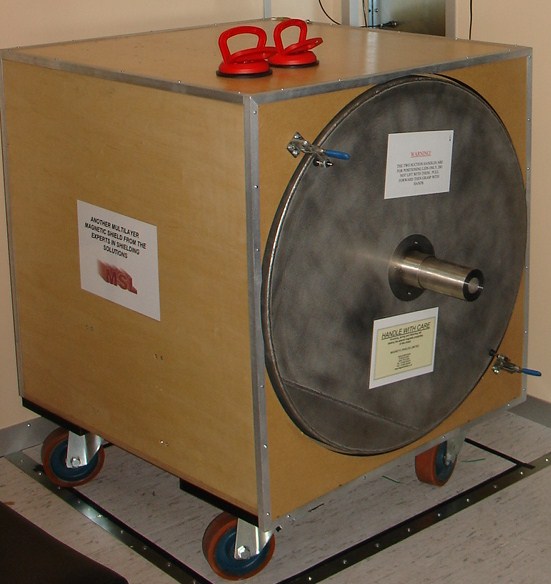
However, mu metal is still around. Modern applications include magnetometers, precision current sensors, electron microscopes, scientific instruments, and experiments that require extremely low magnetic fields. Commercial multi-layer mu-metal chambers are still sold for creating near-zero-field environments; with suitable construction and degaussing, some claim attenuation of static and low-frequency fields by factors approaching a million.
Quantum and cryogenic instrumentation have also created some 21st-century magnetic shielding problems. Ordinary mu metal loses performance at very low temperatures, so related nickel-iron alloys are made specifically for operation at liquid-nitrogen and liquid-helium temperatures.
Don’t Bend It
There are a couple of catches. First, mu metal gets much of its impressive permeability from its metallurgical structure. Machining, stamping, welding, or even bending it can introduce stresses and seriously degrade its magnetic properties. High-performance shields are therefore commonly formed first and then hydrogen annealed to restore their permeability.
So buying a sheet of wonderfully permeable material and folding it into a box isn’t necessarily the recipe for a wonderfully permeable box.
The second surprise is saturation. Mu metal is superb with weak fields but isn’t necessarily what you want closest to a powerful magnet. Its saturation induction is only around 0.75 tesla. In strong fields, manufacturers recommend combining it with a lower-permeability material having higher saturation capability, letting that outer layer tame the field before the mu metal handles what’s left.
History
British scientists Willoughby S. Smith and Henry J. Garnett patented mu metal in 1923 for inductive loading of submarine telegraph cables for a British company that built the Atlantic undersea telegraph cables. The seawater surrounding these cables added capacitance, requiring inductance to compensate. This was first done by wrapping the conductors with a helical wrapping of metal tape or wire of high magnetic permeability, which confined the magnetic field.
Mu-metal was invented to directly compete with permalloy, the first high-permeability alloy used for cable compensation, but it belonged to competitor Western Electric. Mu-metal was developed by adding copper to permalloy to improve ductility. Each 1.6 km of cable needed about 80 km fine mu-metal wire so there was a great demand for the alloy.
Other Tricks
Mu metal isn’t the only way to fight magnetic interference, as you can see in [FesZ’s] video below. Ordinary steel and other high-saturation magnetic alloys can redirect stronger fields. At higher frequencies, conductive copper or aluminum shields become effective through induced eddy currents. Ferrite is good at high frequencies, too, but is not very ductile nor is it very conductive. When you really need a quiet magnetic environment, active compensation coils can measure the ambient field and generate an opposing one.
But if the problem is a weak DC or low-frequency magnetic field, the basic trick hasn’t changed much. You just give the magnetic flux an easier path. Sometimes the old material in that 50-year-old television can be at home in a quantum computer, too.












The measurements “1.6 km” and “80 km” seem odd choices for comparison until you realize that they’re almost certainly converted from “1 miles” and “50 miles.” Since it’s just a ratio, you don’t actually need to do unit conversion. Just say “Each km of cable needed about 50 km of fine mu-metal wire.”
Speaking of relative, what does “relative permeability around 100,000 or more” actually mean? I really have no clue!
Relative permeability is a dimensionless quantity that compares a materials magnetic permeability to the permeability of free space. A relative permeability of 1 would mean the material is as permeable as the vacuum of empty space or in other words non magnetic. Irons tend to have relative permeability in the thousands and up.
Relative to the permeability of empty space (vacuum). Magnetic permeability has kind of weird units in SI, so people often take the permeability of the vacuum as 1, ignoring the units, and then everything is relative to that. So mu metal has about 100,000 times the permeability of vacuum (or air).
Actually the forerunners of the MKS (aka SI) system, the CGS systems, had the weird units. The Gauss-CGS used µ₀=1, dimensionless, which results in cm as the unit for both inductance and capacitance. Well, you can theoretically use anything for µ₀ and ε₀, as long as it satisfies µ₀⋅ε₀⋅c²=1, it might provide a convenient shortcut for a specific application.
Show off 😜
Show off.. MKS is a predecessor of SI
Look up the three commonly used CGS variants on Wikipedia:
https://en.wikipedia.org/wiki/Centimetre%E2%80%93gram%E2%80%93second_system_of_units
The rarely used Heavyside-Lorentz variant is the weirdest, it tried to simplify Maxwell’s equations by eliminating 4π in addition to introducing c:
https://en.wikipedia.org/wiki/Heaviside%E2%80%93Lorentz_units
Be warned, don’t dig too deep into this stuff. Side effects might not be covered by health insurance.
Alright, I don’t want to see any Korny jokes around here, understand?
Hey, nu metal ftw :D
no flux given
Well, I’ll follow the leader then….. OH DAMN IT!
Just pointing out, mu metal permeability fizzles out even at 100kHz from 100,000 to 2,000. At 1MHz maybe 800. Back in the day shielding was only needed for low frequencies, but today that’s all gone way up.
Modern EMC chambers use ferrite tiles.
Mu metal in transformers are legendary for the lower distortion and wide bandwidth compared to silicon grain-oriented steel. Jensen, Cinemag sounding very good lol.
Cutoff (as a transformer core) is related to strip thickness / particle size. The alloy is similar to (same as..?) MPP, used up to maybe low 100s kHz (beyond which losses are unacceptable). The average permeability is much lower though, due to the myriad airgaps in the powder construction. The cutoff (where |mu_eff| drops by 3dB say) occurs when material mu becomes comparable to mu_eff. So, material mu starts rolling off much lower than there (say, |mu| ~ 100k at some 100s Hz) — but higher than for strip, anyway.
Amorphous/nanocrystalline is made thinner than rolled strip, also achieves quite high (DC) mu, and has an initial cutoff around 10kHz. This is easily seen in CMC datasheets (the skin effect region has a |Z| ~ sqrt(f) asymptote, before capacitance (between layers, or of the winding) takes over).
AFAIK, the ultimate material limit (something to do with electron paramagnetic precession) is typically in the 1GHz ballpark? Ferrimagnetic materials are needed to go further (spinel ferrites also top out around here, but YIG I think pushes a bit further?, hence use in circulators, but also the interesting EPR effect used for tunable resonators).
As for shielding, skin effect works in your favor, so a low (magnetic) cutoff isn’t a bad thing per se! :)
Arguably, a conductive RF shield doesn’t “stop” RF radiation, but rather routes it around the area to be protected in a fashion similar to what mu metal does with a magnetic field.
An RF shield may route the energy to ground; but since “ground” is a rather squishy concept when it comes to everyday electronic devices…
When I worked at Burroughs a very long time ago, I worked on their cheque (check) reader sorters. It had a band of MU metal that protected the MICR read head. The band would get worn from the cheque rubbing against it. Never thought Mu metal is still in use
One thing not mentioned, but is kind of implied, that bangs, bashes and drops will reduce the relative permeability. So always handle it with great care.
Well, sources of stress — ultimately it’s work hardening, tangling up slippage planes in the crystal, which also pins magnetic domains, that also hardens the material magnetically.
Mu-metal in TV’s? Was this some kind of convention in North America?
In almost 50 years I have never seen mu-metal in a television, or around any other CRT for that matter (with the exception of some very old scopes). I have seen it being used in many other types of equipment.
I have seen mu metal in really old vacuum tube televisions.
I feel old. At my first job, I repaired this sort of set. Yes, they had mu metal shields. Later sets did not.
Vacuum tube TVs were a bit before my time, but that makes sense when you take tubes into consideration. Some of the older vacuum tube radios also used it for shields, and I have worked on those (as a radio amateur). I still have a vacuum tube radio manufactured within the last 55 years, that has a complete mu-metal chassis (combined transistor and tube design).
There was a mu-metal shield for the disk drives in the Heathkit H89.
I used to work for a company that digitzed old casette X-ray machines with digital detectors. We had some noise problems and tried, and partly did solve the issues with ferrite’s and mu metal.
I remember manufacturing a box for some noisy inductors from mu-metal. With minimal bending of said metal of course :)
I misread the title and thought maybe I was about to read an article about Nickelback instead of Nickel-Iron.
Hard drives use mumetal around the magnets for the head, presumably to prevent the strong magnets from affecting the platters.
I once ran across mu metal, circa 1989-90. We were prototyping a device and the CRT monitor’s magnet fields were causing problems with what was essentially a small, low velocity magnetic rail gun.
I thought the engineer who told me about it was pulling my leg. Shield from magnetic waves? Yeah, right.
So it’s like a Faraday Cage but for magnetism vs electricity? Neat. I’ve seen sheets of this in machines I have pulled apart…. you know… for science.