
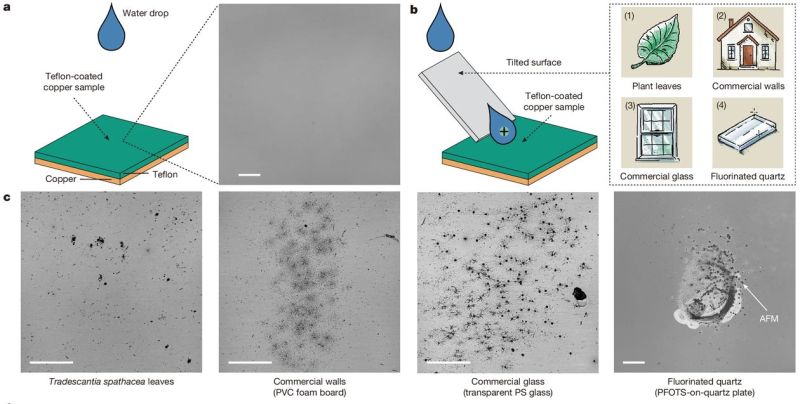
Generally, we do not look at the gentle patter of raindrops on a surface with much concern, but according to a study by [Zhongyuan Ni] et al. in Nature, we should probably regard these droplets with a little scrutiny for their corrosion potential. What they found is that these drops can gather a significant electric potential as they gently slide down a surface, with over 1 kV measured. By first having droplets charge up on an insulating surface before hitting a target metal surface, they were able to induce significant corrosion.
Despite the target metal surface being coated with a protective layer, these charged droplets managed to gradually break down the coating, exposing the bare metal. In this example, a Teflon coating was used, with water droplets containing a small amount of dissolved sodium chloride to simulate natural raindrops.
It was postulated that this causes dielectric breakdown of the insulating protective coating, as the charged water drop acts as one electrode and the — often grounded — metal surface as another electrode. Subsequent investigations on the samples showed that this appears to be indeed the case.
A potential defense here would be to discharge any water before it can reach sensitive surfaces, but it’s not a straightforward problem to solve. As noted in the study’s conclusion, charged droplets can also be generated in clouds and waves, in addition to the insulating materials demonstrated in the study. It’s also a phenomenon that can cause issues anywhere charged droplets occur, such as in a wide range of industrial processes.
If you’re interested in the electrical generating properties of falling water, check out Lord Kelvin’s Generator! Hackaday’s own [Steven Dufresne] explored this phenomenon a few years back.












1Kv on a single raindrop is pretty mind-boggling. I know the amount of energy is still minuscule, but still.
Never even heard of fluorinated quartz… Just a laboratory-grade material for generating static electricity? I’d read an article just on that. I wonder if it’s possible to make at home? …Although I don’t want to get anywhere near fluorine chemistry.
It’s 1 kV (and not 1Kv, k = kilo, V = Volt, always a space between the number an the unit). The voltage ‘benefits’ from the quite large mass of a waterdrop (voltage proportional to the mass). The voltage is inversely proportianl to the charge.
See also the Kelvin water dropper https://en.wikipedia.org/wiki/Kelvin_water_dropper
Guess I’m not used to thinking of the mass of a water drop being quite large, but it is a different domain we’re talking here isn’t it. That’s a pretty clever gizmo.
Another day, another totally unexpected physical phenomenon that makes perfect sense once explained.
Maybe waterproof coatings could be made of slightly conductive materials, like ESD mats are, to let it discharge more smoothly?
That might result in galvanic corrosion :)
Water droplets on a car are like mouses gnawing at cheese.
Still, powder coating on a car lasts for 50years.
Maybe a discharge mechanism going on?
… unless you don’t like dusty cars and wash it :o)
Now what if it isn’t a gentle slide? Like a plane/drone made of modern non-conductive materials flying through a cloud? I guess the droplets would immediate turn in big drops but if they already have a charge you just have a big charge in a big drop as end-result I would expect. Those drop would then fling off and leave a charged trail?.. So, can we detect a F35 that way? Asking for a friend :P
Makes me wonder how long the slide of the drops has to be anyway.
Time to start experimenting flying drones/planes into clouds with measurement sensors. There are some places on earth with natural rock formations where where you can look down on clouds below you from above. Cape of Good Hope and the Cape Peninsula (South Africa) is one that comes to mind, I am sure that there are more. The legality of doing it from a tourist attraction, I have no idea. And it is a long way down to the clouds, you could easily loose your sensor array fighting against a gravity well.
More
https://phys.org/news/2026-09-droplets-mechanism-mobile-ions.html
On fluorine
https://m.youtube.com/watch?v=noofu82l8mg&pp=ygUJRmx1b3JpbmUg