
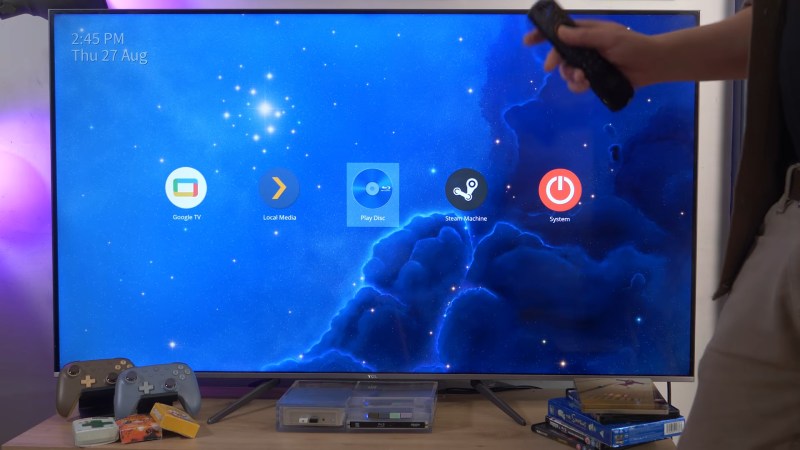
The Year of the Linux Desktop hasn’t been on its way for quite as long as nuclear fusion plants, but somehow it seems to recede into the horizon at just about the same rate. Every year, it’s another year in the future. You know what isn’t a desktop? A television. [Haggis on Toast] makes a case that while there may be barriers to desktop adoption, there’s no reason not to use Linux for a set-top box, and shows one such build in a recent YouTube video.
Of course everyone knows commercial set-top boxes and “smart” TVs alike run Android, which is built atop a Linux kernel. Those are getting steadily more frustrating to use as corporate enshittification continues, so why not DIY? [Haggis]’s build uses a miniPC in a custom 3D-printed case, running Nobara Linux with a Waydroid TV build to provide the Android set-top box experience, plus light/casual gaming via Steam.
Control is via gamepads or a cheap USB remote, with the frontend provided by DeckyLoader. Getting it all set up might be a pain if you’re new to Linux. However, everything comes with easy installers, so it should be a breeze if you’re more than casually computer literate in any other operating system. The most intimidating part of this build is probably reflashing the Blu-Ray player to unlock the ability to play and rip 4K disk content. But if you’ve embraced the death of physical media, you can skip that part.
Ironically, old Android TV boxes can also be repurposed into headless Linux machines.
Thanks to [Keith Olson] for the tip!












As streaming continues to enshittify, the HTPC (and its associated ability to play discs, archive files and leverage ad block) becomes relevant again.
No proper DRM with L1 Widewine codec.
That means:
No Netflix, No Prime, No Hulu, No Paramount+, No Disney+, No HBOmax.
All of those streaming services are garbage, not missing much.
To be honest; yes, most content is garbage. The algorithms that suggest new stuff are even worse. But every once in a while you get to see something really good.
Unfortunately the “constant rental” system (aka. subscription) is the only thing we have for content. I assume it won’t change the next 20-40 years until someone comes up with an even worse system…
I neither miss linear TV, nor plastic disks nor magnetic tape. I enjoy watching streamed stuff. I rarely ever re-watch something. The only reason I sometimes tune back to linear TV is to get some livestream of News, every couple years, i.e. election results. That’s it. Not into watching Live Sports.
There’s always piracy.
Not that I would, of course…
when buying doesnt mean owning.
Then piracy isnt stealing. (aka ‘buy’ a movie/game/series on prime/playstation/etc only for them to loose licenses and take it away)
Breaking Bad was pretty good and it used real-life chemistry for its plot. I also miss Dr House.
Not to advertise but I’m (pleasantly) surprised that Apple has had some pretty good shows, ongoing.
Netflix sort of stepped back from making good English-language shows. Not sure how they do in foreign language, some of those shows get praise but I can’t judge if that is justified. I wonder what percentage of their income is foreign now, it might surprise.
Wanna watch Ghost Busters? Sorry. Spaceballs? Nope! Anything decent? Negative, ghost rider. In Los Angeles, we at least have Vidiots.
Do you mean that you cannot use L1 Widevine codec at all on Linux? Because this is demonstrably false. I use Firefox on Ubuntu 24.04 and watch Netflix regularly. On Android I also watch Netflix via the standard app. It did not work straight out of the box on Ubuntu, but neither was it terribly hard to set up. It’s just a matter of downloading them.
Widevine is absolutely supported on Linux. Google’s own Widevine documentation explicitly lists Linux as a supported desktop platform, and specifically lists Chrome on Linux, Chromium, Firefox, Edge and Opera as supported Widevine platforms.
There’s Widevine and there’s Widevine. Yes Linux supports Wideven L3. Widevine L1 needed for 4k content is not supported. Some streaming services even look down on L1 so much they give you crappy bitrates and not even 1080p.
In other words Widevine L3 is totally insecure and can easily be ripped. L1 is much more secure and doesn’t work on Linux.
I would never connect a TV to the internet.
Only complete fools without self-respect, like popular tech journalists/youtubers, do that.
Don’t worry, the TV will connect on its own.
Got a Samsung TV that can’t seem to call home because you refuse to connect it to a network, or do connect it and block access to where it wants?
No problem! It will save up the data and then connect to a helpful Samsung phone over a convenient custom wireless protocol!
Don’t have a Samsung phone?
Also not a problem! One of your neighbors might! Or someone walking by on the street, or a delivery person, or a…
Using a smart TV as a dumb display isn’t safe in 202X.
Unfortunately we either need a custom firmware for these devices that we control (and they will fight against) or to open the devices and start cutting traces to disable the microphone, wireless chips, etc.
It’s pretty insane.
You don’t need to worry about that if you install Jellyfin. Plus there’s a bluray drive so you can rip every movie you own or borrow.
I wonder how many will simply abandon watching television entirely when the UK switches off over the air TV entirely rather than go out and spend money on a new internet only television.
Although I guess it does also beg the question of pirate television.
Will the grip be tightened such that online television becomes a walled garden.
Piracy much like drugs involves someone taking that first hit, and since there’s a lot of content out there, that’s a lot of hits.
In my experience and based on who I talk to, most people don’t look for “online television” as much as just change their viewing habits. Movies or series tend to come from streaming sites, but no one really watches the filler stuff that you find on tv anymore. Instead, and in some cases in replacement of series and movies as well, just watch Youtube or Tiktok or whatever else. There are a lot of interesting videos and series made by ordinary people. In some regards they are far more interesting and often cover niche topics. Why watch some crap you don’t really care about because it’s the only thing on when you can watch something you actually find interesting whenever you feel like watching it?
I don’t watch tv at all anymore, hardly even series on Netflix. It all seems so dumb to me that I just can’t stand it. However I do watch certain things on YouTube. My tastes have certainly changed, and it’s because I now have real choice in what I watch and I’m not at the mercy of the network and their time slots. When it comes to subscriptions, Netflix has the right model. Others think they can charge far too much for far too little. That’s where piracy trends have shown us that if the price is too high, people will pirate, and if it is cheap or just right, they won’t bother. Charging and playing ads is not the model it once was. People will just block ads and if possible still not pay.
Actually avoiding an internet by design television seems impossible these days – to get a replacement for my grandparents that wouldn’t do anything odd and keep asking them to pay for some new streaming service (which would mean lots of tech support phonecalls for me) I ended up having to buy a PC monitor for them!
Wow, I did not know it had gotten that bad.
I do hear about people that bought TV’s and who then do not connect them though, but I guess they know were to find the info on models that you can buy safely.
Addendum:
Maybe it also differs per region and local law what the companies dare to do to the consumer.
Yeah, never connecting them sort of helps makes the smart TV less obnoxious but it really doesn’t make them OAP suitable – I’d get way too many tech support calls over nothing, and trying to deal with them over the phone on something as technical as actually reading the popped up window begging you to plug it into your network far enough for me to know what it is and then painstakingly guide them to hitting whatever passes for “No I just want to watch TV”.
For folks with so many decades on them that computerised technology was never really something they understood or got on with even the best of the smart “never connected” TV I’ve experienced would be far far too confusing for them to deal with on their own. And with how shockingly poor the app stores and all the streaming services they’ll probably be able to sign up for but not figure out how to leave and such on them are its not something it is safe to connect up and just let them play with.
They don’t advertise them very much, but meeting room screens are robust and internet and AD free, and come in large sizes too. Just plug whatever source you want in them. Price wise they are similar to the smart TVs, but have longer expected lifetime.
Yeah looked for them as well but they don’t seem to exist at the size needed for this particular room (at least I couldn’t find any in the amount of time I was willing to search), and ultimately are basically just a PC monitor functionally.
We have been doing this for several decades. We no longer bother with the DTV dongles though, the content turned do complete garbage and lies, so now we stream our own curated multimedia content, and add things such as a home wiki which turned out to be a more heavily utilised mode in the end.
You gotta consider staying in the loop on what lies are pushed though, then you know what agenda is pushed and then you are informed on what is being done and possibly why it is done and by which groups, and then perhaps you are less blindsighted by what they will try to pull.
But it’s so tiresome and depressingly nasty though.
I have local AI for that, monitoring the situation. Google dropped a very good time-series prediction model recently too.
My 4 year old 43″ 4k Android smart TV is perfect for my utility, i really don’t need any more. It’s TCON board failed, and i didn’t want to spend my time figuring out the exact MLCC that failed so i bought a new one for 30 USD and made it work again
My only compain is, android smart tv manufacturers ship TVs with really such anemic hardware, it makes them really less functional despite decent panels. A dual core and 2GB RAM and 8GB flash for an Android TV, in 2026? Of course it’ll lag even playing youtube!
Still i will admit, they are doing phenomenal work with keeping the TV prices constant for years despite inflation
I think Android is the bottleneck. If it was possible to port a much lighter and open system such as say Alpine Linux on that hardware, the power and RAM wouldn’t be an issue anymore. 8GB are already more than enough for say a full LibreElec install and a Alpine desktop would fit in half of that RAM.
I second that – average “smart TV” now is about the equivalent of ESP32-C6, when compared with the average PC/laptop. Maybe the uppity uber ones are not, but the budget ones seem to be that piddly in comparison.
A lot of people I know don’t even bother, they buy the cheapest large TV and connect it to the cheapest laptop’s HDMI out. Average laptop now can handle 4K streaming just fine, and some even can do the uber-impressive upscaling from older/lowrez formats into 4K.
Having said that, I am kind of surprised gaming-level TVs didn’t become a reality. I would expect that people would want for the TVs to join the gaming rig fray as well, but maybe I am less right, and average Sam is not really into GTA tournaments. At least I haven’t seen smart TVs that would offer, say, Solitaire or Tetris or Frozen Bubble. At least not in the US, which is not the largest smart TV market anyway.
I think you are both off on this.
Smart TVs are awful because they are loaded with spyware, go out of date easily and are practically impossible to upgrade. Better to use a separate device to feed a TV and let it stay offline.
RE: “…Better to use a separate device to feed a TV …” that’s literally what I said in the second paragraph. Cheapest TV fed with HDMI from a PC/laptop. With PC/laptop there are choices – one is not locked into some kind of proprietary hardware with spyware baked in, and can upgrade easily.
I think similar pattern happened earlier, btw, late 1990s/mid-2000 with not many noticing, but it did make a HUGE difference at the end. Once home/budget PCs became powerful enough to run music processing (or synths, or anything that has to do with music, mixing, editing, etc), dedicated hardware keyboards/mixers/compressors/etc market shrunk to maybe 1/10th if not less. Right now average Sam with his $400 laptop can do what a million-dollar recording studio was doing in the 1990s, and with better quality overall, too, since one now can do other things, mastering, etc, using hundreds of pre-baked solutions that come included.
Professional keyboards, one example I know reasonably well, had to lunge forward to stay ahead of PCs, but they still got stuck behind – most now require you to have a PC/laptop near to “make better use” of the features, which to my naive/simple mind means that they’ve largely lost. If I am to buy a good quality sound board for low latency throughout (most, even budget ones, are low latency), then WHY do I even need a keyboard with its own dedicated/unrelated sound board? Keyboard makers decided to go the Casio Accompaniment way – pack in as much prebaked stuffs as possible, since they can (all those closed up recording studios that went out of biz due to MP3 revolution … their archives were probably bought on the cheap and repackaged as prebaked things … but I digress, sorry).
Back to the topic at hand, the smart TVs I’ve personally seen recently were nowhere near close to gaming rigs; to me it seems they are heading in the same direction the budget-level keyboards of the 1990s were, towards obscurity/insignificance overall. Professional keyboards level the Smart TVs are not, with professional level stuffs you have the recording studio level of sound processing, and smart TVs are not video studios of the 1990s by any stretch of any imagination, that’s why I gave them the ESP32-C6 equivalent of computing power. Advanced VCRs, maybe, but not much smarter than average cable converter box with a VCR included. Browsers, yes, some TVs have them, but again, those are “lightweight”, ie castrated browsers that cannot do much, really.
Android OS that seem to be prevalent choice for the Smart TVs, too, is not full-blown OS either, it still pales in comparison to “regular” OS on a laptop/PC, and I’ll stop at that. :]
Having rambled through many junctions on the way through towards my punchline that I’ve forgotten, there exist dedicated and not so badly made overall OSs made for the sole purpose of avoiding for-profit cartels. I know one that I’ve used for some while, and it could run within 500MB (that’s Mega-Bytes) of RAM quite comfortably, I think it was something like Dynebolic OS, and it wasn’t the only one, just the one I found relatively easy to use. I don’t fathom I’d want to explore rooting average Smart TV and installing Dynebolic, but that’s the path that I’d think of if/when I find I need a challenge :] Funnily, now I think RP4/5 can surely pull that off with ease, again, times of dedicated/locked-in hardwares were late 1990s/mid-2000, and that was also the times when in the US it was quite obvious that the cell phone companies did NOT want you to know that you can buy a cell phone and put in a SIM card of your choosing. Most would not even cell phones that won’t be locked into their exclusive networks only.
Sorry for the long rag chew. I think it was worthy :]
Honestly, the formatting and the lack of relevance makes this “long rag chew” feel unworthy of it’s length and frankly like an unhinged rant post.
I’ll give you that you did mention what you said, but I disagree with your overall determination and desire for “gaming” TVs. Tying something big and expensive to other expensive hardware that also can go out of date rather easily, does not seem like a wise choice at all. It makes it significantly harder to upgrade, more expensive, and, without root access, just gives the manufacturers more vectors into your home.
At the absolute most, I could see them stuffing console hardware into TVs so that you had something like a TV with a PS5 built in. However, that has already been tried in the past and never caught on.
I tried a Linux set top box many years ago and found the video playback wasn’t very smooth. Sounds like it’s time to try again after many years of using a Windows “set top box” and a Linux file server.
It has improved. You may need to tweak some graphics drivers to ensure the screen tearing is fixed. Those settings are turned off by default for whatever insane reason.
I’ve been using MythTV as a Linux TV for nearly 20 years now.
I’m surprised everyone doesn’t use it. In the transmission days it de-enshittified TV.
https://www.mythtv.org/
I find the headline misleading. Not sure I would have looked if it said: “Is This The Year Of The Android … Television?”
It is Linux though. Way droid is just a VM and not required nor running the show.
The video suggest that WayDroid is not just a VM because it uses the kernel of the host. So it’s probably more like a container.
The article is about a Linux TV box which includes the ability to run Android TV apps, it’s not an Android TV.
Phh. We were doing Linux-based streaming STBs at least 25 years ago. Thought thinking about it, we were using Linux as a desktop os too…
My TV has never had a network connection, it’s HDMI from my AVR which is fed by my PC.
I connected mine to the network once, to do a firmware update when I brought it home, then pulled the plug.
https://youtu.be/6IFVTcM28KA
Even still they can be bad actors.
But you’re are never making someone use Linux that simply doesn’t want to use Linux, stopp trying to tell me how to use my computer, I can actually build chips for…
Only when I switch to Linux GBAtemp hacked it and stole terabytes of data
Didn’t happen using official copy of Windows
Governments especially ain’t using Linux…..
I wish I could make my smart TV dumb. I never use the smart part and it takes “forever” to start my TV. I just need it to start with HDMI 1 and just ignore the smart TV part. Now I turn on my Steam Controller, it turns on my Steam Machine, I then walk away and come back two minutes later when everything is booted, because the TV is just so slow.
I was looking into that. The idea is that shopping malls and shops use TVs are POS (point-of-sale ) devices, billboards. In the past, these where sold as as dedicated devices.
But, it is costly to build and warehouse multiple SKUs. So, there must be a way to turn a television into a dumb HDMI display device, that does not accept remote input….
Google: “Enabling POS mode on a Samsung TV” , or your favorite TV brand.
The Nobara link is a YouTube link that asks whether it’s ok to leave YouTube, before going to the Nobara site :).
The past/present/future is Torrent.
It’s a $750 mini pc and a USB Bluray drive in a custom enclosure. Absolutely none of this is new or novel.