
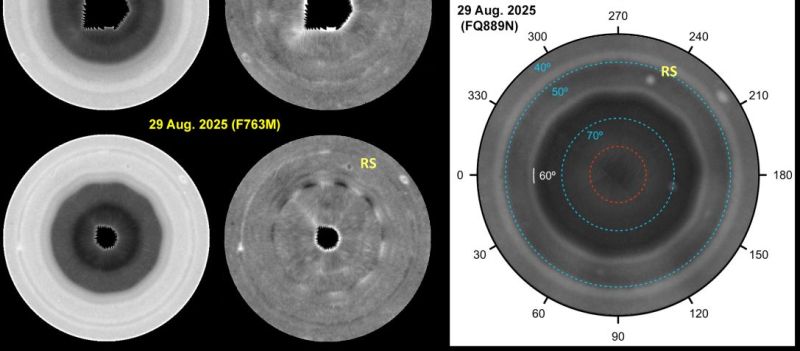
Although some would argue that the hexagon is the bestagon, astronomers have discovered that Saturn appears to favor the ten-sided decagon on its south pole. This comes as its south pole has recently been confirmed to show a pattern that’s oddly ten-sided, per a recent research article by [Agustín Sánchez-Lavega] et al. in Science Advances.
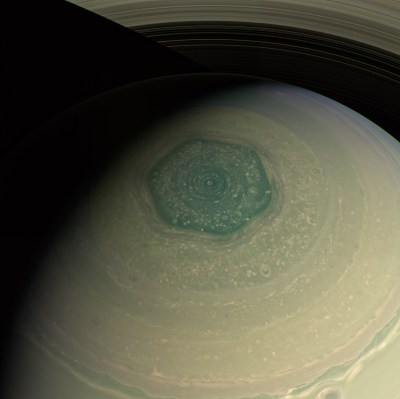
Because Saturn is a gas giant, this naturally isn’t some gigantic planet-sized rock formation, but rather an interesting wave phenomenon in this massive gas bubble. The hexagon shape on its north pole had been known about for a while already, so it is perhaps not too surprising to find something similar on its south pole.
These shapes are generally the result of standing waves within a polar vortex, through the interaction of waves in Saturn’s atmosphere. For the north pole hexagon, the formation is driven by an intense eastward jet, but no similar wave had been reported for the planet’s south pole.
While in this paper a decagon shape is identified based on multiple observations, they postulate that it’s due to a meandering wave in the area rather than a jet as at the other pole. This clearly doesn’t make this wave pattern as obvious as the one at the north pole, but it provides another fascinating insight into fluid dynamics scaled up to a planetary gas giant.












It is politticaly correct to say that some…body (celestial body) has a ten sided bottom? Tsss.
Keep cool, this was about Saturn, not about Uranus…
Americans should learn to pronounce, at least, non English words in the proper way.
U in Uranus is pronounced U, NOT You. If you prefer the Greek form over the Latin one, it’s Ouranus. Still not “YOU”ranus
Thence the worn joke above is just rootless.
Whooosh
In Greek, it’s Ouranós. Ο Ουρανός. The stress is on the last o (where I put the acute accent).
I just thought I’d join in with the pedantism… :)
It’s not pedantism, it’s matter of [lack of] respect for cultures.
Aglosaxons, in general, expect that everyone around the world pronounce the English terms correctly, but doesn’t deserve the some treatment in the opposite direction.
It’s plenty of Latin or Greek words where “eye” is used in place of I for no reason.
Like virus, (and even Nikon, which isn’t Greek or Latin but still…)
It’s plenty of words where “e” is pronounced as “i”, like media/multimedia.
It’s plenty of Italian word of common use in English where the singular or plural form is used randomly, no matter the context, like “Lasagna” (singular), salami/zucchini/broccoli (plural).
And so on…
@[The Solutor], adapting loanwords into the phonetic system of your language is normal in all languages.
I am one hundred percent certain that you do not pronounce the loanwords in your native language the way the people of those words’ origins pronounced them, and you certainly don’t maintain the grammatical rules of those original languages in your native language.
“Anglosaxons” (a people who have not existed for nearly a millennium, so I’m going to assume you mean native English speakers) do not expect everyone around the world to pronounce English terms “correctly”, in fact the role of English as a lingua franca means native English speakers are more accustomed to hearing English words pronounced in different ways.
@The Solutor
We aren’t talking about Anglo-Saxons, but Americans, who aren’t all Anglo-Saxon and who don’t insist on pronouncing English correctly at all. Ask a Brit.
(And yes, it’s spelled ‘Anglo-Saxon’ not ‘Anglosaxon’.)
Commented in jest
Scientist stopped calling it that decades ago to prevent that old stupid joke.
It’s now called ur-rectum
All this talk, but the point is made though: Saturn says ‘if you land here you’re screwed’
Ehm.. no.
Perhaps that’s not even always true in English speaking world.
You don’t say Eyetaly or Eyendia or Heymerica.
It’s just that the spelling is applied randomly like in all English, so when borrowing/stealing a term why not adopt the original correct pronounce?
Don’t mix nuances and accents that is normally to get wrong when moving across different countries/cultures.
Here here is purposely adopting the local rules to something imported, even at academic level, more matter of selfcenterism rather than ignorance.
“You don’t say Eyetaly or Eyendia or Heymerica.”
Google for a list of English words that start with an “I” and you’ll see that most of them are NOT pronounced with a starting “eye” sound so I’m not sure what you’re trying to say here.
I suppose that when you have the largest number of moons of any planet in the solar system, you can do whatever you want.
[Anyone consider that perhaps, just perhaps, this not-so-strange pattern is a consequence of the very large number of moons? You read it here first, folks]
I counted eleven. The pattern becomes weak in the lower left quadrant, making it difficult to say for sure.
One of the co-authors of the paper is A Bloke In A Shed: https://www.abc.net.au/news/2026-09-07/outback-amateur-astronomer-part-of-saturn-decagon-wave-discovery/107112590
… A really nice shed that is a home-made observatory. Hackaday could do an article on Trevor Barry.