
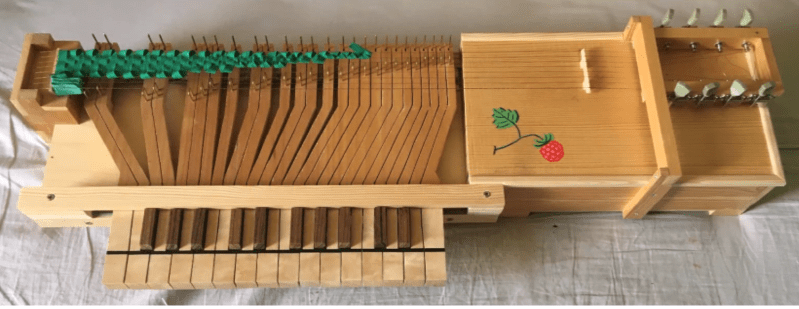
The Clavichord needs no introduction to fans of Early Music, and a lengthy one to literally everyone else. Even classical music buffs who have heard of Bach’s works for the “Well-Tempered Clavier” — another word for clavichord — will mostly have heard them performed on Piano. That is perhaps fitting, as the clavichord is a distant ancestor of the modern piano. It has keys — though fewer of them than a piano — whose action strikes strings — though much, much fewer of those than a piano, as each string is required to generate multiple notes. [Ian Summers] has an excellent guide on how he built his, though be warned that that link goes to a PDF and the SSL certificate was having problems as of this writing. If you aren’t comfortable grabbing a PDF over old-style HTTP, we’ve embedded the demo/build video below so you can give a listen to what this pre-piano instrument sounds like.
[Ian]’s Clavichord isn’t a pure reproduction of a historical example, which makes it unusual in the world of Early Music where most obsess over authenticity. That means [Ian] was able to document his design decisions and why he built the instrument the way he did. There are two octaves and ten strings, which means each string is expresses two or three notes since this instrument is fully chromatic– that means there are ‘dark’ keys for the sharps/flats. Like a piano, the keys whack the strings to make sound, but unlike a piano, they do so directly: no mechanism and no hammers, which makes for some interesting differences in the sound. You can add vibrato, for instance.
[Ian] accomplished this build entirely with traditional woodworking, unlike the 3D printed piano mechanism we saw recently. There’s enough meat in the guide, and the instrument is simple enough that we suspect it would be easy enough to adapt the design to make it with extruded plastic or laser-cut parts, like this Zither.












Super cool project! Pedantic note: ‘clavier’ is more of a generic term for keyboard instruments, rather than being interchangeable with clavichord specifically.
I wonder if more mass in the tangents would give more sustain to the notes, some are really shorter than others. The thin wire form takes energy out of the string rather than holding it longer damping vibration into the soft wooden keys.
No, it won’t. This has been tried during the ‘revival’ period of these early keyboards in the second half of the 20th century, when makers thought that the modern piano technology and experience will help to improve the acoustics of these quiet instruments. Revival period instruments are greatly despised by serious amateurs and professionals. No one these days tries to improve them and only replicas of good original models are made.
Seems lovely, but unfortunately I can’t check the PDF because of an SSL error (SSL_ERROR_NO_CYPHER_OVERLAP)
for this one, you can get the content if you remove the ‘s’ from https, if your browser will let you do that (i used wget).
i’ve been getting this kind of error, especially from ssh, more and more lately. some developers are rapidly obsoleting long-standard ciphers, usually in preference to a ‘quantum ready cipher’ or ‘post-quantum encryption’ or whatever. On the one hand it’s simply frustrating as a user — i’m not actually fighting against the kind of advanced persistent threat that will bother to capture and then decrypt all of my traffic. And on the other hand, the language they’re using is all wrong! There’s no bogeyman using a quantum computer to crack encryption. Yeah, brute forcing keeps becoming more plausible as cpu/gpu hardware improves, but quantum computing is still a pipe dream / salesman’s fraud.
vexing all around. 99% of the time, i just want https to be good enough to prevent my isp from injecting ads.
Most people live in the cloaca of information and should not be allowed to use encryption. Period.
You use Chrome or IE you suffer from ads. Simple.
The SSL certificate industry is in the process of changing the length of time that a cert is valid, from 398 days or whatever it was, down to 47 days by March of 2029. Certs are currently valid for 187 days or something like that; the next step will be 100 days, and then finally 47 days. This is not the same thing as the yearly renewal that you pay for to your registrar or other SSL source.
Also hopefully familiar to fans of Wendy Carlos.
Impressively ambitious woodworking project. That cloth ribbon woven through all the strings is really interesting, kinda makes me want to try my hand at some luthiery
I’ve got the pdf to 1/3 of it’s size without perceivable loss in quality.
Edit: that sounded rude. Just wanted to say that somethings off with his generator.
It’s sad that nowadays you have to convert your PDF to a video (a video for F’s sake!) in order to get the deserved attention. Feels like blog post like era is long gone. Anyway, nice build!