
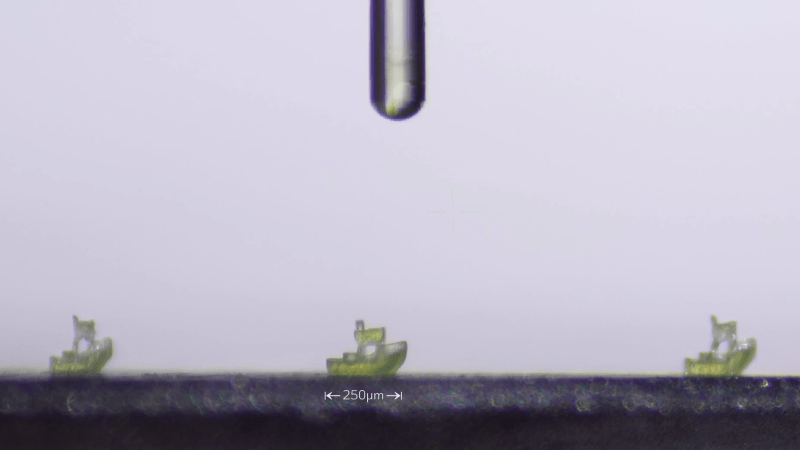
Resin 3D printing has opened up a whole new scale of resolution for hackers, but the technology can go still finer; commercial micro-SLA and two-photon polymerization printers can print items with sub-micron feature sizes, but the machines are well out of reach for hackers. There’s more than one way to get such high resolution, though, as [Diffraction Limited] demonstrated with his micron-scale resin printer.
The printer builds on [Diffraction Limited]’s previous micro-manipulator and fiber-coupled laser. The micro-manipulator holds the end of the optical fiber just in front of the build plate, which is coated with resin. A 405-nm laser shines through the fiber, curing the resin in a narrow cone in front of the fiber’s core, which the micro-manipulator can trace in a pattern to build up objects, much like an FDM printer. Since the fiber’s inner core is only three microns across, the cured resin shears cleanly away from it when the fiber moves. Since the principle is so similar to an FDM printer, a standard slicer could be used to generate the tool paths.
Early testing proved that the principle worked, but the resin wasn’t absorbent enough for very high resolutions; UV light passed through previously cured resin too easily, limiting the minimum layer height. A UV-absorbent dye dissolved in the resin solves this by limiting the light’s penetration depth. [Diffraction Limited] found that curcumin, the natural dye responsible for turmeric’s bright yellow colour, worked well for this; as an added bonus, alcohol easily extracts it from turmeric powder. This solved the resolution issues well enough for [Diffraction Limited] to print a series of Benchies 150 µm long, a Stanford bunny dwarfed by a human hair, and a few other microscopic pieces. Conveniently, the curcumin dye leaves the printed objects slightly fluorescent under UV light, making them easier to pick up under a microscope.
For a slightly different approach to FDM-inspired microscopic 3D printing, check out necroprinting. For the absolute limits of 3D printing, check out the world’s smallest Benchy.












I had just watched this and came here to see if it had been shared!
The detail is astounding – I want to know how long a tabletop RPG figure would take to print :D
Good news! You can finally fit the entirety of your epic dungeon on your dining room table. Bad news: in order to do this and maintain accurate scale, you now need optical tweezers to move the pieces around.
What is this? A 3d printer for mycoplasma? How can we be expected to teach living cells to learn how to 3d print… if they can’t even hold the output?
hands down candidate for Hardware Hack of the Year Award right here.
amazing work
Ok, initially I thought how cool. But then I realized 250um benchy is actually quite large. With current standard 16k resin printer you get 14um resolution, so that’s almost 20 pixels for defining benchy (in one axis) and with interpolation that’s plenty. So I can do comparable job on standard printer and good resin especially if I go 365nm which is sharper. I wonder why you just don’t do 2-photon homemade.
By volume that is 64 Benchies to one!… if the 16k printer can do single pixels.
The other thing he did is add an addative to prevent light bleed in the resin, which he found was needed to push resolution as low as he did.
I wonder how the light bleed resistance of off the shelf resins compare to the resolutions of the best screens these days.
“So I can do comparable job on standard printer and good resin…”
I would be willing to bet a considerable number of Brownie points that it aint that easy. How bout you fire up the printer and post up some pics to prove me wrong?
Thats going to be one blocky butt ugly attempt that MAYBE might look benchyish if you squint really hard and know what its supposed to have been so you can delude yourself into believing you can see a benchy in the blocky blob.
Disagree? get to work proving me wrong bucko
No offense but you’re way off. For one thing, 20 pixels length-wise isn’t nearly enough to get comparable definition to what was shown even just at a glance, even if it were 250um. Interpolation isn’t going to help with that for minimum feature definition, it helps with smoothing but doesn’t give you sub-pixel feature resolution.
For another, the article at least says: “a series of Benchies 150 µm long”.
The approach described in the article is fascinating, even if relatively impractical since it suffers from the usual curse of fdm compared to masked lithography. But it does make one wonder about whether similar 3-4um feature sizes could be achieved with lenses and a screen mask. The curcumin use is also very interesting and I’m wondering if it might have other uses in more regular MSLA printing. Obviously the immediate trade off becomes layer height.
Yeah… No.
20 micron pixels still has nothing on 3um laser, you’re getting about 44 laser dots in that one 20 micron pixel so not even close to the same potential, a 14um pixel you got 21 laser dots so still not even comparable theoretical best resolution (also those 14um pixels are usually rectangular with the other length being 17-19 so worse than you would think)
You can’t easily even get single pixel accuracy without very complex workflows and a lot of testing and simulation I can garuntee is impossible without being part of a lab dedicated to this type of work and research. I would know as this is what I do. Although tricks like the tumeric would really help in getting you closer to that but you still need to understand much more than simple exposure time calibrations.
365nm is not sharper, not at least at these resolutions. It has lower penetration depth, meaning you would need less tumeric, it doesn’t change the width of your pixel or laser.
I can garuntee if you tried to make a 250um benchy yourself you’d get a undefined blob. If I tried with all the gear I have and protocols for this I’d get at best a blocky blob that resembles a benchy if you squint enough
Aztec patterns for FASA starship miniatures?
Just what the world needs… more f-ing tugboats!
When are they going to print something meaningful, like a baby yoda?
Hmmm… Done right you could actually have an avenue for 3D printing micro channels. I could definitely see a host of need microfluid circuits being made and exploed on the cheap if they can nail down some of the optimizations.
*new
My life for an edit button!!!
I was just thinking if this might allow a hybrid of sorts.
The Destroyer saucer from Independence Day had elaborate lower surface detail…so I wonder if injection molds might have tiny holes/pass-thrus with many small such 3D print heads to give details upon an injection-formed model.