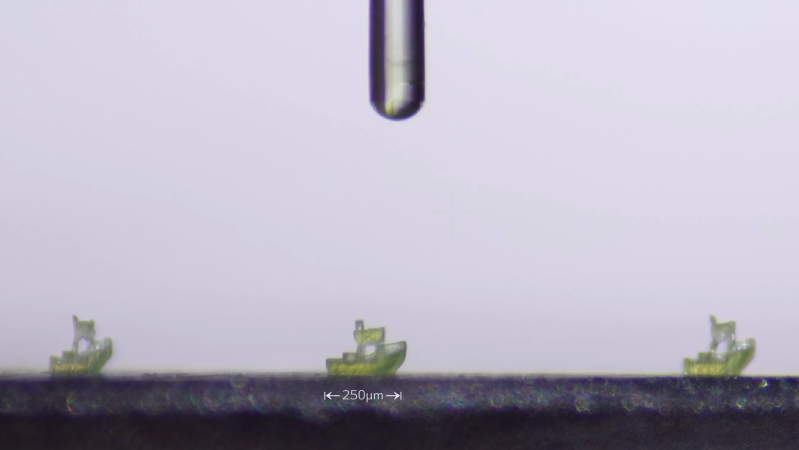
A white background is shown, with a grey metal plate at the base of the image. On the plate are three tiny green Benchy models. Above the Benchies is a glass cylinder. Below one of the Benchy models, text says "250 µm".

Printing Micron-Scale Benchies With Resin And Turmeric

Resin 3D printing has opened up a whole new scale of resolution for hackers, but the technology can go still finer; commercial micro-SLA and two-photon polymerization printers can print items with sub-micron feature sizes, but the machines are well out of reach for hackers. There’s more than one way to get such high resolution, though, as [Diffraction Limited] demonstrated with his micron-scale resin printer.

The printer builds on [Diffraction Limited]’s previous micro-manipulator and fiber-coupled laser. The micro-manipulator holds the end of the optical fiber just in front of the build plate, which is coated with resin. A 405-nm laser shines through the fiber, curing the resin in a narrow cone in front of the fiber’s core, which the micro-manipulator can trace in a pattern to build up objects, much like an FDM printer. Since the fiber’s inner core is only three microns across, the cured resin shears cleanly away from it when the fiber moves. Since the principle is so similar to an FDM printer, a standard slicer could be used to generate the tool paths.

Continue reading “Printing Micron-Scale Benchies With Resin And Turmeric”
Computers May Someday Need A Drink

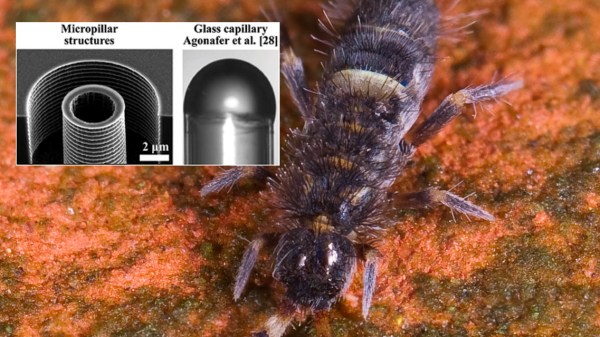
“We want to put water right into your processor.” If that statement makes you sweat, that is good. Sweating is what we’re talking about, but it’s more involved than adding some water like a potted plant. Sweating works naturally by allowing liquid to evaporate, and that phase change is endothermic which is why it feels cool. Evaporative coolers that work in this way, also known as swamp coolers, haven’t been put into computers before because they are full of sloshy water. Researchers in South Korea and the United States of America have been working on an evaporative cooling system mimicking the way some insects keep themselves cool by breathing through their exoskeletons while living in damp soil.

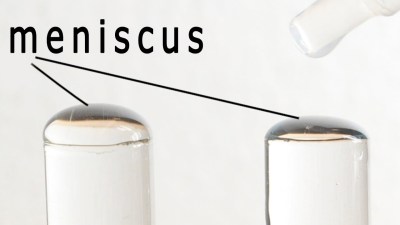
Springtails are little bugs that have to keep the water and air separate, so they don’t drown in the wet dirt where they live. Mother Nature’s solution was for them to evolve to do this with columns that have sharp edges at the exit. Imagine you slowly add water to a test tube, it won’t spill as soon as you reach the top, it will form a dome. This is the meniscus. At a large scale, say a river dam, as soon as you get over the dam you would expect spillage, but at the test tube level you can see a curve. At the scale of the springtail, exuded water will form a globe and resist water pressure. That resistance to water pressure allows this type of water cooling to self-regulate. Those globes provide a lot of surface area, and as they evaporate, they allow more water to replenish the globe. Of course, excessive pressure will turn them into the smallest squirt guns.

We have invented a lot by copying Mother Nature. Velcro was inspired by burrs, and some of our most clever robots copy insects. We can also be jerks about it.