
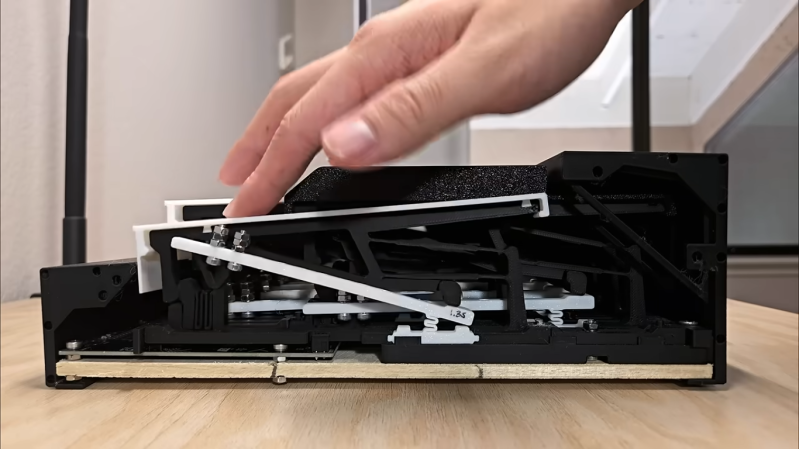
A piano’s internal mechanism for translating a key press into sound is surprisingly complicated. It has to do a lot of things simultaneously and quickly: provide precise control over velocity, ensure the hammer doesn’t press itself against the strings, ensure the hammer rebounds without accidentally hitting the strings, allow for quick, continued strikes of the strings, and dampen the string after the key is released. Not only is that a mouthful to say, it’s a tall order for a mechanical device and took (arguably) around 150 years for the idea to be refined into what most of us would recognize as a piano. But could [dovetail] do it with a 3D printer in a few weeks?
[dovetail]’s design relies on compliant mechanisms, which are solid parts that flex in specific and controlled ways to provide movement. The action took many iterations to make sure that all of the feelings of all the parts of a real piano action were accounted for in this model. Pianos have more than one key, though, so [dovetail] also had to design a modular system to piece all the keys together. The modularity extends to the piano’s electronics as well, with a set of PCBs daisy-chained together, each of which supports a set of keys. This is a hybrid piano, a style with a real action but digital sound production. Using infrared sensors allows the instrument to behave as a MIDI keyboard, but one with the goal of feeling somewhere between a digital piano and a fully analog one.
The piano was first demonstrated at Open Sauce, where a number of musicians were able to try it out. As a prototype device it still has a few rough edges that [dovetail] plans to improve upon, like changing the sensors from IR to hall effect, improving the action and using a different filament. There are some other things he has planned as well which we look forward to seeing in future videos. And, although a completely different instrument, it has a number of similarities to this action built to strike a bass drum instead.
Thanks to [Keith] for the tip!












I don’t think I like the clicking sound it makes. Piano actions use felt in some areas to avoid that.
i really think there’s a lot of room for materials science to improve piano actions. i’m hoping something cheaper, longer lasting, perhaps even easier to repair if someone truly commoditizes / standardizes it. though an anecdote about what is actually happening — i like the feel of the modern mid-range yamaha e-pianos…feels good considering it’s not a real piano. but i hate the feel of modern mid-range yamaha upright acoustic pianos. the funny thing is, i think the two feel remarkably similar! the best e-piano feels like the worst acoustic piano. a remarkable feat of engineering but dubious to my personal taste.
but the thing is, the century of learning how to build a piano was the same as a century of learning how to maintain pianos. and i’m just not convinced a compliant plastic mechanism is going to hold up well. i’m a little worried about it breaking but i’m even more worried about the feel changing over time. an impressive accomplishment, to be sure, but it isn’t really reproducing the real work.
Kawai has gradually introduced carbon fiber (some sort of abs hybrid, I guess) but it’s been a very slow process. I’ve had one for about 10 years, and the action has held up well. I think it might hold up better than a straight wood action, but I don’t have any proof.
None of my digital pianos have held up very well (Yamaha, Roland, Kawai) – the action seems to wear out with constant playing.
It’s kind of the same for string instruments. The synthetic materials haven’t reached parity, but they are better than they used to be.
The stuff you mention is most commonly used to make things cheaper, not better. I don’t think the plastic piano will sound that great.
Have you built a WNG action? I replaced an entire action for a customer’s mason and Hamlin. They are pretty space age compared to old school. Also kawai has the millennium action which is a pretty nice hybrid between old and new.
Cool project, perhaps according to some it has a long way to go, but the idea is solid.
I really hope the next project is a decent microphone-holderstickthingymajig, looking at the video (where the mic. is attached to a screwdriver) I think it could be useful for the followup videos.
Dang, that silk screen is gorgeous- I don’t use enough artistic creativity in my silk screens (I also don’t make enough PCBs) very inspiring!
I’ve looked at this concept for a while, I have concluded that the best approach is to use a very simple key mechanism with a spring for return force and no attempt to implement the action using mechanical parts, instead I will use a metal rod sticking out of the bottom of each key and a small coil of wire set up as a solenoid. Sensing the speed and position , I can set up a small algorithm on each key to drive the solenoid to create the desired action. The best part is I can then emulate the actions of different piano types.. Grands and uprights.
I wish I could find it back, I’ve looked with no avail, but I once saw a video that explained piano actions really well. I thought it was Smarter Every Day but maybe I’m wrong.
The conceit of the video was “this should be really simple” and started with a simple hammer on a string, then showed the issues with that and what needed to be added to fix it, and gradually got more complicated until it reached exactly what a piano action is.
Now that I’m thinking it may also have been Steve Mould… Or perhaps not…
Mark Rober, youtube.
Unrelated, never seen anyone playing the piano from inside the deck. :]
dovetail here, thanks for the article! as many have said it still has a long way to go until it can even begin to compete with commercial pianos and it has a variety of issues – the clicking, durability issues, still inaccuracies to deal with in the key action – but it’s a cool proof of concept :)
I too have tried making piano controller action, but I lack the resources right now to do it appropriately. And I probably have dyspraxia, which severely hampers precision work. My main priority was pivot length, which led me to try both wood and hybrid wood+plastic, since long plastic keys are prone to bending. As someone has already said it here, I would recommend a different approach than compliant mechanism, since it’s prone to wearing out by stress. There are plenty of videos showing wood key actions by Kawai and photos of the Vidal Piano Controller, those are fairly simple mechanisms that might inspire you. If you shorten the keys, you may even print the keys out of plastic if you wish. Each key is just a stick on a balance pin (that might be simply a nail), you can put felt on the contact points to avoid it wearing out. Then you may decide how to add weights: either a hammer on a hinge or a massive weight on the end of each key (and probably a massive counterweight below the front too). A hinged hammer gives you more relative momentum because of leverage, while local weights need to be much more heavier, but they are also simpler. Pianist and computer scientist Andrew Leathwick has also a DIY controller on youtube he was building as a narrower keys instrument. He was making it with local weights and acrylic keys. If you fancy it, you might also check out hybrid DIY controllers by CyberGene and Greg Zweigle.
But even if you stick to compliant mechanisms, I would love to see how your project evolves.