
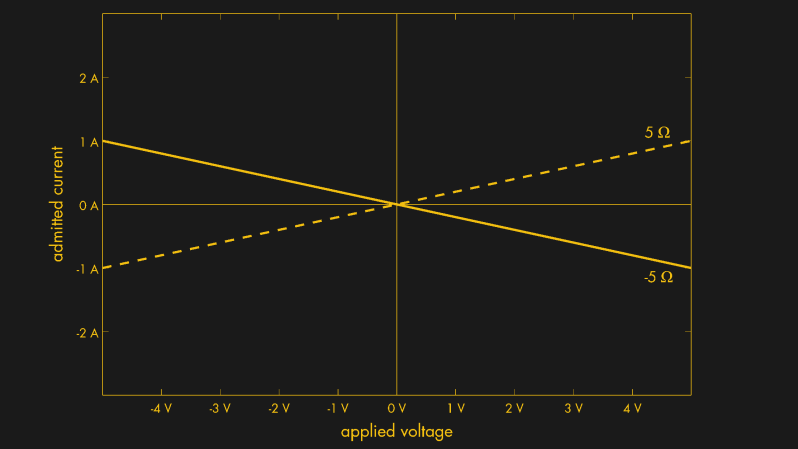
[lcamtuf] has an in-depth look at the concept of negative resistance that goes somewhat further than one might expect. Normally, as voltage across a resistance increases so too does the current. Negative resistance is the concept of current decreasing as voltage increases. But beyond the raw concept, there are a few other ways to look at this idea.
The usual way to think about it is negative differential resistance (NDR). Not everything has a linear relationship between voltage and current, and for a device to exhibit NDR means that in certain ranges the I–V curve actually slopes downward; increasing one of voltage or current decreases the other. This kind of thing occurs in neon lamps. Once they are glowing, increasing current can result in decreasing voltage.
True negative resistance, that of a literal -100 Ω resistor, does not exist. Not in the sense of a passive component, anyway. Such a device would supply power into a circuit rather than dissipating it, and would therefore require an external power source to do so. If that’s not a deal breaker, then it’s actually fairly simple to build one. [lcamtuf] provides a design for a device that uses an op-amp to exhibit ideal constant negative resistance. Naturally it only does so within its operating range; going beyond risks letting out the magic smoke.
Is making a literal negative resistor of practical use? Perhaps only in very specialized situations. But it is worth having a basic understanding if for no other reason than it rears its head in unusual places: the strange tunnel diode comes to mind.












Yes, calling this behavior “negative” resistance is misleading, for the reasons appointed. It would be much better to call it dynamic/differential resistance (or trans-resistance), because the only way to observe it is via tracking multiple DC operating points of the component and comparing them.
True. Sometimes shorthand is almost idiomatic in usage, where normally you’d want something precise.
…the phantom “centrifugal force” comes to mind. Misleading, but still useful within a rotating frame of reference as long as you keep its limitations in mind.
This is strictly true, but by the same token it is also misleading to say an amplifier has “power gain” when more power goes into all amplifiers, than comes out of them. “Negative resistance” is not a special case of omitting the bias point / bias power, when talking about the dynamic effects of something.
Well, not realy. When discussing gain of an amplifier, there are several well established things to consider:
If not explicitly stated, the gain is considered to be “forward gain”, e.g. output signal / input signal (and yes, there’s such thing as “reverse gain”).
“Power gain” term is usually used in circumstances where engineers want to explain that the amplifier has both voltage and current gain, and NOT that the amplifier uses some power to operate. And yes, amplifiers can have only voltage or only current gain (the other one being = 1).
Otherwise, if I try to continue your line of thought, we can actually discuss the amplifier’s “input power consumption”, e.g. the power that is dissipated into the amplifier’s input by the previous stage (in RF amplifiers this is actually important topic).
Kind regards everyone.
Hm, we’re probably not allowed to use trans-resistance in these DEI-averse times. 😜
There will be an executive order to rename trans-resistance to resistance of America /Red-tailed hawk scream in background/
If you describe it in mathematical notation everything becomes clear. There exists differential negative resistance. A negative passive resistor doesn’t seem to have much meaning, other than a reverse polarised power source.
When I was in college an instructor showed the class a negative resistor. If I recall correctly, it was somewhat larger than a thumb and contained internal circuitry including a battery. So a negative resistor does not require an external power source.
“If I recall correctly, it was somewhat larger than a thumb and contained internal circuitry including a battery. So a negative resistor does not require an external power source.” Really? 4Reals?
What I love about negative resistance is the realisation that power loss – I^2R, becomes power gain when R is negative. Thus when something has a negative resistance characteristic in part of it’s curve, it can thus become an amplifier or support oscillation.
This applies to less obvious components like the whole electricity grid.
Tunnel diodes have a negative resistance range. It is an absolute snap to make an oscillator out of one.
https://josepheoff.github.io/posts/iv13
A tunnel diode, a couple of resistors, and an inductor and capacitor tank to set the frequency. Easy as can be.
Tunnel diodes have negative differential resistance, not negative resistance. I have no idea why these two terms are/were used interchangeably.
It’s because people are lazy and suck, expecially “in these DEI-averse times” pull the other one. My first thought was “zero-sum resistance” but how do I know there’s a zero sum going on? I don’t. No need to point out that “negative resistance” gets clicks.
Oscillators are one frontier of electronics that i have little experience with, despite having worked professionally for almost a decade.
I’m not talking about DDS or PLLs, but proper harmonic oscillators made of discretes
So…… Ohm was wrong? It shouldn’t have advanced from “theory” to “law”?
What? How in the world did you get that conclusion from the article? Neither this nor the linked article say anything that even implies Ohm’s Law was invalid. To the contrary, Ohm’s Law is used to illustrate what negative resistance and negative differential resistance means.
Ohm’s law has an issue where it’s both a physical ‘law’ describing the behaviour of ohmic materials in certain regimes, and the definition of resistance at the same time. A diode has no ohmic behaviour, but if you so insist you can calculate a value of R for any point at the V/I curve
Ohms law only applies to a very small subset of resistors -those which have Ohmic behaviour.
I have some standard reference resistors used in a calibration laboratory. They were, naturally, calibrated and the calibration showed the resistance varied by 3% (0.03) over their voltage range.
“…This kind of thing occurs in neon lamps….”
‘This kind of thing’ occurs in all gas-discharge devices, from the lowliest neon bulb and those fluorescent tubes overhead, up through the largest high-intensity carbon-arc lamp ever designed and constructed.
That’s why they all require a ballast of some sort.
Gunn diodes exhibit this property. Current flows through it and gets “bunched up” periodically. You can tweak the device design to get useful frequencies. They’re a cheap way to get on the amateur 24GHz band, for instance. Signal quality sucks – if you think you’ve seen phase noise before, take a look at these babies. But they’re good enough for CW and AM voice.
What horrible confusing nomenclature. So resistance that increases as a function of voltage is a negative resistance value??
Such stupidity. Way to show your intelligence, HAD.