
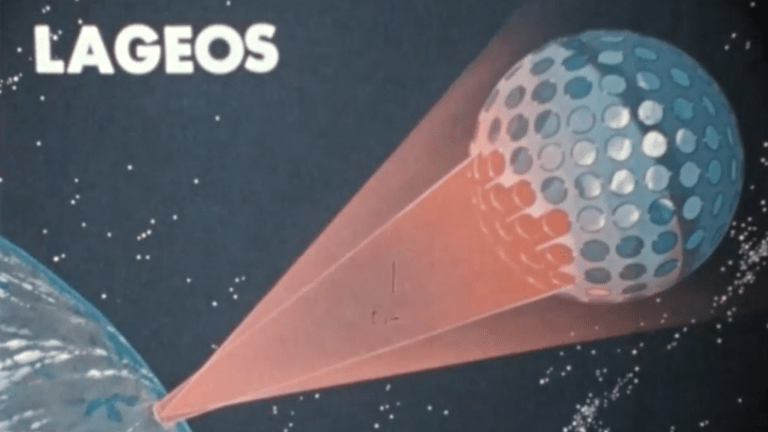
Launched in 1976, LAGEOS-1 (LAser GEOdynamic Satellite) is unusual in that it contains no instrumentation, no electronics, no power supply, and no means of propulsion. It’s spherical, weighs just under 407 kg, and looks a bit like a disco ball. It may not be accurate to say it does nothing, but unlike most satellites its role is entirely passive. It’s also one of the oldest scientific satellites still in service.
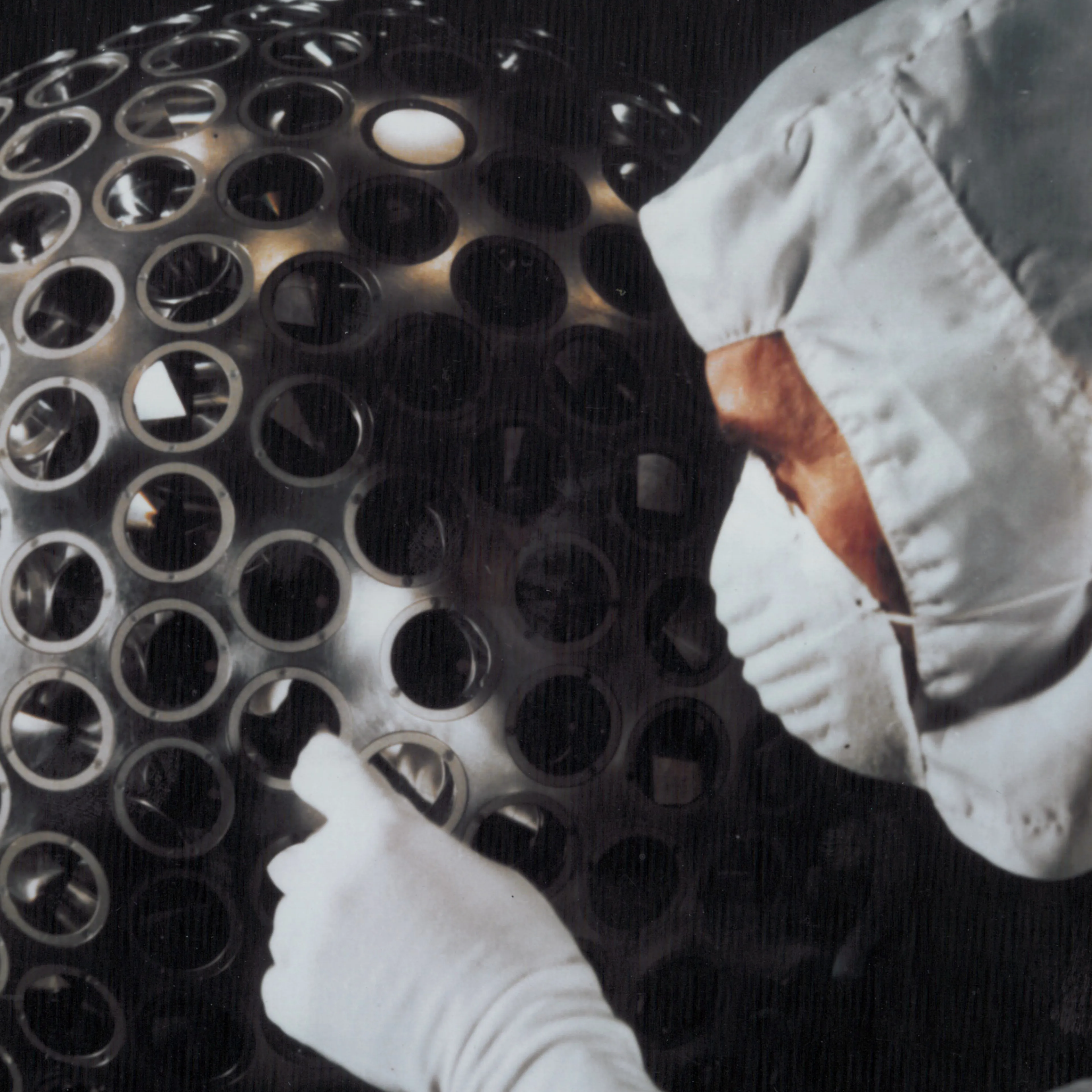 The lens-like objects covering the surface of LAGEOS-1 are corner cube retroreflectors, which have the nifty effect of always reflecting incident light right back towards its source.
Ground stations fire short laser pulses at it and measure the time it takes for the light to return, a form of time-of-flight ranging. Since LAGEOS-1’s orbit is highly stable, it provides a reliable reference point for measuring even tiny changes in the Earth itself. The size, shape, rotation, and more of our planet can be measured as a result. LAGEOS data (LAGEOS-2 was launched in 1992) has also been used in tests of general relativity.
Its orbit and construction were deliberately chosen so that atmospheric drag and other disturbances would be minimal. The simple, maintenance-free design combined with an extraordinarily stable orbit means LAGEOS is expected to circle our world for millions of years to come.
LAGEOS-1 also contains a message to the future in the form of two identical plaques prepared by Dr. Carl Sagan just in case there’s anyone around to find it some day. Check out the short 1975 video from NASA, embedded just below.









(LAGEOS-2 was launched in 1922) – Quite an accomplishment :-)
2022, surely (and stop calling me Shirley!)
More likely that it’s 1992.
Oh! How embarrassing. FIxed, and thanks for the catch!
Warhol launched it from Studio 54, don’t ya’ know
https://www.earthdata.nasa.gov/data/platforms/space-based-platforms/lageos-2
that video was short on details, one of which is that this satellite orbits at about 3000 miles above Earth
How much is that in standard bananas?
about 4,800 kilometers, so in medium Earth orbit, high enough to be seen by roughly half of the planet. About 12 times the orbit of the ISS (International Space Station @ approximately 400 kilometers (250 miles).
Half the planet from a 4800 km altitude orbit? Not even close. The footprint is closer to one fifth the surface area of earth.
How many Rhode Islands is that?
(let’s see…earth’s surface area, divide by 5, carry the one…)
25,105.24 Rhode Islands.
(I wish HaD would use AMERICAN Standard Units…)
That would put the orbit at 52493 football fields.
It won’t really be any good until LAGEOS-3.11 for Workgroups.
I remember hitting it with our green laser on top of Haleakalā, Hawaii, in the early 80s, then onto the laser retro-reflector left on the moon. That was some fun times for sure setting up the range gate pulse to help eliminate all the background photons. On the moon we were looking at detecting 1 to 7 laser photons per laser shot.
Pretty long range gate, to hit a satellite launched ten years later :-)
Time passes slower for objects in orbit than it does on Earth so, although it was launched in 1992, it reaches orbit earlier in Earth’s history. For an object orbiting at the speed of light, this would be as far back as the Earth’s creation, 4000 BC and for an object orbiting at 0mph, it happens today. I can’t remember from physics class whether the relationship is linear or not.
This is why the computers on space missions are so old, they need to reach space for the era they existed in.
I remember when we had two TLRS and one MOBLAS co-located at Goddard in ~1989. It looked like Star Wars with all three lasers converging on one satellite. Cool stuff.
Some people have all the good jobs.
Have a friend who was in charge of a TV broadcast facility. They were using kilowatt tubes as drivers for the final amp. These got replaced on a schedule, so the tubes removed were perfectly good, just that their position on the failure probability curve was a bit higher.
Needless to say, the radio amateurs in the organisation had power amplifiers built around this exact tube, and there was no need to worry about disposing of the tubes that got replaced.
It’s all power FETs now…and the ham radio amps have probably been redesigned to use the still-good FET modules.
I wonder how long it would take to tidally lock.
NASA in the 70s: It’d be totally groovy to put a disco ball into orbit, man!