
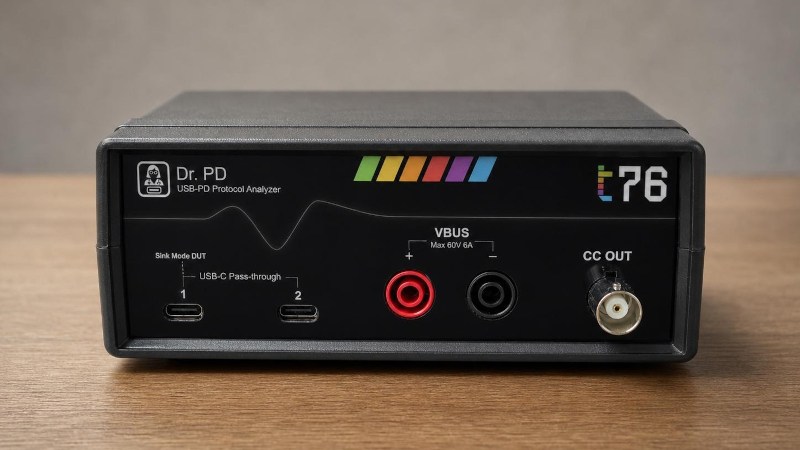
USB-C Power Delivery (PD) has been a boon to anyone working with low-voltage DC power, because at a stroke it replaces a vast array of wall warts, power supplies, and connector standards with one simple and straightforward commoditized system. But with varying capabilities between sources and sinks, it can be difficult to know what’s going on.
[Marco Tabini] has created Dr. PD, a USB -C PD protocol analyzer. It can sit between USB-C PD source and sink, or emulate a sink in order to characterize a source. It supports an impressive range of USB power protocols, and can work up to the full 48 volt/240 watt limits of the technology. The project is open source and is to be the subject of a crowdfunding campaign should you want one without the extra work.
It’s likely that many of you will have had bad experiences with cheap USB-C PD gear failing to follow standards, being unable to handle the specified current, or just plain supplying the wrong voltage. We have, and while USB-C PD is genuinely a great technology, this regrettable hardware represents its grubby underbelly. This is just the project we need on the bench in our hackerspace.
In the past we’ve written about USB-C PD as a great example of new technology done right.










IMHO, the undying barrel jack seem to be the consumer-grade survival of the fittest. Jack size supposed to be the voltage/power, and presently I see the venerable 12V as the one that had made it into the 21st century unchanged.
IM Other HO, USB-A had enough contact surface to be near replacement for barrel-jack, and making it double-sided would be bringing it closer to the 12V kind. I still think USB-A was the right form factor, and the right step, and other USBs since then – steps down due to their diminishing contacts surface.
Unrelated, but related, while 5V DC seem to be the winning VHS standard, it is not the best, as a lot of electronics need at least ~12V DC to operate efficiently (actually, some power MOSFETs prefer around 35V). This brings up an old discussion (that I am not to go into here) about power supplies automagically configuring themselves to deliver proper voltage/current, AC included. I am just saying analyzing the power supply/draw is something I would do first, when/if I find enough free time to chase after that shiny object.
24V would be even better, but then again there’s +/-15V…
I second both, and +/-15V (or any +/- voltage) is easily obtained from an AC transformer.
Well there’s still polarity, a gotcha that has gotten many.
Cackling like a mad scientist as I produce a product with a DC barrel jack with a negative pin and positive jacket for absolutely no reason
They exist. :-(
original gameboy power connector did this, no idea why
I have a label maker from a well known company that uses this, presumably there’s a million of those out in the wild.
Welcome to guitar pedal world…
Centre-negative barrel connectors are very common. Here in Japan, probably more common than centre-positive.
So I am the only one that can’t view hackaday.io due to a bad cert? Being going on for a day or two.
All good here so it’s you. Can you upload a screenshot somewhere of the cert being sent to your browser?
Nope. Not the only one.
========================
Secure Connection Failed
The page you are trying to view cannot be shown because the authenticity of the received data could not be verified.
What can you do about it?
The issue is most likely with the website, and there is nothing you can do to resolve it. You can notify the website’s administrator about the problem.
Same Here. Since Saturday , at least.
I’m seeing a perfectly normal LetsEncrypt cert:
Subject Name
Common Name
hackaday.com
Issuer Name
Country
US
Organisation
Let’s Encrypt
Common Name
YE1
Validity
Not Before
Thu, 27 Aug 2026 14:57:31 GMT
Not After
Wed, 25 Nov 2026 14:57:30 GMT
Subject Alt Names
DNS Name
hackaday.com
DNS Name
http://www.hackaday.com
Public Key Info
Algorithm
Elliptic Curve
Key Size
256
Public Value
04:CA:D4:4C:16:77:33:7A:E6:D6:1E:22:5B:39:BC:32:44:30:C9:EF:B0:78:F5:C7:78:63:31:9F:EF:1C:8A:EA:AB:EE:27:8E:8E:D3:31:D5:E4:21:4F:3C:B6:F2:9B:61:B2:F9:27:B9:51:C4:FC:D1:94:20:74:A1:0C:CA:07:4D:5F
Duh, you said hackaday.io (not .com). That one also works for me:
Subject Name
Common Name
*.hackaday.io
Issuer Name
Country
US
Organisation
Let’s Encrypt
Common Name
YR2
Validity
Not Before
Wed, 30 Sep 2026 22:33:33 GMT
Not After
Tue, 29 Dec 2026 22:33:32 GMT
Again, there was zero point with the forced USB-C standardization if we are forced to still carry around multiple different chargers and cables due to incompatible charging protocols and supported voltages. Unless you are rich enough to pack several Thunderbolt 4 240W in your everyday carry.
Fortunately we’re not! I’ve been carrying around a single 65 W USB C PD supply for a few years now and I’ve never seen a case where it didn’t charge a USB C device.
hmm, probably should have waited to post this until the crowdfunding was actually open…
Make a smaller version and call it a pd-atrician