
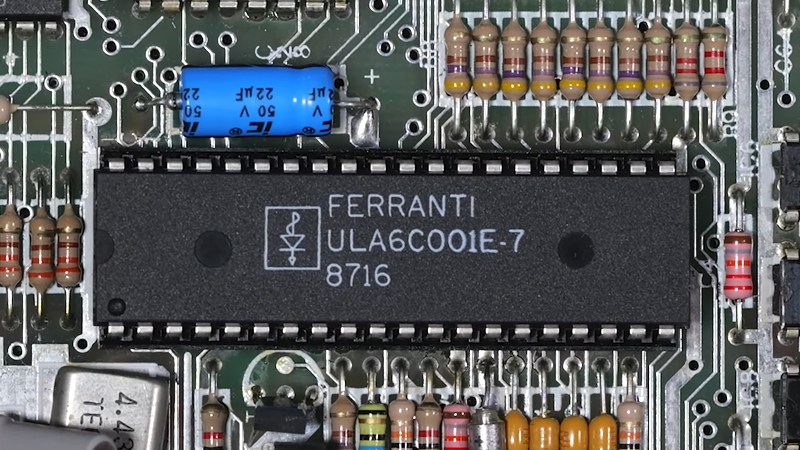
In the 8-bit home computer boom of the early 1980s, Sir Clive Sinclair’s machines were always among the cheapest on the market, often packing a surprising level of sophistication in their limited hardware. If there was one component that was key to their success it was the Ferranti ULA, or Uncommitted Logic Array, a clever way to make an ASIC from a chip containing a library of logic parts ready made. The Sinclair ULAs have been reverse engineered, but their full details have remained a mystery. Until now it seems, because here’s [Happy Little Diodes] with a treasure trove of original Ferranti design documents covering all the Sinclair parts.
The documents were picked up on eBay, and contain folders with printouts, engineering drawings, and hand written design notes. They cover the full range of Sinclair products of the era, including the ZX81 and Spectrum, the ZX printer, the Microdrive, the Spectrum Interface 1, and even the curious little flat screen TV. Oddly the IP is now held by the satellite broadcaster Sky as the holder of Amstrad’s portfolio, but fortunately Sky have recognised their historical importance and allowed their sharing with minimal changes. They’re all catalogued with download links in a Google spreadsheet, so dig in and see what you can find. Of particular interest are the ULAs that haven’t been reverse engineered yet, and the subtle differences between different versions of the same ULA as the engineers tried to fix bugs. The video is below the break.
If you’re curious about the ULA and Ferranti, we linked to a period film about it.












That’s awesome!
Btw, there’s also an excellent book (which I just happen to have!) called “The ZX Spectrum ULA: How to Design a Microcomputer” by Chris Smith. If you’re a fan of vintage machines, you should take a sneak peek. Just saying.
Cool, sounds like a type of FPGA. I’ll have to watch this later.
Unfortunately it lacks the FP part. Something like this would probably fit somewhere in between FPGA and fully custom ASIC, with a baked design from the factory like an ASIC but using a bunch of standardized logic cells like an FPGA.
Semicustom. ISTR them, dimly. They were not hugely popular, and often analog. Signetics comes to mind for some reason. The logic blocks were on the die, lacking only the metal interconnect layer, which was your design.
Or maybe I’m just old and full of it :-)
So closer to a CPLD that is “programmed” in the mask before manufacturing (and after taking a lot of your money) ?
That would still give the better bulk pricing of an asic without having to design the entire thing from scratch. Not bad
or NEC with their cmos-x line of gate arrays FEOL product
The ZX81 (aka Timex 1000) was great! 😎
It was relatively cheap and great for hardware hacking!
Someone could easily attach a relay card, a robot arm and so on.
Some educational elevator simulations also existed, I think.
The cheap plastic case and the bad foil keyboard encouraged to mod it, as well.
Such as tapping the monochrome baseband signal (VBS) inside the HF modulator box for better video quality.
The ZX81 might have been one of the first “barebone PCs”, maybe.
There were several clones being made which didn’t use the ULA, also.
Especially in the Eastern Bloc where the ULA was unavailable.
Throughout Europe the ZX Spectrum was heavily being cloned/derived from, comparable to how IBM PC or Apple II was.
The heavily hyped C64 and the equaly good Atari 800 had no such clones,
they were 100% proprietary systems. Even more than Macs were (they had clones).
Apparently, cloning their custom chips wasn’t considered being feasible or worthwhile.
There were software emulations of all of them early on, though! 😃
PC-Ditto (’86, for Atari ST), ZX81-Emulator (’92, Atari ST),
Personal C64 (90s, DOS), Apple2Win (early 90s, Win 3.1x), TOS2Win (early 90s, Win 3.1x), WinZ80 and WSpecem (90s, Win 3.1x) ..
Dr. Matt Regan is building a C64 from discrete logic.
https://www.youtube.com/playlist?list=PLjQDRjQfW-858WC0-6qttbDLkoyBTvYVm
What’s very interesting is that he is not building the chips using conventional logic, but using a state machine driven from eproms. So not even using a 6510 CPU…
You want to learn something about computer design? Watch all this guy’s videos. ..