
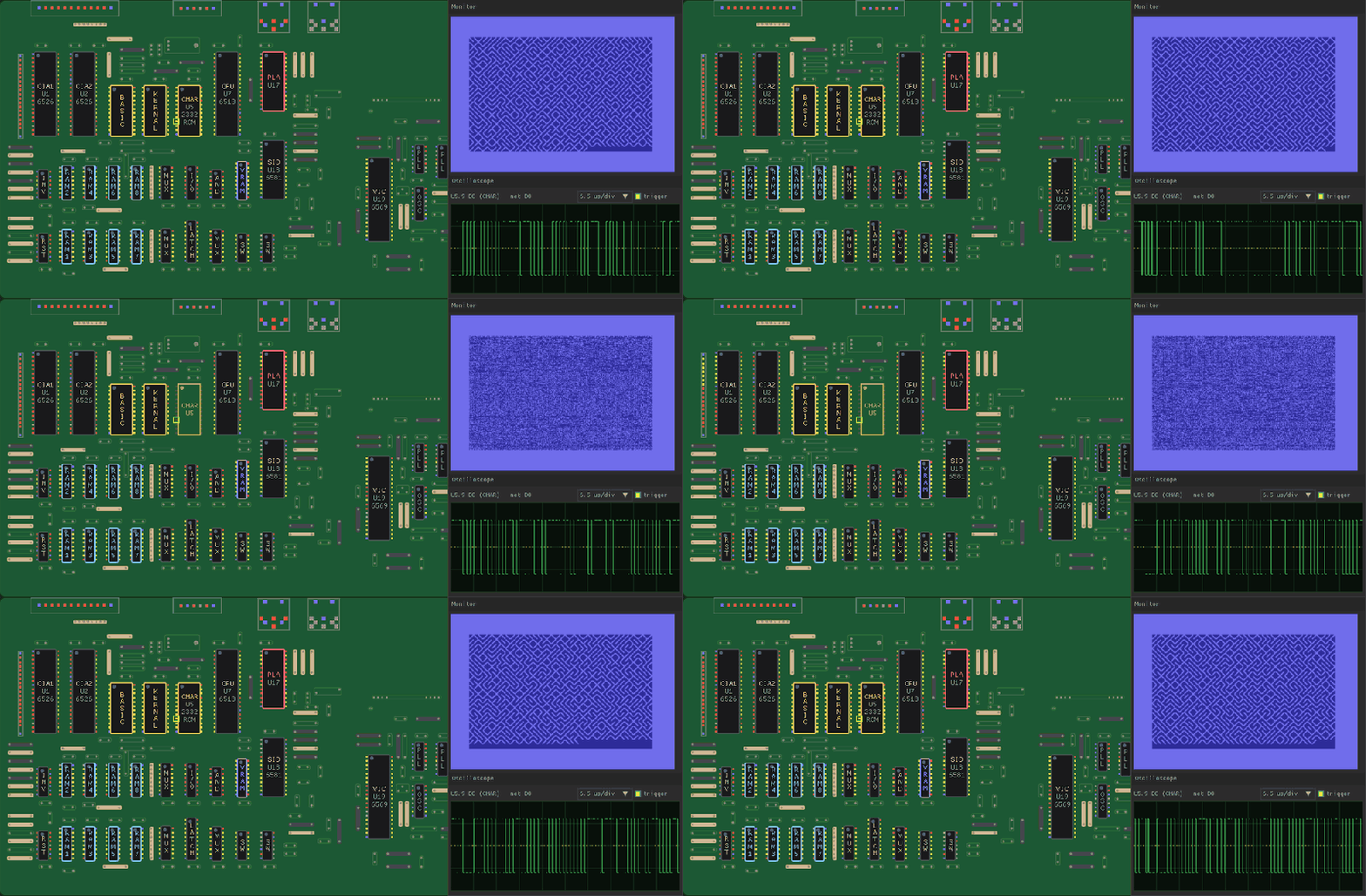
If you want to play old Commodore games, there are C-64 emulators available for just about any platform– but most of them are so high level, they’re really meant for just that: playing games. [antirez] has a different goal with his c64-hw-sim project— it’s a lower-level emulation that simulates every chip and every connection on an ASSY 250407 motherboard, and all the chips on it, too. Ever wondered what happens when a specific chip is missing, or a random pin is shorted to ground or forced high? You can do all that in software, with no risk of harming antique hardware.
While that might be a fun bit of faffing about for a certain sort electronics sadist, the real utility is to learn about the hardware, both in the abstract and to help you troubleshoot a board you might have. It’s likely that many given failure modes reproduce the same effects– lots of things can knock out the display output, for example–but at least if you’ve reproduced a flaw in software you can try testing the hardware to see if that’s the cause of your problem. Assuming the simulation covers your hardware issue, anyway.
There’s cycle-accurate chip emulation for the processor, CIAs, SID and VIC-II via code by [Andre Weissflog], a.k.a. [flooh]. Meanwhile analog circuitry in the video, audio and power sections are not simulated so not everything fault will be replicable here. Still, it might be a neat tool– just don’t try and run any games on it, because even on high-end modern hardware it only runs at about one-third speed. That’s fast enough for diagnostics, but not so much for Maniac Mansion, never mind Elite.
Speaking of Elite, did you know the source– both of the port and the original– is available with comments? If you want an emulator you can play, you can get it on everything from microcontrollers like Teensy to your personal computer.
Thanks to [Salvatore] for the tip!












I wish there was a web version.
If you’ve got hosting it would be pretty easy to adapt one
Thank god it’s not.
As an old school hacker this peaks the interest of that kid who started messing around with hex editors to boost his funds in games back in his Amiga days…
And best of all, no need to sacrifice hardware to the L33t Godz in the name of “education”
Interesting – I’ve just taken delivery of a non-working C64. This may be a good way of validating probed signals.
Circuit bend emulation, awesome.
For those of you wondering about the GIF showing bunch of diagonal characters like a 45 degree maze, the one line BASIC command is:
For another cool design, use 200.5 instead of 205.5 and experiment with other numbers over 128. Also change the .5 to a different number to bias one character over other.
PERSCII (Commodore 64, 128, VIC-20, PET, and many other Commodore computers, not Amiga) character 205 and 206 are for / and . For other computer, you will need to check the computer’s ASCII table and if they are not next to each other, you’d need to redo BASIC command for random 0 and 1, then if x=1 then print / else print \
There is an entire book about this (and similar) one liner. https://10print.org/
So many ways to scratch the vintage computer itch now.
You can do software simulations. You can do hardware simulation and have a C64 running on a $38 FPGA (https://github.com/MiSTle-Dev/C64Nano). Or you can buy the actual gear on Ebay and Facebook Marketplace.
I was an Atari guy, myself. I used to have a bunch of Atari gear, but it took up so much space and I used it so rarely. But I did the FPGA Atari (like the C64 one, on a Tang Nano 20K) and it works beautifully. I got some DB9 connectors and I need to order myself some Atari joysticks. I’ve already designed a case for it (5″x5″x2″). Takes up almost no space.
I’ve bought another Tang Nano 20K. Going to put the arcade game Galaga on it and build a desktop console out of plywood, with arcade style joystick and buttons, to house it.
dedicated Galaga machine? I love that idea :)