
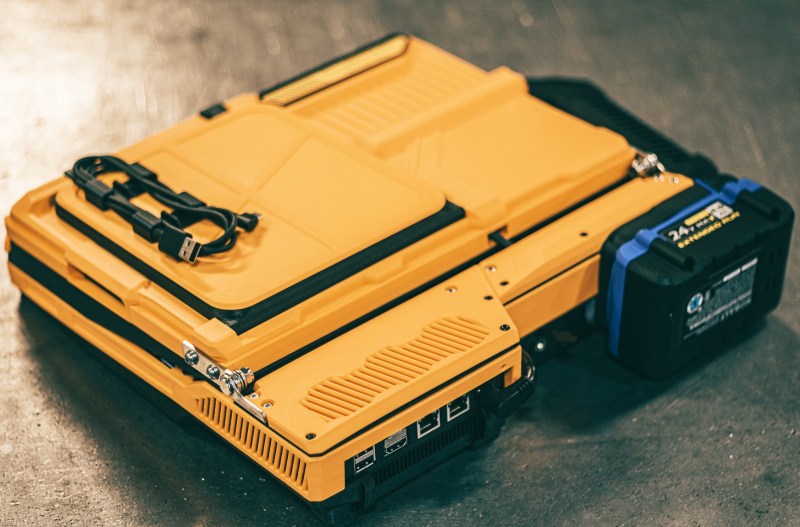
There are two kinds of cyberdeck: the kind someone makes on a lark and operates purely on ‘rule of cool’, and the kind designed to do practical work. The Slurptop by [Slurpburgers] is decidedly in the second category — but that doesn’t mean it lacks for coolness. What’s cooler than a power-tool battery?
That last feature might make this closer to the Neuromancer definition of cyberdeck than most featured on these pages. You still can’t jack it into your cortex, but it does have the ‘assemble from off the shelf components at need’ vibe of the original concept. It also means there should be plenty of battery power to keep working with the power-hungry x86-based GMKtec MiniPC that runs this thing.
If the battery gets low, which it will after about 4 hours or so, swapping is easy — but not hot swapping. Luckily [Slurpburgers] grabbed a module meant for Uninterruptible Power Supplies to swap over to wall current, so this device can be plugged in whenever necessary. Alas, charging must be done on the factory charger, not the device, but that swapping really adds to the ‘future of the past’ cyberpunk flare of the device in our opinion.
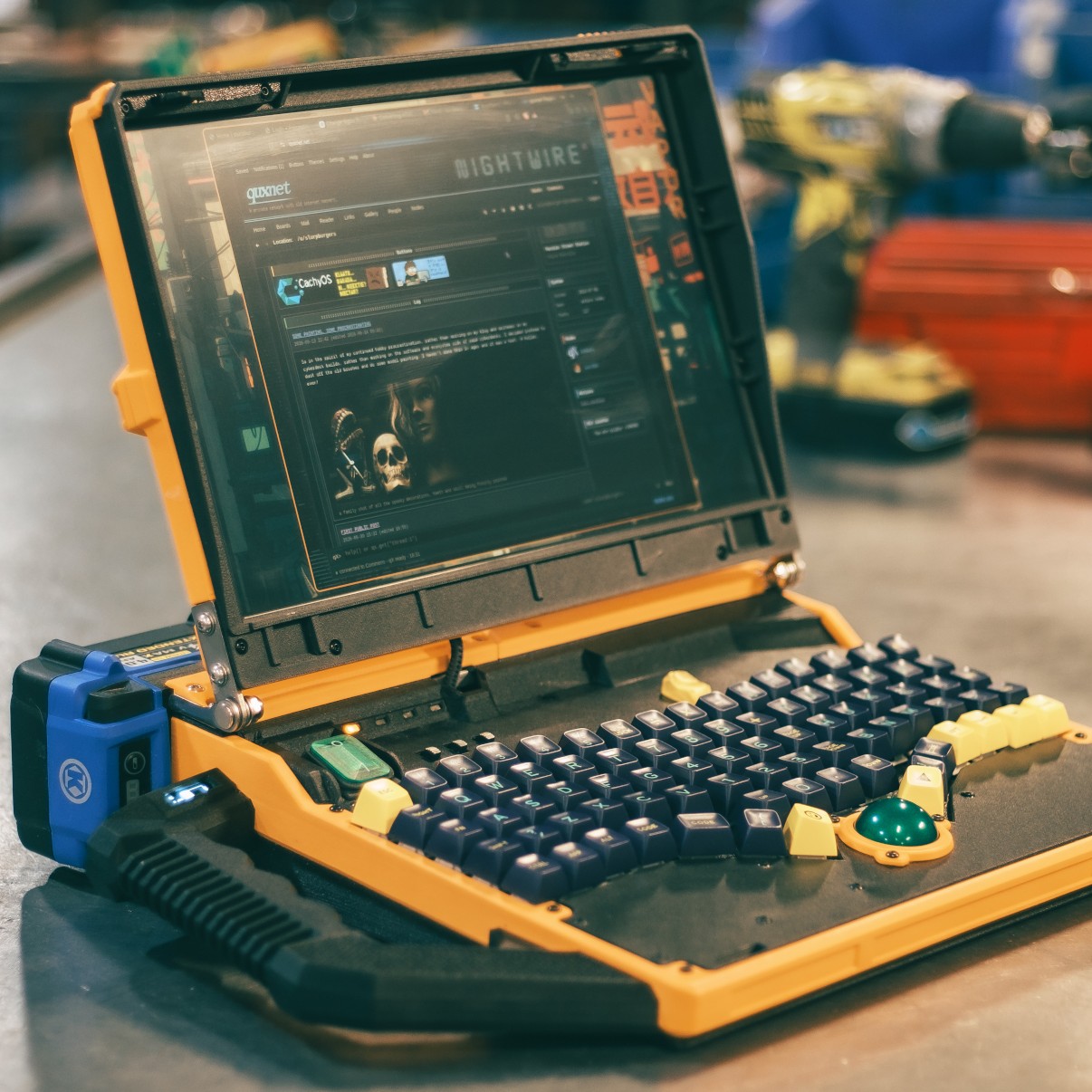
Speaking of the past, why did we ever stop putting mechanical keyboards and trackballs onto laptops? The inputs on this thing are glorious, and this writer’s hands envy the ergonomic curve of it while typing away on an old HP Pavilion’s sad and squishy low-profile keys. The trackball itself is a minor hack, being made using the guts of an old gaming mouse. Not everyone will approve of every design choice here, but that’s the point of doing it yourself — so like [Slurpburger], you can have it your way.
This is hardly the first time we’ve seen a clacky laptop but we can’t recall a cyberdeck made with tool batteries before.
Thanks to [JohnU] for the tip!












I just want a touchpad with the buttons below I can use with my thumbs. What happened to those?
Now that’s a tasty rig. Love that gmtek. I won’t yuck the guys yum too hard but damn does that thing need hotswap and charging on deck. Stat. Awesome design. Hinges look rock solid. Wonder how the screen handles rumbling against those caps and that ball.
Gonna advertise my electrical ignorance here: What if they gave it two battery connections and then you can swap them one at a time?
Technically possible but you’d want to isolate the batteries from each other (so likely individual buck/boost converter) and add a little logic or manual toggle so only one is drained at a time – otherwise when you plug in a single new battery you are putting that 20+V battery on the line holding the 18v or less from the remaining mostly flat battery. Which might be alright but is a recipe for high current and heat as the battery try to equalise rapidly – far easier to engineer isolation than to be sure your electronics and batteries can survive that.
And without seperation it isn’t certain you could pull of the change either – if you run them both flat at the same time as they are on a common bus the one left may not actually be able to supply enough current to keep the machine running before it cuts out either.
Well, let me think,a temporary stand-by mode with a slim 10,000ma or something then quick hot swapping 💥💥
(Now I want to make this mod on my own version (:)
Easier a custom circuit with a small lithium cell, no?
Don’t care about charging on board if using power tool batteries – if you are the sort to have them in a way that makes you think this is a good idea you’ll have many you are cycling fairly often and have a few on the shelf already charged… Hot swapping would be very nice though, can’t see it being practical to find space for two power tool battery at once, but a decent sized capacitor/battery bank internally to give you that time to swap seems pretty possible.
Good find.
I would buy a broken power tool light that does charging and battery, and use its charging board.
Add a second battery port, either swapping without cycling power or extra runtime. Maybe an adaptor plate to take multiple different types of battery packs. I wonder if the computer can see the charge status.
I can’t see it being overly difficult to incorporate a charger into the case somewhere, maybe a nice illuminated rocker switch to swap between charge and a led bar graph for charge remaining.
That’s kind of how the battery pack for my Yaesu ham radio works. It’s got a switch on the top so that when one battery starts to go, you flip the switch and it switches over to the other power source.
Just in time for Edgerunners 2. That’s one of the best-executed decks I’ve seen.
If you end up making more/distributing it, use a few different colors of PLA so you can pander to people’s power tool ecosystem loyalties. Be sure you can inflame tensions between the Ryobi and Makita megacorps. And make an Arasaka or an Ono-Sendai of course
Less Neuromancer—more Mike Rowe.
Yellow vest and hard hat peripherals required.
It looks like it needs Fischer USB ports :)
They seem to have multiple wholly different ports for the same USB 3.2. Rather ISOBUS, no?
Beautiful! I love it! Nice to see a cyberdeck that’s not a RPi 5 under the hood in a 3D printed case
This is basically the same project of compute in a printed case – As who cares what the compute is as long as its useful enough for purpose (so I can see arguments against the Pi Zero powered versions being more valid as while very useful and potentially enough for whatever the expected use of this cyberdeck is its just not a great general computer).
Pi 5 arguably is one of the best possible choices for something like this, performant, available, affordable (ish at least), relatively low power draw even running flat out – there is a reason so many folks have used Pi 4/5 or the CM versions.
This example is nice don’t get me wrong and should be a good step up in performance on a Pi version with so much RAM and the 16 threads, so if you want some real grunt in your deck this style might not be a bad choice at all. Even if its a bit expensive for what it is I’d think – once moving in this sort of spec and not using an ATX/Pi mounting standard to be easy to replicate I think I’d look for broken screen/dead battery laptops/gaming handhelds as then you’ll get cheap, already have a UPS functionality built in etc.
Really not in love with the fan size in use, too small so I can’t imaging the thing is nice to share a space with, but the overall concept looks great, love me a decent trackball and the structure seems a good balance of printable, good looking and strongenough.
Very inspiring. The Atlas lawnmower has a two battery system that uses one then swaps to the other. Can salvage from a worn out mower. I think the latest ESP32 is powerful enough to be the CPU.
ficsit corporate would like to remind pioneers that company issued computers are for playing company efficiency training material only, using the ficsit standard issue computer for other activities will result in performance rating penalty.
Well put together. Reasonable goals. Very cool.
But once again… NOT a cyberdeck.
You can’t just keep throwing that word out there for any cool custom build.
You are basically destroying our ability to use the word properly by using it wrong.
A cyberdeck must meet all the following conditions.
1. A portable general use computer.
2. Constructed of parts with discreet functions. (Display, input, compute, sensors, networking, etc.)
3. Assembled at the place of use, somewhere not intended for it.
4. Disassembled after use and removed.
A cyberdeck is just as much about HOW something is used as what it is.
(We have plenty of words that work like this. Is that a refrigerant? A poison? A reagent? A fuel? It depends on what situation we are talking about. Are you ingesting it? Trying to burn it? Etc.)
A single thing cannot be a cyberdeck.
This is just a REALLY cool custom laptop, because that is the form factor it was built to be.
A phone is not a cyberdeck. (Monolithic device)
A phone + USB C display + keyboard, used to take notes in a classroom, is a cyberdeck.
A laptop is not a cyberdeck. (Monolithic device)
A slabtop (laptop without the screen) + VR/AR glasses, used to type in a coffee shop is a cyberdeck.
A portable LAN party PC is not a cyberdeck. (Assembled somewhere intended for a portable PC)
A computer + projector + speakers, used to run a guerilla movie night on the side of a warehouse wall is a cyberdeck.
These requirements come from how the word is used in cyberpunk classics like Gibson novels, Shadowrun, Cyberpunk RPGs, and movies like Johnny Mnemonic (in which we SEE Johnny assemble a deck to connect to the VR web inside that store)
Note: that media also shows characters using the word wrong, because the word has sometimes been generalized in universe to mean ‘computer’. Other times it is used for a machine that is missing one of the requirements, but is a special version that performs the same functions. Example, a ‘corpo’ security squad might have a large, permanently installed cyberdeck in an office to use for counter-hacking attackers who are using a regular cyberdeck that they brought onsite to jack into the network directly during an op.