
An AI Chatbot For The Apocalypse

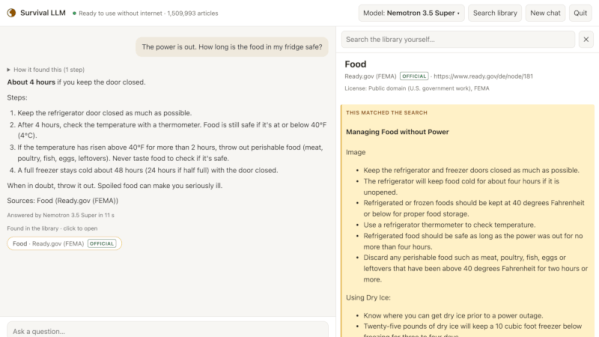
You don’t have to be a full-on “prepper” to at least occasionally wonder what would happen if civilization collapsed. One thing you probably couldn’t do is go on the Internet and ask your favorite AI how to purify water, repel zombies, or treat a burn, all of which may be highly relevant depending on your situation. Now, with Survival LLM, you have a chance.

The  LLM is pretty much the stock chatbot, but it is trained on survival topics, and it runs locally. Naturally, you need the Internet to set it up, so you’d want to do that now before everything hits the fan. The training set uses medical references, survival manuals, FEMA and CDC documents, and nearly a million Wikipedia articles. It includes the survival references in a library and links to them when answering, too.

The installer is small, but it assesses your system and loads a model based on what you have. If you have less than 32 GB of RAM, you’ll get the IBM Granite 4.2 8B model, which was able to correctly answer 14 of 22 test questions. Other models do better, including the NVIDIA Nemotron 3.5 Super model, which got 21 correct, but requires at least 128 GB of memory.

Now, somehow you have to power your computer, but that’s a separate problem. At least there will be plenty of GPUs to scavenge from abandoned data centers. We’ve seen prepper digital libraries before. More than one, in fact.

Magnetic Lock Opens By Magic

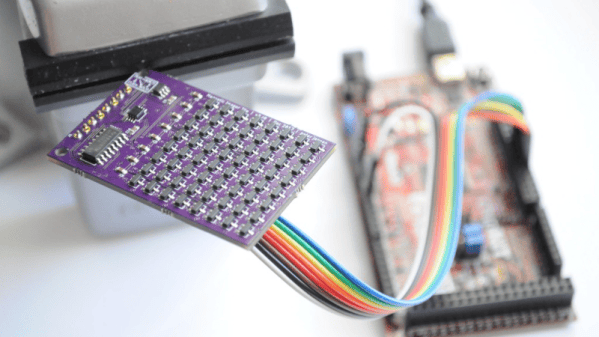
Over on IEEE Spectrum, [Stephen Cass] has a project that would probably have seemed like a magic a few centuries ago. Imagine a box that uses a magnetic device to holds a locking bolt, requiring a magnet to disengage it. The only problem is that any strong magnet can open the box. [Stephen], instead, used an array of 64 Hall-effect sensors developed by [Peter Jansen] to look for a specific magnetic gesture.

Inside is a Teensy that can read the 8×8 grid of sensors. A magnetic stylus allows you to draw an unlock pattern. The system lets you train the gesture you want. There are a few problems. The sensor covers a small area, so it is hard to reliably produce the gesture. Putting an obvious mark on the box is a dead giveaway, so [Stephen] put a Celtic knotwork pattern on the box and uses part of it as a reference.

The other problem is that if you run out of battery, the box is locked forever. Well, at least until you apply mechanical force and break the box open. Wireless charging would be an option, but we might favor a small jack that would allow you to plug in an external battery.

This is a clever use of the sensor. However, we might have preferred a mechanical solution that didn’t require batteries. Or, perhaps, you could use a few normally open and normally closed reed switches to make a kind of magnetic combination lock. It would still need a battery, but it wouldn’t draw current until you connected the switches. Both methods also have drawbacks, of course. Like most things, you just get to pick the drawbacks you can live with.

You can see a video of the magnetic imaging tile from [Peter] below. We really want a setup like this for our secret door. We also wonder whether switchable magnets could provide a battery-free solution.

Continue reading “Magnetic Lock Opens By Magic” →







