Magnetic Lock Opens By Magic

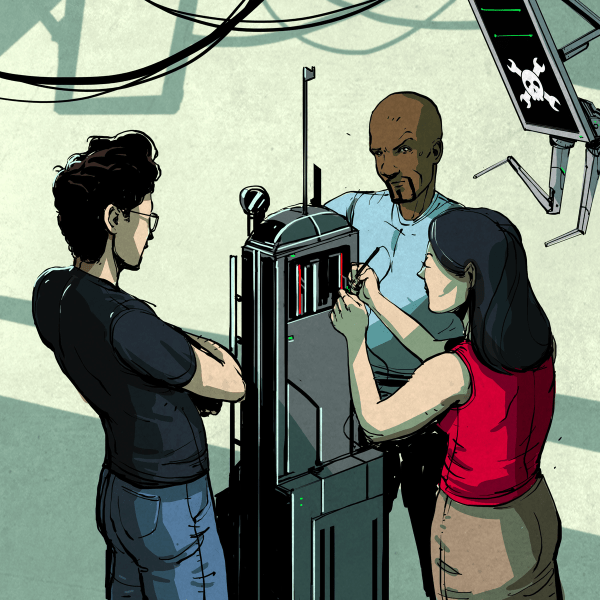
Over on IEEE Spectrum, [Stephen Cass] has a project that would probably have seemed like a magic a few centuries ago. Imagine a box that uses a magnetic device to holds a locking bolt, requiring a magnet to disengage it. The only problem is that any strong magnet can open the box. [Stephen], instead, used an array of 64 Hall-effect sensors developed by [Peter Jansen] to look for a specific magnetic gesture.

Inside is a Teensy that can read the 8×8 grid of sensors. A magnetic stylus allows you to draw an unlock pattern. The system lets you train the gesture you want. There are a few problems. The sensor covers a small area, so it is hard to reliably produce the gesture. Putting an obvious mark on the box is a dead giveaway, so [Stephen] put a Celtic knotwork pattern on the box and uses part of it as a reference.

The other problem is that if you run out of battery, the box is locked forever. Well, at least until you apply mechanical force and break the box open. Wireless charging would be an option, but we might favor a small jack that would allow you to plug in an external battery.

This is a clever use of the sensor. However, we might have preferred a mechanical solution that didn’t require batteries. Or, perhaps, you could use a few normally open and normally closed reed switches to make a kind of magnetic combination lock. It would still need a battery, but it wouldn’t draw current until you connected the switches. Both methods also have drawbacks, of course. Like most things, you just get to pick the drawbacks you can live with.

You can see a video of the magnetic imaging tile from [Peter] below. We really want a setup like this for our secret door. We also wonder whether switchable magnets could provide a battery-free solution.
Continue reading “Magnetic Lock Opens By Magic” →

A Classic TV Trope For An Escape Room

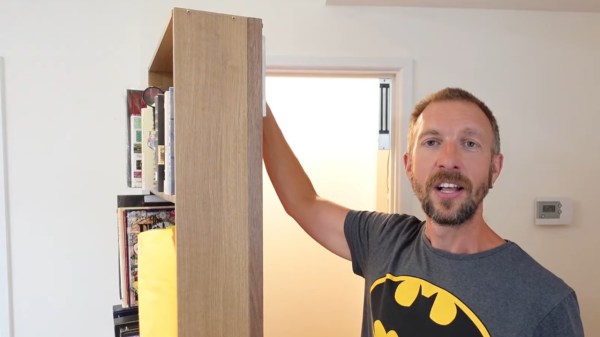
No spooky mansion is complete without a secret passage accessed through a book shelf — or so Hollywood has taught us. What works as a cliché in movies works equally well in an escape room, and whenever there’s escape rooms paired with technology, [Alastair Aitchison] isn’t far. His latest creation: you guessed it, is a secret bookcase door.

For this tutorial, he took a regular book shelf and mounted it onto a wooden door, with the door itself functioning as the shelf’s back panel, and using the door hinges as primary moving mechanism. Knowing how heavy it would become once it’s filled with books, he added some caster wheels hidden in the bottom as support. As for the (un)locking mechanism, [Alastair] did consider a mechanical lock attached on the door’s back side, pulled by a wire attached to a book. But with safety as one of his main concerns, he wanted to keep the risk of anyone getting locked in without an emergency exit at a minimum. A fail-safe magnetic lock hooked up to an Arduino, along with a kill switch served as solution instead.

Since his main target is an escape room, using an Arduino allows also for a whole lot more variety of integrating the secret door into its puzzles, as well as ways to actually unlock it. How about by solving a Rubik’s Cube or with the right touch on a plasma globe?

Continue reading “A Classic TV Trope For An Escape Room” →

A Home Network, Security System, And A Hidden Room Behind A Bookcase

Ok, now this is something special. This is a home network and security system that would make just about anyone stop, and with jaw hanging agape, stare, impressed at the “several months of effort” it took [timekillerjay] to install their dream setup. Just. Wow.

Want a brief rundown of the diverse skill set needed to pull this off? Networking, home security, home automation, woodworking, running two thousand feet(!) of cat 6a cable, a fair hand at drywall work for the dozens upon dozens of patches, painting, staining, and — while not a skill, but is definitely necessary — an amazingly patient family.

Ten POE security cameras monitor the premises with audio recording, infrared, and motion detection capabilities. This is on top of magnetic sensors for five doors, and eleven windows that feed back to an ELK M1-Gold security system which effortlessly  coordinates with an Insteon ISY994i smart home hub; this allows for automatic events — such as turning on lights after dark when a door is opened — to occur as [timekillerjay]’s family moves about their home. The ELK also allows [timekillerjay] to control other things around the house — namely the sprinkler system — via relays. [timekillerjay] says he lost track of how many smart switches are scattered throughout his home, but there are definitely 39 network drops that service the premises.

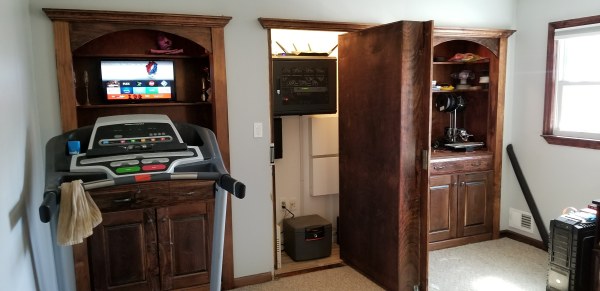
All of the crucial components are hidden in his office, behind a custom bookshelf. Building it required a few clever tricks to disguise the bookshelf for the secret door that it is, as well as selecting components with attention to how much noise they generate — what’s the point of a hidden security system if it sounds like a bunch of industrial fans?

An uninterruptible power supply will keep the entire system running for about 45 minutes if there is a power outage, with the cameras recording and system logging everything all the while. Not trusting the entrance to his vault to something from Batman, he’s also fitted the bookshelf with a 600lb magnetic lock that engages when the system is armed and the door already closed. A second UPS will keep the door secured for 6+ hours if the house loses power. Needless to say, we think this house is well secured.

[Via /r/DIY]