
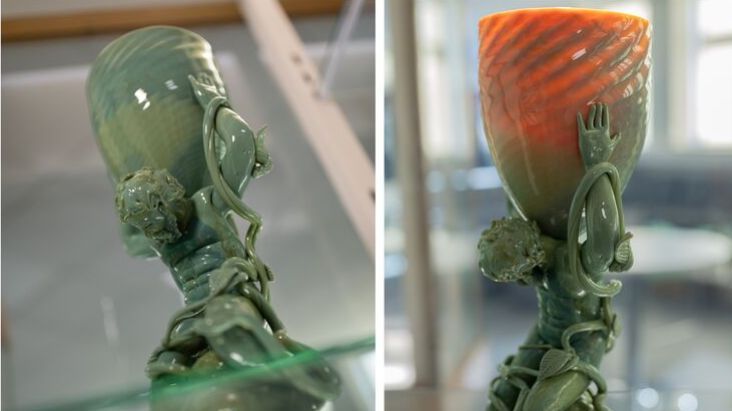
Although most archaeological finds from ancient civilizations aren’t quite as exciting as what you might expect from the movies, occasionally you come across something that’s truly special. The Lycurgus Cup is one of those, with the 3rd or 4th century CE glass cup and its incredible detail surviving likely because it ended up in church treasuries after the fall of the Western Roman Empire. Now its almost magical dichroic glass effect has been recreated in a modern take by researchers at the University of Sheffield.
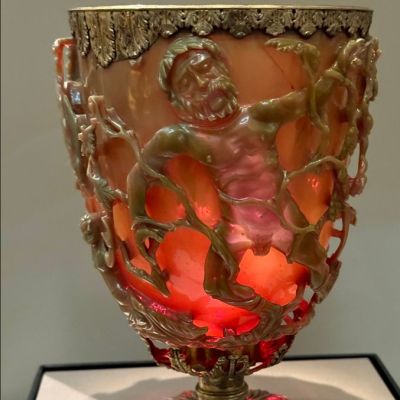
Dichroic glass takes on a different color depending on the lighting conditions, with the Lycurgus cup appearing to be green glass when lit from the front and red when light passes through it from behind. This serves to give the portrayed scene – of the demise of King Lycurgus from Greek mythology – an extra boost with the right lighting.
The cause of this dichroic effect in this ancient marvel of glass work was unknown for the longest time, but research on a fragment of the glass revealed that it contains nanoparticles of both gold and silver. Since then a number of researchers have recreated this dichroic glass, with [Lars Kool] et al. using FDM 3D printing to create objects embedded with the same nanoparticles that also display this effect.
Where this work by the University of Sheffield differs is in that it creates the effect not only in glass, but also creating a piece of art in the form of a modified Atlas statue to use it. The resulting dichroic effect is rather similar, which isn’t too shocking since unlike over 1,600 years ago we can now literally see and measure nanoparticles in glass, while adding exact amounts of each to pure glass.
Here’s to raising a dichroic glass cup to bridging the millennia with recreated luxury glass recipes.











Did they try nanoparticles of just silver/gold by themselves too? Or with other metals?
That’s pretty amazing, I want a coffee mug that does that
We did not add nanoparticles at all. There is a reaction of all the starting materials as the glass melts and the nanoparticles form as the glass cools
…I’ll assume you did try it with different metals and ratios
From another point of view it’s glass and when it’s lit from the front it also passes light out the other side so the color depends on where the observer, not “how the glass is lit”.
Yes that is true. Scientifically it is light in transmission that shows the red effect – i.e. the light passes through. Scattering or reflected light shows the green
Well worth seeing the original, when in London. It is a bit difficult to find amongst all the other treasures in the gallery!
I always thought the best way to depict The Doomsday Machine as seen on screen would be as glass.
Glass can be 3D printed–how about blue versions of this cup’s glass?
Reproducing with a 3d printer is one thing. Let them show how they did it back then. That is much more interesting. And how did they discover the effect. Happy accident?
People have been making glass since over 5,500 years ago. This glass is from 1,600 years ago. That leaves 3,900 years of accidentally making glass that has this effect. Once you have accidentally made such glass, you can remold it into a cup fit for a king, and win favors. :)
And if anyone asks you how you did it, you can always say: “It’s a trade secret, I can’t tell you”. As long as there’s no other king who wants such a glass, or your king wants such a glass for his queen as well, you’re safe. :)
3,900 years is a very long time. Numerous chances for a happy accident.
Now a cup like this with veins and organic features would be lit.
What I find fun about the cup is that it fools our color memory as much as our eyes. Show someone the green front-lit version, then the red back-lit one, and most people will swear the glass “changed,” when really only the light path did. Color-memory research points the same way: after only a few seconds, people tend to remember a color as more saturated than it really was. I’d love to know whether the Sheffield replica is tuned to match the original’s hue exactly, or just to reproduce the effect.