
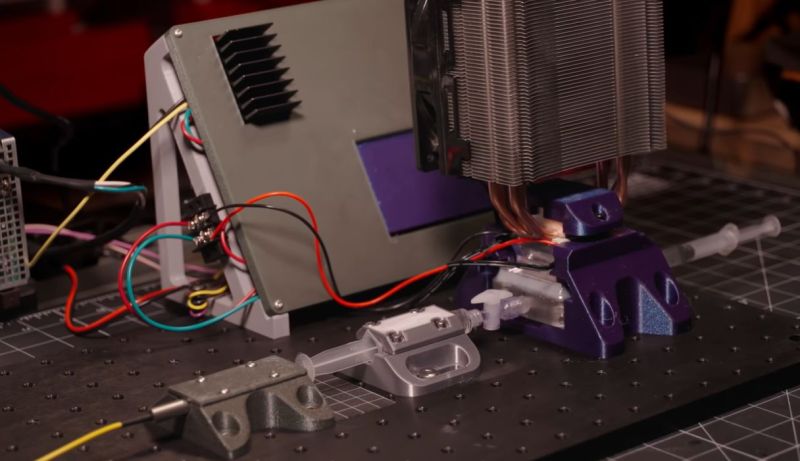
Although not very glamorous, wax motors are a fairly common type of linear actuator. They use the thermal response of waxes and the resulting volumetric expansion or reduction to create a relatively fast, smooth, and highly predictable actuator that can work for decades. They can often be found operating valves and things like the door mechanisms of washing machines. As [BubsBuilds] demonstrates in a recent video, you can even build your own wax motor for very precise control.
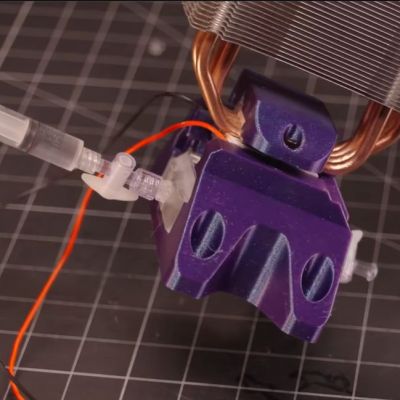
Here simple paraffin wax is used, which changes in volume by 1.15 times when it goes from solid to its molten state. Calling it a ‘waxtuator’, [BubsBuilds] characterized this expansion rate over the temperature range between solid and fully molten to make it a controllable actuator. In his experiments, a gap of less than 5 µm was maintained over twelve hours, showing how precise this device can be if you can control the temperature that the wax is kept at.
One major issue is the low conductivity of paraffin wax, which as some commentators remark can be solved by mixing something like fine copper particles into the wax to increase the thermal conductivity. In the shown implementation instead multiple channels in the aluminium block are used, which are melted by a TEC element.
The wax exerts pressure on a working fluid, which then pushes on a hydraulic cylinder that can be used for whatever precise linear actuating task has to be performed. Although initially water was used as a working fluid, this posed many issues with wax-water interface compatibility and vacuum degassing.
Although ethylene glycol makes for a better working fluid, this proved to be its own hassle. With the water-wax version a displacement sensor was thus used to measure and calibrate the whole setup. The electronics used to control the TEC in combination with the current temperature and displacement are a story in itself, but essential for making this device work.
While not something we often see tackled in the DIY space, we’ve covered a few teardowns of commercial units over the years.












Please be kind and respectful to help make the comments section excellent. (Comment Policy)