
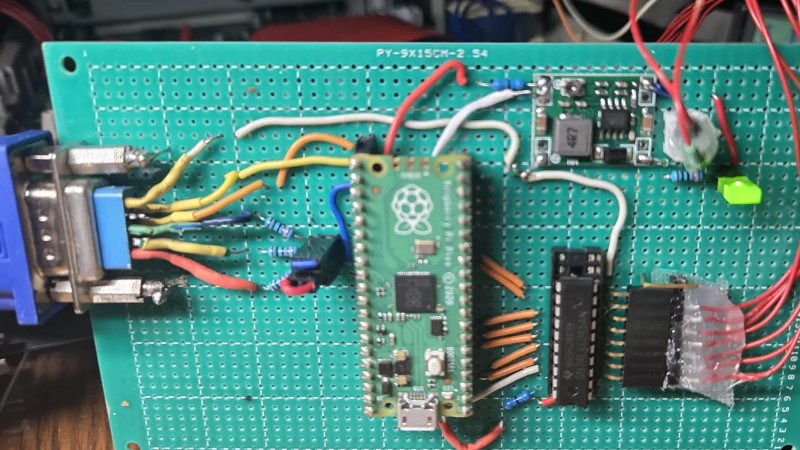
A quick search through AliExpress will find PCBs that take HDMI or VGA and translate them to DSI lanes for TFT panels, and even boards that translate DSI to HDMI in the other direction. Usually they need dedicated silicon or if you’re doing it yourself, an FPGA, but depending on the display that need not be the case. As an example, [Voltage Ventures] has replaced a defective STN display with a more modern one using nothing more complex than a Raspberry Pi Pico.
The display comes as part of a Samsung cash register that looks as though it comes from the 1990s, which is in keeping with it having a monochrome STN display. A replacement was going to cost a fortune, so some way of translating between the two was in order. It has a 4-bit data bus, so there’s a description of how they sampled the bus and identified the timing used. It’s hardly the highest resolution display by today’s standards, being a meager 320 by 240 pixels. Once the format is known it’s a case of transposing it to monochrome VGA in the microcontroller. Initial work was done with an STM series chip, later this was moved to the RP2040.
We like this project, and it’s a reminder that even something broken and old can still be rescued.












The question isn’t what it cost compared to sourcing a direct replacement display. The question is, what did it cost compared to just replacing the entire cash register with something more modern that offers equivalent (or better) functionality?
I’m all for repurposing old technology and keeping it functional long beyond its useful lifetime. My daily-driver Linux box is an HP desktop tower from 2011, and my file server is two years older. (I used to have a ca. 2013 old-PC as my file server, but that one crapped out one day and I swapped it out for an even older salvage system.)
Something breaking down can be a “sign” that it’s time to let it go, not necessarily to take extraordinary measures to revive it. Sometimes I think we need some sort of DNR equivalent for obsolete technology.
as people repeatedly say here…
this isn’t “buy something a day”, it’s “hack a day”
No, the question is: What can we learn from this project?
There are tons of old bespoke hardware that’s still in use because of any combination of:
– it simply works
– it’s embedded in some kind of ecosystem, and you’d have to replace everything
– it’s in some way part of a certified process
– it may have modern replacement that LOOKS good or better, but if you want all features the old thing has, be prepared to shell out serious money. Like specialized test equipment.
Here, even if it’s only about the fact that employees can work with the old cash register blindfolded and you don’t want to learn how to work a new one, that’s entirely ok.
Maybe a cash register doesn’t tickle your interest, maybe some old HP measuring device that would cost 5 figures to replace with a modern equivalent will.
Yes, in that case you’d say: “Yea well in THAT case…”
But for THAT case you find projects like this that show you a way how to pull it off.
There are many of us that do things like this, for reasons that has nothing to do with money on any level. Many times, the end-result is not even important. It is the process to get to that end-result that we value.
P.S. – my file server is a Core 2 Quad machine with 8GB RAM running a ZFS array, and I also have another workstation running a 3GHz Core 2 Quad with 16GB RAM (still a very useful desktop machine to run KiCAD and Qucs-s).
Where is the fun in that?
Anyone who likes or “thinks” Linux disqualifies here, I think.
Because unlike DOS or Amiga OS, Linux has no “home” platform.
Hardware doesn’t matter to Linux (just build from C++) sources and becomes exchangeable, secondary, meaningless.
There’s no deeper relationship to any architecture.
In the paradoxical world we live in, an insanely complex microcontroller is pennies, and the mundane metal and plastic of the cash register is expensive
Because all the “progress” is just miniaturization.
Not because of making better technology but as a cost saving measure.
Smaller structures “waste” less material (unless yield rate is poor).
But yes.. The intellectual, immaterial value is there.
Modern micro chips should be valued because its the manifestation of human ingenuity.
Comparable to the mechanical pocket watch or an Fabergé egg, albeit being mass-produced by a machine.
The idea that chips are cheap because smaller structures “waste less material” misses the actual miracle of semiconductor manufacturing by a mile. Raw silicon is literally just refined sand… we aren’t exactly pinching pennies on the base materials. We shrink the architecture so we can optically print billions of logic gates simultaneously across a massive wafer, yielding thousands of fully integrated systems in a single pass.
The mundane metal cash register is expensive because someone has to physically screw its macroscopic parts together one by one.
You aren’t buying a “mass-produced pocket watch,” you’re buying the ultimate economy of scale. We all switched to electronics because its smaller, faster , and lighter. It wasn’t the cheaper option in the beginning. But now complex system integration happens at the speed of light, printing an esp32 chip onto silicon. Rather than the speed of the assembly lines of old days.
If you want a cheap cash register, that can be arranged. It just depends on who is screwing it together, and who is screwing them over.
I DO wonder if he knows that he published his SSN, though…
The AI “PCB” mockup was not necessary.
I thought it was Hackaday policy not to use AI-generated images in articles. I zoomed in to see what level translator or buffer they used, and it’s a… 7N conjoined-I-and-C 8G5:6 upside-down-Y. Custom part, no doubt. One pin pair smaller than its socket, naturally. The through-hole SMD capacitors next to it are a nice touch.
I missed the double-ended Pico!
I thought the routing looked odd!
Funny enough it’s from the project, HaD did not bake the image. It looks like the project author fed a tool his completely real project photo photo and told it to fix the perspective, which resulted in what you see.
the ai image really upset me on a sensual level. i remember in 3rd grade, we had a ‘science fair’ in class at school and i didn’t do anything so i just brought my 150-in-1 electronics kit and hooked up some wires randomly and technobabbled incoherently at everyone that asked questions. didn’t even hook up blinking lights, just pure BS. at the time i felt lucky to get away with it but maybe i was truly ahead of my time.
It came from the project, not HaD
Our robotics team did similar thing during one of those robotics fairs pre-COVID.
The intention was to build an autonomous robotic platform for doing… stuff. It was about 10 years before similar machines became popular in Ukraine. Sadly our university gave us just enough funding to buy a large pizza, not build a large robot.
During the competition (and month or two before our MSc graduation) we only had bare steel frame, go-kart wheels and 2-stroke engine from a mini-bike attached. None of the electronics was even in the “schematic” stage. Still, a decent A2-sized poster combined with some tech babble landed us first prize in the “freestyle” category.
That was the one time when it reall paid off to overcome one’s social awkwardness.
I did the same but I had the 200in1 kit
Looking at the original article, I can see that quite a bit of hard work went into this project. I hope that those hard working people take this criticism to heart and avoid AI generated artwork in the future.
I can’t speak for the author, but I personally am not an artist or photographer. A good use of AI is to fill in for our shortcomings and as such I can understand why they opted to use it as the opening photo.
They built one on a perfboard. There’s pictures of the real perfboard version available in the original article.
The perfboard photo is perfectly useful and truthful about what was built.
The AI “photo” is garbage. It does not represent the reailty of the project. It is completely fake and misleading.
It has no business being there. It has no business being used as a “photo” of a project. It has no business even existing.
The second image is what they should have used: it’s not beautified, but also not scrambled into uselessness. It’s a perfectly serviceable photograph of the actual device.
It is not a good use when it is nonsensical slop like this.
This is my bad, I have to admit I missed it. It came from the original project.