
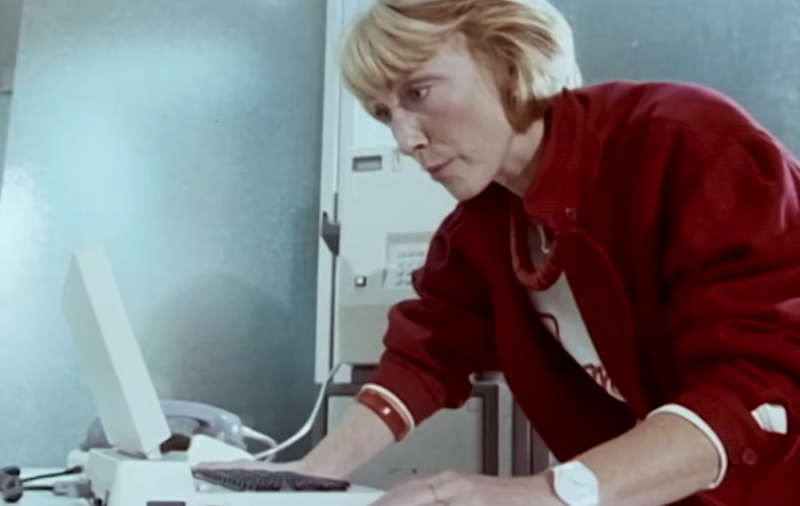
With so many online messaging services to choose from it’s almost as though the daddy of them all, email, has faded into the background as something you only use for more formal contacts. But it’s still the underpinning of much of the business world’s electronic communication and is likely to stay so for the foreseeable future. The BBC Archive takes us back to a time when email was relatively new, when in 1986 [Lesley Judd] takes a very chunky 1980s laptop on a plane from London to the Netherlands, and sends an email to her colleague at home using a payphone and an acoustic coupler.
There are so many of-their-era quirks in this film it’s difficult to pick, but little things like the aircraft still having smoking and non-smoking areas, there being no sign of a mobile telephone, or the payphone operating in Guilders rather than Euros make it from a different time. Perhaps most interesting though is the email system in use, because this isn’t an internet based service. Instead it’s using Telecom Gold, which was the UK telco BT’s online service offering to businesses, and part of the international Dialcom network. This was a commercial service which hung on until some time in the 1990s when the Internet finally displaced it.
The British writer L. P. Hartley used the phrase “The past is a foreign country; they do things differently there” as the opening sentence of one of his books, and the film below the break certainly brings that to mind. It’s a time that’s within reach, yet the changes in information technology over even the next decade or so would make the tech depicted not just obsolete but almost unrecognizable. Most of us today could sit at a 1996 laptop and send an email, but few of us would be as immediately at home with Telecom Gold.
It’s still possible to use an acoustic coupler today though.







Modern connection speed and convenience aside, am I the only one who misses how cool it felt to use an acoustic coupler? Maybe it’s just the nostalgia of kid me experiencing such magical technology. Even with how spoiled we are today though, I legitimately still crave the old bbs scene. A few years ago actually considered hooking back up to copper service (discouraged but still offered in my area) just for this, but I couldn’t find info that any still even exist. And pretty doubtful that if I set up my own I’d have anyone at all dialing in. I know there are online methods, but it’s not really the same.
I’ve noticed with kids today, even with the latest and greatest tech releases, none of it feels magic to them anymore. To them it’s more just “better” or expected. I wish they could experience the same level of amazement that we did back then—as my nephew likes to say, “in the olden days.” The closest I can get is explaining to them how the internet was carried by just strange sounds over the phone.
I also really liked the acoustic couplers. I built one myself at one point. I used it for pay-phone phreaking and it hooked to a micro tape-cassette instead of a modem, but it was really cool in my mind. I was only 13-14 years old at the time I guess.
Information reliability at that time was even worse than it is now, even with AI. I heard from one guy who knew a guy who did a certain little trick with a phone. I tried it out, and sure enough, it worked! but only on some phones. Other things like recording the clicks the coins made, I was too late for, at least in my town, the phones did not operate that way when I was running amok. Lots of things were word of mouth or urban legend, and you didn’t know if it would work till you tried it. The anarchist cookbook that I had access too was no exception. Somethings worked, others were just lies to fill out the number of pages. Experiments involving one material worked, others involving other materials did not.
I think we forget how roundabout and unreliable information was when the best resource you had for information was some encyclopedia written by a book publishing company with shaky concepts of truth and bias. We have certainly become spoiled by things like wikipedia. We pretend that AI has taken us backwards when it comes to information, but really, it used to be a lot worse and even with AI, access to correct information is far beyond what it was before we all jumped on the internet.
Consider getting an amateur radio license, and use packet radio. 1200 bps is standard, 9600 bps on some links. Just like the old days.
Today’s kids are fascinated by vintage tech, vintage cloths and stuff, though.
It’s refreshingly different and “new” to them, which makes sense. :)
production is epic..
I found the acoustic couplers fairly inconsistent in use and had a number of modems instead, ranging from 300 bps to 56K, the first being home made.
Around 1989 I got access to the internet, at that time mostly accessible by academia only, and used that to arrange a trip to USA through a friend working for UCSB via E-mail.
A revolutionary experience … for the time.
BBC 007? Really?
Did you pick the password?
FYI Leslie Judd became well-known in the UK, when she was a presenter on the kids TV show, “Blue Peter” in the 1970s. Her successor, Janet Ellis, was “Murder on the Dance Floor”, Sophie Ellis-Bexter’s mum.
Btw, the technology in the video was slightly dated by the time of making.
That acoustic coupler is an old 300 Baud model, rather than 1200 or 2400 Baud.
Sure, for payphone use at a noisy airport 300 Baud were more reliable, I admit.
That “notebook” is no real notebook, but rather a handheld, a big electronic organizer. Some sort of PDA.
It has PIM applications, BASIC interpreter, a small RAM disk and a feature limited terminal application.
Many commenters think it was hi-tec, but it’s from 1984.
It’s comparable to a late 80s/early 90s vtech learning computer for kids.
https://www.homecomputermuseum.nl/collectie/tandy/tandy-200/